Understanding Market Makers in Modern Forex Trading
Understanding Market Makers in Modern Forex Trading
Market makers play a central role in modern Forex trading, yet many traders only have a vague or misleading idea of what they actually do. From providing liquidity to shaping price movements, market makers are deeply embedded in the structure of the foreign exchange market. Understanding their role is no longer optional for traders who want to survive and grow in today’s competitive trading environment.
In the past, Forex trading was often explained using simple supply and demand concepts. While those ideas are still valid, they no longer tell the full story. The Forex market has evolved. It is now driven by advanced technology, algorithmic systems, and institutional participants who operate at speeds and scales far beyond retail traders. At the center of this system stand market makers.
This article aims to explain, in clear and simple language, how market makers operate in modern Forex trading. We will explore their purpose, how they provide liquidity, how prices are formed, and why their presence is both necessary and controversial. By the end of this series, you will have a realistic and balanced view of market makers based on structure, not myths.
What Are Market Makers in Forex?
Definition and Core Function
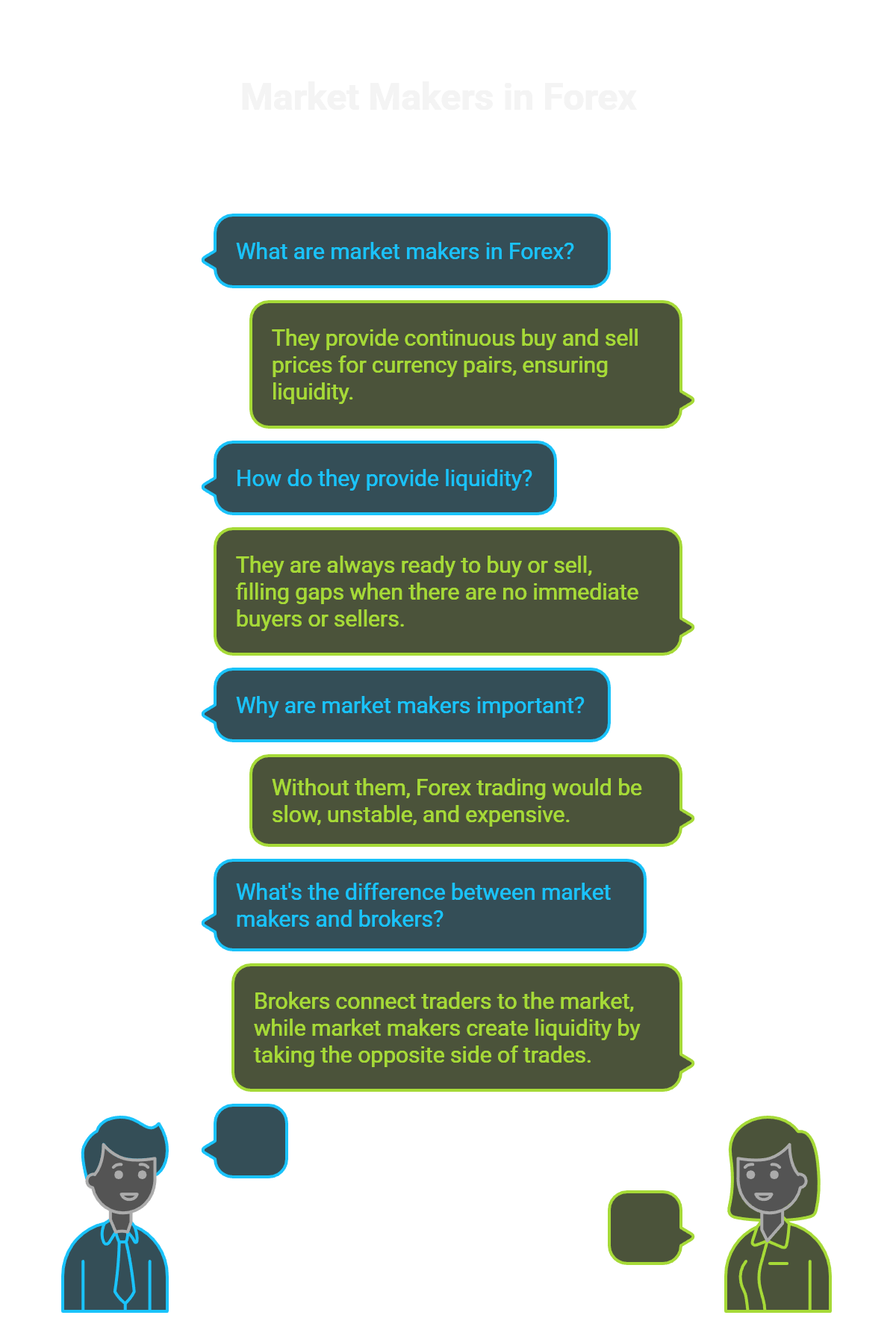
Market makers are financial institutions or entities that provide continuous buy and sell prices for currency pairs. Their main function is to ensure liquidity in the Forex market. Liquidity means that traders can enter and exit positions quickly, at predictable prices, and with minimal delay.
In simple terms, market makers are always ready to buy or sell. When a trader places a buy order and there is no immediate seller, the market maker steps in. When a trader wants to sell and there is no buyer, the market maker fills that gap. This process keeps the market moving smoothly.
Without market makers, Forex trading would be slow, unstable, and expensive. Prices would jump sharply, spreads would widen, and many trades would fail to execute. Market makers exist to prevent that outcome.
Market Makers vs Brokers
A common source of confusion is the difference between brokers and market makers. While some brokers act as market makers, not all brokers are market makers.
A broker is an intermediary. It connects traders to the market. A market maker, on the other hand, creates liquidity by taking the opposite side of trades. In some cases, a broker routes orders to external liquidity providers. In other cases, the broker itself acts as a market maker.
This distinction matters because it affects pricing, spreads, and execution quality. Traders must understand whether they are trading directly against market makers or through an agency model.
Why Market Makers Exist
Market makers exist because markets need stability. The Forex market trades trillions of dollars daily. For such volume to function efficiently, there must always be someone willing to trade.
Market makers absorb short-term imbalances between buyers and sellers. They reduce volatility caused by sudden order flows. In return, they earn money through spreads, commissions, and risk management strategies.
The Evolution of Market Makers in Modern Forex
From Floor Trading to Electronic Markets
In the early days, market makers operated on trading floors. Prices were quoted verbally. Transactions were slow and limited to major institutions. Retail traders had little access.
The shift to electronic trading transformed everything. Prices became digital. Execution became faster. Market makers adapted by using advanced systems that quote prices automatically.
Today, market makers rely on algorithms rather than humans. These systems update prices in milliseconds based on order flow, volatility, and market conditions.
Rise of Algorithmic Market Makers
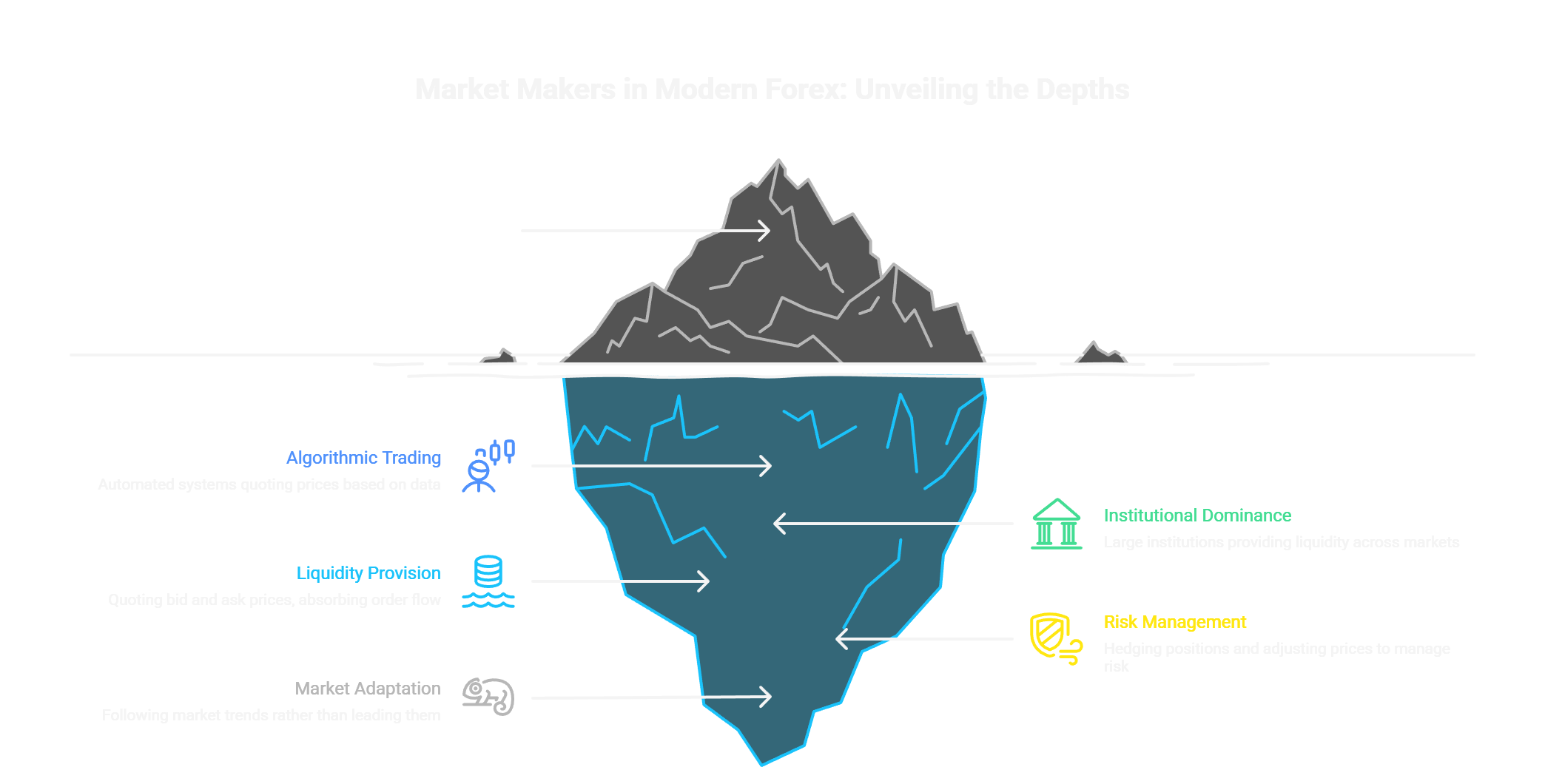
Modern market makers are algorithm-driven. These algorithms analyze massive data streams in real time. They adjust spreads, manage exposure, and hedge risk automatically.
Algorithmic market makers can quote prices across dozens of currency pairs simultaneously. They respond instantly to news events and liquidity changes. This speed gives them a structural advantage over slower participants.
For traders, this means tighter spreads but more complex price behavior. Understanding this shift is critical for modern Forex trading.
Institutional Dominance
Most market makers today are large institutions. These include global banks, hedge funds, and specialized liquidity providers. They operate across multiple markets, not just Forex.
Their size allows them to manage risk efficiently. Losses in one market can be offset by gains in another. This diversification strengthens their ability to provide liquidity consistently.
Retail traders, by contrast, operate with limited capital and tools. This difference explains much of the imbalance in the Forex ecosystem.
How Market Makers Provide Liquidity
Continuous Bid and Ask Prices
The most visible role of market makers is quoting bid and ask prices. The bid is the price they are willing to buy at. The ask is the price they are willing to sell at.
The difference between these prices is called the spread. The spread is a primary source of income for market makers. In liquid conditions, spreads are tight. In volatile conditions, spreads widen.
Market makers adjust spreads dynamically. During high uncertainty, they protect themselves by increasing spreads. During calm periods, they compete by offering tighter pricing.
Absorbing Order Flow
Order flow refers to the stream of buy and sell orders entering the market. Market makers monitor this flow closely.
When buy orders dominate, market makers may sell into that demand. When sell orders dominate, they may buy. This does not mean they always lose. They manage positions carefully using hedging and inventory control.
By absorbing order flow, market makers prevent sharp price jumps. This stabilizing function benefits all participants.
Inventory and Risk Management
Market makers hold inventories of currencies. These inventories expose them to risk. To manage this risk, they use several techniques.
They may hedge positions in correlated markets. They may adjust prices to attract opposite orders. They may reduce exposure during uncertain periods.
Risk management is at the core of market making. A market maker that fails to control risk will not survive.
Price Formation and the Role of Market Makers
Do Market Makers Control Price?
A common belief is that market makers “control” price. This idea is partly true and partly false.
Market makers do not decide long-term trends. Those are driven by macroeconomic forces, interest rates, and global capital flows. However, market makers do influence short-term price movements.
They influence how price reacts to order flow. They influence where liquidity is available. They influence spreads and execution.
Understanding this distinction helps traders avoid unrealistic expectations.
Short-Term Price Movements
In the short term, market makers can push price toward areas of liquidity. These are zones where many orders are clustered.
This behavior is often misunderstood as manipulation. In reality, it is a liquidity-seeking process. Market makers need liquidity to manage their positions.
Price tends to move where liquidity exists. This explains many stop-loss hunts and false breakouts seen in intraday trading.
Long-Term Market Structure
Over longer timeframes, market makers follow the market rather than lead it. They adapt to trends instead of creating them.
They adjust exposure as trends develop. They hedge risk across timeframes. They remain neutral whenever possible.
This adaptive behavior is why blaming market makers for all losses is misleading.
Common Myths About Market Makers
Myth 1: Market Makers Always Trade Against Retail Traders
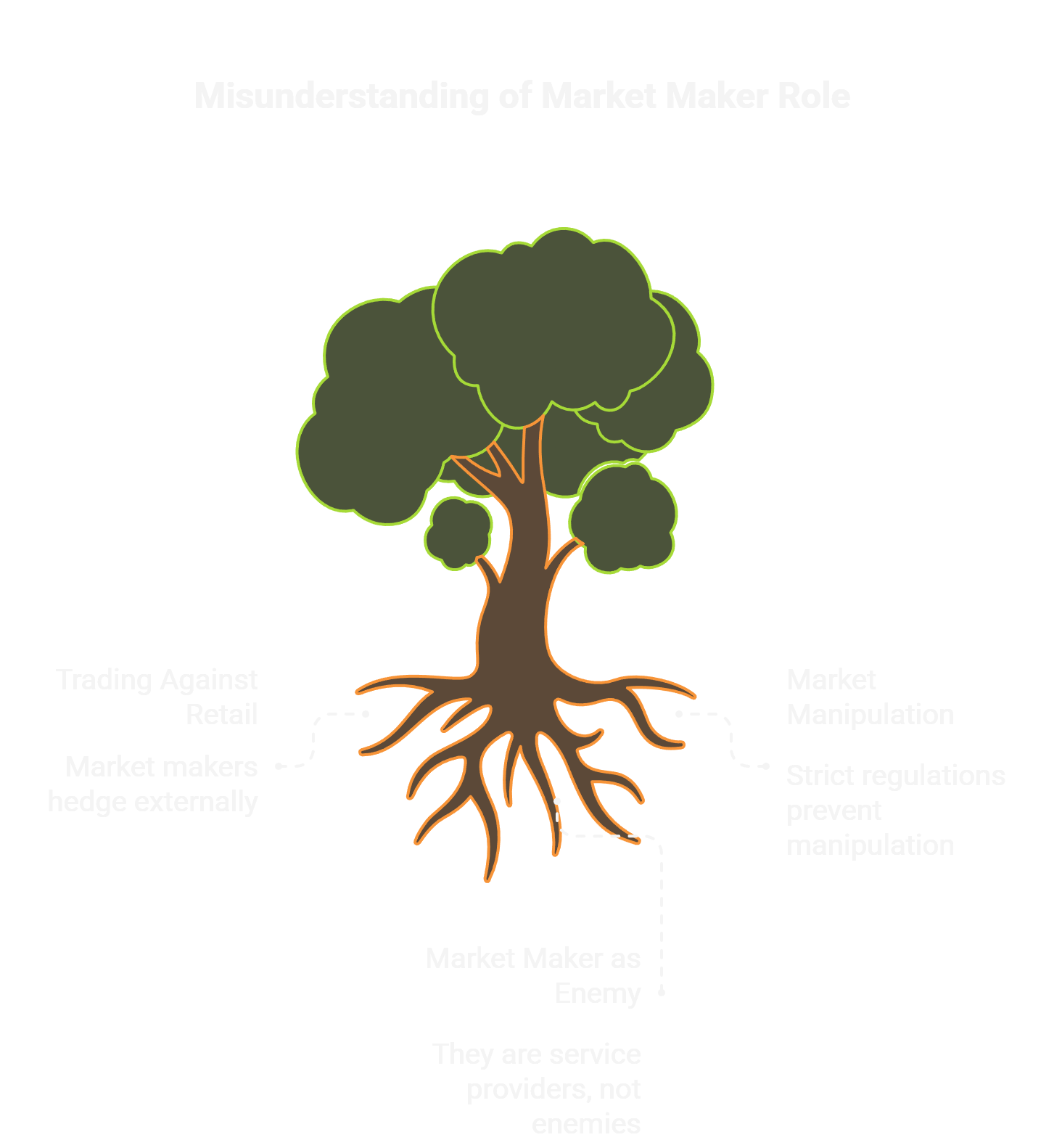
This is one of the most widespread myths. While some brokers internalize trades, not all market makers directly oppose retail positions.
Many market makers hedge exposure externally. Their goal is not to make retail traders lose. Their goal is to remain balanced and profitable.
Losses occur because of poor strategy, not because of personal targeting.
Myth 2: Market Makers Manipulate the Market at Will
Market makers operate under strict regulations. Large-scale manipulation would attract attention and penalties.
What traders often call manipulation is usually liquidity-driven movement. Price seeks areas where orders exist. This is a structural behavior, not a conspiracy.
Understanding liquidity changes perspective.
Myth 3: Market Makers Are the Enemy
Market makers are not enemies. They are service providers. Without them, trading would be far worse.
The real challenge is ignorance. Traders who understand market makers adapt. Traders who do not blame.
Why Understanding Market Makers Matters for Traders
Better Trade Timing
Knowing how market makers operate helps traders improve timing. It explains why breakouts fail and why reversals occur.
It also helps traders avoid trading during low-liquidity periods where spreads widen and execution worsens.
Improved Risk Management
Understanding market makers leads to better stop placement. Stops placed at obvious levels are vulnerable.
Smart traders learn to think in terms of liquidity, not just indicators.
Realistic Expectations
Perhaps most importantly, understanding market makers creates realistic expectations. Trading becomes a process, not a gamble.
This mindset shift is essential for long-term success.
Conclusion
Market makers are a fundamental part of modern Forex trading. They provide liquidity, stabilize prices, and enable global participation. While their role is complex, it is not mysterious.
By understanding how market makers operate, traders gain clarity. They stop chasing myths and start reading structure. This knowledge does not guarantee profits, but it removes illusions.
In the next part, we will explore how market makers interact with retail traders, brokers, and liquidity providers in real trading environments.
The Relationship Between Market Makers and Retail Traders
How Retail Orders Reach Market Makers
In modern Forex trading, retail traders rarely interact directly with the interbank market. Instead, their orders pass through brokers, trading platforms, and liquidity systems before reaching market makers. Understanding this path is essential for grasping how market makers influence execution.
When a retail trader places a trade, one of three things usually happens.
First, the broker may internalize the trade and act as the counterparty.
Second, the broker may hedge the trade with an external market maker.
Third, the order may be routed directly to a liquidity pool where market makers compete to fill it.
In all cases, market makers play a role, either directly or indirectly. They provide the prices that traders see on their screens. They also determine how fast and how accurately trades are executed.
Retail traders often assume their trades move the market. In reality, individual retail orders are small. Market makers aggregate thousands of such orders and manage them as flow, not as isolated trades.
Why Retail Traders Often Feel Disadvantaged
Many retail traders feel that the market moves against them. This feeling is common and understandable. However, it is rarely personal.
Market makers react to order flow. If many traders enter similar positions, liquidity builds in predictable areas. Price often moves toward those areas because that is where transactions can occur efficiently.
This behavior creates the illusion of targeting. In truth, it is a mechanical response to supply and demand at scale.
Retail traders who cluster their stops at obvious levels increase the likelihood of being caught in these moves. The solution is not anger, but better positioning and risk awareness.
Market Makers, Brokers, and Liquidity Providers
The Broker–Market Maker Connection
Not all brokers operate the same way. Some are pure intermediaries. Others are hybrid models. Some act as market makers themselves.
Market-making brokers internalize client trades. This means they take the opposite side. However, this does not automatically create a conflict of interest. These brokers often hedge risk externally.
Liquidity providers, which include banks and non-bank institutions, supply pricing to brokers. Market makers are a major part of this liquidity network.
The Forex market is not centralized. It is a web of relationships. Market makers sit at the center of this web.
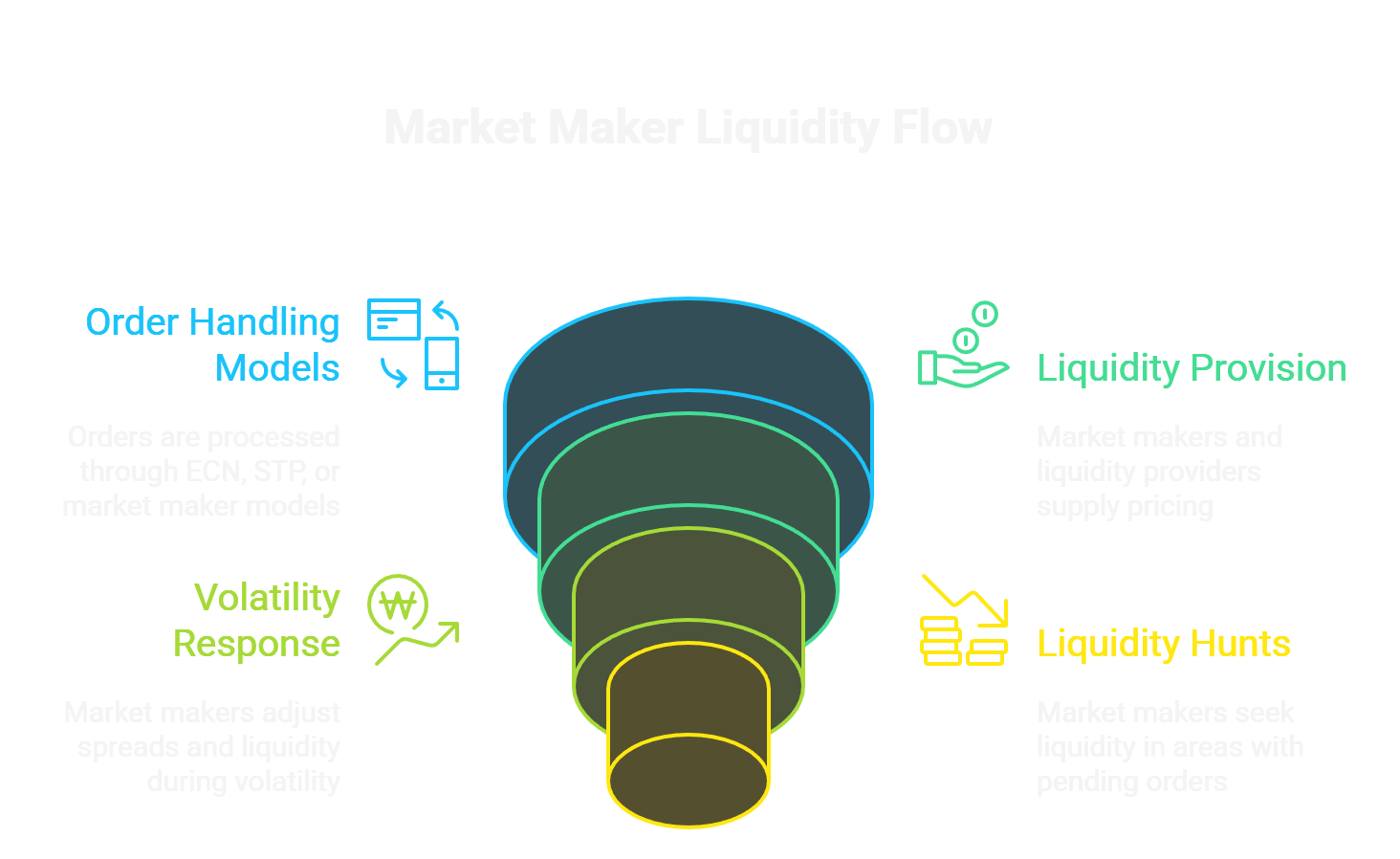
ECN, STP, and Market Maker Models
Traders often hear terms like ECN and STP. These models describe how orders are handled.
ECN models route orders to a network of liquidity providers. Prices come from multiple market makers competing.
STP models pass orders through without dealer intervention.
Market maker models internalize flow.
Each model has advantages and disadvantages. No model is inherently “good” or “bad.” Execution quality depends more on regulation, transparency, and technology.
Understanding these models helps traders choose the right broker and manage expectations.
Liquidity, Volatility, and Market Maker Behavior
How Market Makers Respond to Volatility
Volatility changes everything. During calm periods, market makers provide tight spreads and deep liquidity. During news events or uncertainty, they pull back.
This behavior protects them from sudden losses. It also explains why spreads widen during major announcements.
Retail traders who trade during high-impact news without understanding this dynamic face higher costs and slippage.
Market makers are not trying to punish traders. They are managing risk in uncertain conditions.
Liquidity Gaps and Price Spikes
Sometimes price moves sharply with little volume. These moves often occur during low-liquidity periods, such as market opens or holidays.
Market makers reduce exposure during these times. With fewer quotes available, small orders can cause large moves.
Understanding liquidity cycles helps traders avoid dangerous periods and adjust position size.
The Role of Market Makers in Stop Runs and Liquidity Hunts
What Is a Liquidity Hunt?
A liquidity hunt occurs when price moves toward areas with many pending orders. These areas often include stop-loss clusters.
Market makers do not hunt stops out of malice. They seek liquidity to manage inventory. Stops provide liquidity.
This process is a natural outcome of how markets function.
How Traders Can Adapt
Instead of placing stops at obvious highs and lows, traders can use structure-based placement. They can also reduce position size and accept wider stops.
Thinking in terms of liquidity rather than indicators changes how traders see the market.
Market makers reward patience and punish predictability.
Ethics, Regulation, and Trustworthiness
Regulation of Market Makers
Market makers operate under strict regulatory frameworks. Major institutions are monitored closely.
Abuse, manipulation, and unfair practices carry severe penalties. This reality limits extreme behavior.
While no system is perfect, the Forex market is far more regulated than many traders believe.
Transparency and Data
Modern trading platforms provide more data than ever. Order book insights, volume tools, and execution reports increase transparency.
Traders who educate themselves can verify many assumptions instead of relying on rumors.
Trust comes from understanding, not blind faith.
Why Professional Traders Study Market Makers
Institutional Perspective
Professional traders think in terms of flow, liquidity, and structure. They study how market makers operate because it reveals how price behaves.
They do not fight the system. They align with it.
This mindset separates professionals from gamblers.
Long-Term Consistency
Understanding market makers helps traders survive drawdowns. It reduces emotional reactions. It improves discipline.
Consistency comes from clarity.
Conclusion
Market makers are deeply connected to every aspect of Forex trading. They interact with brokers, manage liquidity, respond to volatility, and shape short-term price behavior.
Retail traders who understand this relationship gain a strategic edge. They stop blaming and start adapting.
In the final part, we will explore how traders can align their strategies with market maker behavior and use this knowledge in real trading plans.
How Traders Can Align With Market Makers Instead of Fighting Them
Thinking in Terms of Liquidity, Not Indicators
One of the biggest mistakes retail traders make is relying only on indicators. Indicators lag. Market makers do not trade based on lagging signals. They trade based on liquidity, flow, and risk.
To align with market makers, traders must change how they read price. Instead of asking, “Is RSI overbought?” they should ask, “Where is liquidity resting?” This shift transforms decision-making.
Liquidity often sits above equal highs and below equal lows. It also gathers around round numbers and recent swing points. Market makers move price toward these zones because that is where transactions can occur efficiently.
By identifying these areas, traders stop reacting and start anticipating.
Price Action Through a Market Maker Lens
Price action tells a story. Every candle represents a balance or imbalance between buyers and sellers. Market makers respond to these imbalances.
Strong impulsive moves often indicate institutional participation. Slow grinding moves often signal low liquidity. Sudden wicks into key levels often show liquidity grabs.
Reading price this way reduces confusion. It also removes the illusion of randomness.
Building Trading Strategies Around Market Maker Behavior
Entry Models That Respect Liquidity
Traders who understand market makers avoid chasing breakouts blindly. Instead, they wait for price to take liquidity and then show confirmation.
For example, price may break above a range, trigger stops, and then return inside. This move provides liquidity for market makers and creates opportunities for informed traders.
Entries after liquidity sweeps often offer better risk-to-reward ratios.
Stop Placement That Survives Volatility
Market makers expect stops to sit at obvious levels. Placing stops there increases the chance of being removed.
Smart traders place stops beyond structural levels, not just technical ones. They also adjust position size to accommodate wider stops.
This approach reduces emotional stress and improves consistency.
Targeting Realistic Profit Zones
Profit targets should also consider liquidity. Price often moves from one liquidity pool to another.
Instead of fixed pip targets, traders can use structure-based exits. This aligns profits with natural market movement.
Market Makers, Algorithms, and the Future of Forex Trading
The Growing Role of Automation
Automation continues to expand. Market makers rely more on machine learning and artificial intelligence to manage flow.
These systems adapt faster than humans. They detect patterns across markets and timeframes.
For traders, this means markets will continue to reward structure-based thinking and punish emotional trading.
What This Means for Retail Traders
Retail traders cannot compete on speed. They can compete on patience and understanding.
By aligning with market maker behavior, traders reduce friction. They trade less but trade better.
The future belongs to informed traders, not reactive ones.
Risk Management in a Market Maker Environment
Why Risk Control Is Non-Negotiable
Market makers survive because they manage risk relentlessly. Traders must do the same.
No strategy works without risk control. No insight replaces discipline.
Understanding market makers reinforces this truth.
Position Sizing and Survival
Smaller position sizes allow traders to survive volatility. They allow flexibility.
Market makers think in probabilities, not predictions. Traders should adopt the same mindset.
Survival comes before profit.
Psychological Shifts Required for Long-Term Success
Letting Go of the “Enemy” Mindset
Seeing market makers as enemies creates frustration. Seeing them as part of the system creates clarity.
Markets are not personal. Losses are feedback, not attacks.
This mindset shift is essential.
Confidence Through Understanding
Confidence grows when traders understand structure. Fear fades when behavior becomes predictable.
Market makers operate logically. Traders who learn that logic gain peace of mind.
Final Conclusion
Market makers are not villains or heroes. They are liquidity providers operating within a complex global system. Their behavior shapes short-term price movement but does not eliminate opportunity.
Traders who study market makers gain a structural edge. They trade with the market instead of against it. They stop chasing and start positioning.
In modern Forex trading, understanding market makers is no longer optional. It is a requirement for consistency, discipline, and long-term growth.



1 Comment
How Investors Use Arbitrage - QMMFX LIMITED
September 25, 2026[…] investors learning how currency pricing works, understanding bid and ask prices in Forex is particularly important because an apparent discrepancy can disappear once the spread is […]