
How Investors Use Arbitrage
How Investors Use Arbitrage to Capture Market Price Differences
Arbitrage is an investment and trading approach that seeks to profit from temporary price differences for the same or closely related assets across markets, venues, instruments, or currency combinations. Instead of relying primarily on predicting whether a market will rise or fall, an arbitrage strategy attempts to identify a pricing inconsistency and structure transactions that take advantage of that discrepancy.
The basic idea sounds simple: buy where an asset is cheaper and sell where it is more expensive. In practice, however, modern arbitrage can be far more complex. Price differences may exist for only a short period, transaction costs can eliminate an apparent opportunity, and professional participants often rely on automated systems capable of monitoring several markets simultaneously.
Arbitrage is used across financial markets, including equities, bonds, derivatives, cryptocurrencies, commodities, and Forex. The exact mechanics vary between markets, but the underlying principle remains similar: investors look for prices that should theoretically have a predictable relationship but have temporarily moved out of alignment.
What Is Arbitrage in Investing?
Arbitrage is the practice of attempting to benefit from a temporary pricing discrepancy involving identical or economically related financial instruments. A classic example occurs when the same asset can be purchased at one price in one market while simultaneously being sold at a higher price elsewhere.
Consider a simplified hypothetical example. Suppose an asset is quoted at $100.00 on Market A and $100.20 on Market B. An arbitrageur could theoretically buy the asset on Market A while selling it on Market B. The gross difference is $0.20 per unit.
That $0.20 is not automatically profit. The investor must account for factors such as:
- Trading commissions and brokerage fees
- Bid-ask spreads
- Exchange or platform fees
- Currency conversion expenses
- Financing and borrowing costs
- Execution speed and potential slippage
- Taxes or other market-specific costs
If the total cost of executing the transactions exceeds the pricing difference, the apparent arbitrage opportunity is not economically useful. This is why professional arbitrage analysis generally focuses on the net price discrepancy rather than simply comparing headline market prices.
Why Do Arbitrage Opportunities Exist?
Financial markets contain many participants, trading venues, liquidity providers, and technological systems. Prices usually remain closely connected because traders respond rapidly when meaningful discrepancies emerge. However, synchronization is not always perfect.
Temporary differences can develop because of differences in liquidity, order flow, trading activity, market access, information transmission, exchange infrastructure, or execution latency. Different venues may also have different bid and ask prices at a particular moment.
In some strategies, the discrepancy does not involve the exact same asset on two exchanges. Instead, investors compare instruments whose values are connected by an economic or mathematical relationship. This distinction leads to several forms of arbitrage, ranging from relatively straightforward cross-market transactions to sophisticated statistical and derivatives-based strategies.
How Arbitrage Can Help Keep Markets Efficient
Arbitrage activity can contribute to price alignment between markets. When traders buy an underpriced instrument, demand can place upward pressure on its price. At the same time, selling an equivalent overpriced instrument can place downward pressure on that price.
As more market participants react to the discrepancy, the gap may narrow or disappear. This process helps explain an important characteristic of arbitrage: attractive opportunities often do not remain available indefinitely.
The more obvious and accessible the discrepancy is, the more participants may attempt to exploit it. In highly liquid electronic markets, some differences can disappear extremely quickly.
How Investors Identify an Arbitrage Opportunity
At a conceptual level, identifying an arbitrage opportunity involves comparing prices or relationships that should remain closely aligned. Investors then determine whether the difference is large enough to justify execution after accounting for costs and operational risks.
- Identify related prices: Compare the same asset across venues or identify instruments with a known economic relationship.
- Measure the discrepancy: Determine the size of the observable pricing difference.
- Calculate total costs: Include spreads, commissions, financing, conversion costs, and other relevant expenses.
- Evaluate execution: Determine whether both sides of the transaction can realistically be executed at the expected prices.
- Assess remaining risks: Consider liquidity, latency, settlement, counterparty exposure, and the possibility that prices change before execution is completed.
This framework is especially important when analyzing Forex trading strategies, because currency markets involve interconnected exchange rates, multiple liquidity sources, and continuously changing bid-ask quotations.
The distinction between a visible price difference and an executable arbitrage opportunity is fundamental. A pricing discrepancy displayed on two screens may look profitable, but the opportunity can disappear once spreads, available volume, execution timing, and other costs are considered. Understanding that distinction provides the foundation for examining how investors actually structure different arbitrage strategies.

Common Types of Arbitrage Used by Investors
Arbitrage is not a single trading technique. Investors can pursue price discrepancies in several ways depending on the market, available technology, capital requirements, and relationship between the instruments involved. Some strategies compare the same asset across different venues, while others rely on mathematical relationships between currencies, securities, or derivatives.
Understanding these differences is important because an opportunity that appears straightforward on paper may require simultaneous execution, sufficient liquidity, access to multiple markets, or sophisticated risk controls to work in practice.
Cross-Market Arbitrage
Cross-market arbitrage is one of the easiest forms to understand. It occurs when the same or equivalent asset is available at different prices on separate trading venues.
Suppose an instrument can theoretically be purchased for $50.00 on one venue while buyers on another venue are willing to pay $50.15. A trader could attempt to buy at the lower price and sell at the higher price. The gross spread would be $0.15 per unit before transaction costs.
However, comparing the last traded prices is not sufficient. Investors need to examine executable bid and ask quotations and the amount of liquidity available at those prices. A large price discrepancy may be displayed while only a small quantity can actually be traded at the advertised level.
Execution timing also matters. If the purchase occurs but the corresponding sale fails or executes at a different price, the trader may temporarily hold an unwanted market position. This is commonly referred to as execution or leg risk.
How Forex Arbitrage Works
Forex arbitrage applies the same general principle to currency markets. Because currencies are traded in pairs, exchange rates create relationships that can be compared across different currency combinations or liquidity sources.
One well-known approach is triangular arbitrage. Instead of comparing the same currency pair on two venues, triangular arbitrage examines the mathematical relationship among three currencies.
For example, consider three hypothetical currency pairs involving the US dollar, euro, and British pound. The quoted rates for EUR/USD and GBP/USD imply a theoretical relationship for EUR/GBP. If the actual EUR/GBP quotation differs sufficiently from that implied relationship, a temporary discrepancy may exist.
A simplified triangular process can involve:
- Converting the first currency into a second currency.
- Converting the second currency into a third currency.
- Converting the third currency back into the original currency.
- Comparing the final amount with the initial amount after spreads and transaction costs.
If the final amount is greater than the starting amount after all relevant costs, the sequence represents a potentially profitable arbitrage opportunity. In real markets, however, quotations can change while the transactions are being executed, making speed and execution quality critical.
Spatial and Broker Price Differences in Forex
Forex prices can also vary slightly between trading venues or liquidity sources. Different brokers may receive prices from different providers, aggregate liquidity differently, or apply different spreads and execution models.
A trader might therefore observe one quotation from one source and a slightly different quotation elsewhere. That difference should not automatically be treated as usable arbitrage. Investors must determine whether the prices are simultaneously executable and whether each platform permits the intended trading approach under its applicable terms and conditions.
For investors learning how currency pricing works, understanding bid and ask prices in Forex is particularly important because an apparent discrepancy can disappear once the spread is included.
Statistical Arbitrage Is Different
Statistical arbitrage is often discussed alongside traditional arbitrage, but the distinction is important. Traditional arbitrage attempts to exploit a relatively direct pricing inconsistency. Statistical arbitrage generally relies on historical or modeled relationships between securities and assumes that deviations may eventually converge.
For example, a quantitative strategy might identify two assets that historically demonstrate a strong relationship. If their prices diverge beyond parameters defined by the model, the strategy could take opposing positions based on an expectation of convergence.
This is not necessarily risk-free arbitrage. The historical relationship may change, the divergence may become larger, or the expected convergence may never occur. Statistical arbitrage therefore introduces model risk and market exposure that may be substantially different from a simultaneous cross-market price discrepancy.
Why Automation Matters in Modern Arbitrage
Many arbitrage opportunities are highly sensitive to time. Once a discrepancy becomes visible, other market participants may respond to it, causing prices to converge. Professional investors may therefore use algorithms to continuously compare quotations, calculate potential costs, evaluate available liquidity, and submit related orders rapidly.
Automation does not remove risk. Software errors, network latency, rejected orders, stale market data, unexpected volatility, and differences between displayed and executable prices can all affect the outcome. The technological advantage of an automated system is primarily its ability to process large amounts of market information and react consistently according to predefined rules.
This is why modern arbitrage should be understood not simply as finding two different prices, but as a combination of pricing analysis, transaction-cost calculation, liquidity assessment, execution management, and risk control.
What Makes an Arbitrage Opportunity Profitable?
Finding a price difference is only the beginning of arbitrage analysis. The more important question is whether the discrepancy can actually be converted into a positive return after considering every cost and execution constraint involved in the trade.
An investor may observe two different prices for the same instrument, yet still have no practical opportunity. The quoted spread must be large enough to compensate for transaction costs, market impact, financing expenses, and the possibility that prices change before all sides of the trade are completed.
Transaction Costs Can Eliminate Small Price Differences
Suppose an investor identifies a theoretical gross arbitrage spread of 0.10%. If the combined cost of entering and exiting the required positions is also approximately 0.10%, the apparent advantage effectively disappears before other risks are considered.
Relevant costs vary by market and strategy but may include:
- Broker commissions and trading fees
- Bid-ask spreads on each transaction
- Exchange and clearing fees
- Currency conversion costs
- Borrowing costs for short positions
- Financing or overnight charges
- Withdrawal or transfer costs in markets where assets must move between venues
For this reason, experienced arbitrage participants generally calculate opportunities using executable prices and estimated total costs rather than simply comparing the most visible quotations.
Liquidity and Market Depth Matter
A profitable quotation is useful only if sufficient volume is available at that price. This makes liquidity and market depth central considerations in arbitrage.
Imagine that an investor detects a $1 price discrepancy between two venues. At first glance, purchasing 10,000 units could appear to produce a substantial gross return. However, the cheaper venue might offer only 100 units at the displayed price. Buying additional units could require accepting progressively higher prices from the order book.
The same problem can occur on the selling side. A quoted bid may support only a limited amount of volume before subsequent orders execute at lower prices.
This effect is commonly associated with slippage. The average execution price can differ from the price initially observed, particularly when an order is large relative to available liquidity or the market is moving rapidly.
Execution Risk and Latency
Many arbitrage strategies involve two or more related transactions. Ideally, these transactions would execute simultaneously at the expected prices. Real trading systems cannot always guarantee that outcome.
One order might execute while another is delayed, rejected, or filled only partially. During that interval, market prices can move. A strategy designed to capture a small pricing discrepancy may then become an ordinary directional position with exposure to market movements.
Latency—the time required for market data, trading instructions, and execution confirmations to travel through trading infrastructure—can therefore affect arbitrage performance. This is particularly relevant in highly liquid electronic markets where professional firms compete for discrepancies that may exist for very short periods.
Key Risks Investors Should Understand
Arbitrage is sometimes described as “risk-free” because certain textbook examples lock in a price difference through simultaneous transactions. Real-world implementation is more complicated. Operational and market conditions can introduce risks even when the underlying pricing relationship appears clear.
| Risk | Why It Matters |
|---|---|
| Execution risk | One side of the arbitrage may execute while another side fails or fills at an unfavorable price. |
| Liquidity risk | There may not be enough volume available at the expected price to execute the intended position size. |
| Slippage | The actual execution price may differ from the quotation used to calculate the opportunity. |
| Technology risk | Software failures, connectivity problems, delayed data, or system errors can disrupt execution. |
| Counterparty risk | A broker, exchange, or other counterparty may fail to perform its obligations. |
| Model risk | Strategies based on statistical or theoretical relationships may rely on assumptions that stop working. |
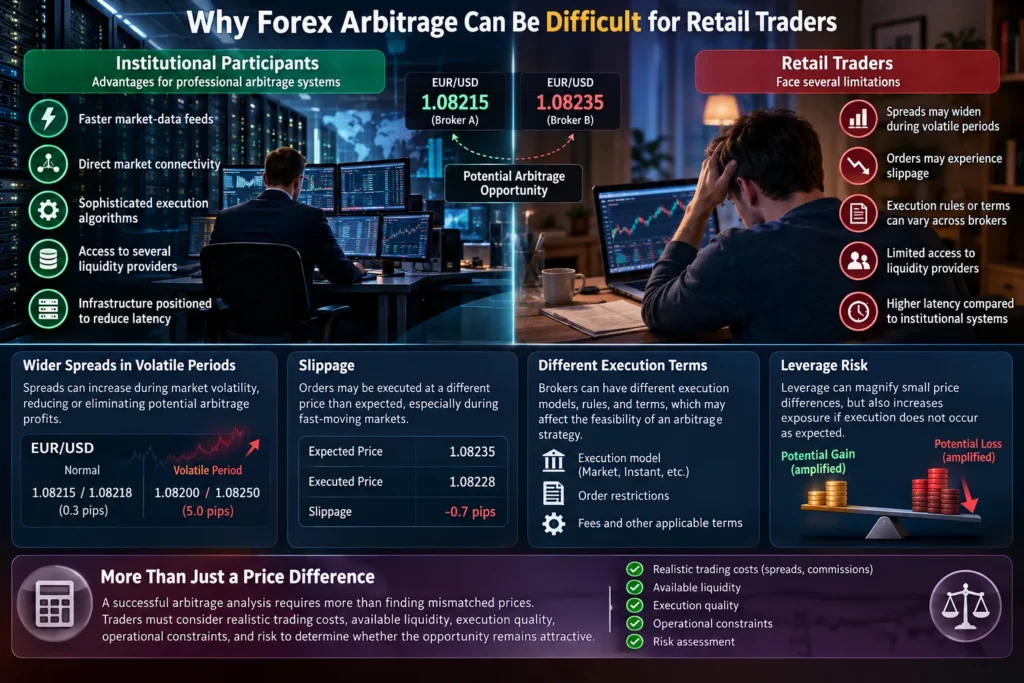
Why Forex Arbitrage Can Be Difficult for Retail Traders
Retail traders may technically observe pricing differences in Forex, but competing with professional arbitrage systems can be challenging. Institutional participants may have faster market-data feeds, direct market connectivity, sophisticated execution algorithms, access to several liquidity providers, and infrastructure positioned specifically to reduce latency.
Retail trading conditions can introduce additional limitations. Spreads may widen during volatile periods, orders may experience slippage, and the execution rules or terms offered by different brokers can vary. Traders should therefore understand the execution model and applicable terms of any platform they use before attempting an arbitrage strategy.
Leverage requires particular caution. Using leverage to magnify a small pricing discrepancy also increases exposure when execution does not occur as expected. A failed or delayed leg of a leveraged arbitrage transaction can create losses that are substantially different from the theoretical result calculated before execution.
Ultimately, successful arbitrage analysis requires more than discovering mismatched prices. Investors must determine whether the opportunity remains attractive after realistic trading costs, available liquidity, execution quality, operational constraints, and risk are incorporated into the calculation.
How Investors Evaluate and Implement Arbitrage Strategies
Once investors understand where arbitrage opportunities may appear and what can make them disappear, the next step is evaluating whether a strategy can be implemented consistently. This requires a structured process rather than reacting to every visible price difference.
Professional arbitrage systems generally combine market data, predefined rules, cost calculations, execution logic, and risk controls. The objective is not simply to find the largest discrepancy. A smaller but highly liquid and reliably executable opportunity may be more practical than a larger discrepancy in a fragmented or illiquid market.
1. Establish the Expected Price Relationship
The first step is defining what relationship should exist between the instruments being monitored. In cross-market arbitrage, this may be the price of the same asset on two venues. In triangular Forex arbitrage, the relationship is derived from exchange rates among three currencies. Other strategies may compare spot and derivative markets or economically related securities.
Without a clearly defined relationship, a trader cannot determine whether two different prices represent a genuine mispricing or simply reflect different financial instruments, contract specifications, settlement conditions, or risks.
2. Use Executable Bid and Ask Prices
One common mistake is calculating theoretical profits from last-traded or mid-market prices. An investor purchasing an asset generally interacts with the ask price, while an investor selling generally interacts with the bid price.
As a result, an arbitrage calculation should reflect the actual prices available for each required transaction. The analysis should also consider the quantity available at those prices.
A simple decision framework can be expressed conceptually as:
Expected net arbitrage return = gross pricing discrepancy − total trading and implementation costs.
This calculation is only an estimate until execution occurs because spreads, liquidity, and market prices can change.
3. Define a Minimum Opportunity Threshold
Attempting to trade every positive theoretical discrepancy may produce poor results. Investors can instead establish a minimum threshold that an opportunity must exceed before an order is considered.
The threshold may account for expected transaction costs, typical slippage, execution uncertainty, financing costs, and an additional margin for unexpected conditions. This approach can help filter out discrepancies that are technically positive but too small to provide a meaningful buffer against execution imperfections.
Technology Used in Modern Arbitrage
Because many pricing differences can be short-lived, technology plays an important role in modern arbitrage. Automated systems can receive market data from several sources, normalize quotations, compare related instruments, calculate expected returns, and evaluate whether predefined trading conditions have been satisfied.
A simplified arbitrage infrastructure may contain several components:
- Market-data feeds for receiving current bid, ask, volume, and market-depth information.
- Pricing logic for calculating theoretical relationships and identifying discrepancies.
- Cost models for estimating commissions, spreads, financing, and other expenses.
- Execution systems for submitting and managing related orders.
- Risk controls for limiting position size, exposure, failed executions, and abnormal trading conditions.
- Monitoring and logging for reviewing orders, system performance, errors, and execution quality.
More sophisticated technology does not automatically make a strategy profitable. Poor data, incorrect assumptions, software defects, or an inaccurate transaction-cost model can cause an automated system to repeatedly execute trades that appear profitable mathematically but lose money in practice.
Practical Example of Evaluating an Arbitrage Trade
Consider a hypothetical situation in which the same instrument has an executable ask price of $99.90 on one venue and an executable bid price of $100.10 on another. The visible gross difference is $0.20 per unit.
The investor must then estimate the cost of buying on the first venue and selling on the second. Suppose combined commissions, spreads not already reflected in the executable quotations, financing, and other relevant costs are estimated at $0.12 per unit. The theoretical remaining difference would be $0.08 per unit before considering unexpected slippage or execution problems.
If market movement causes only one side of the transaction to execute at the expected price, that remaining margin could quickly disappear. The example demonstrates why a gross discrepancy should never be interpreted automatically as expected profit.
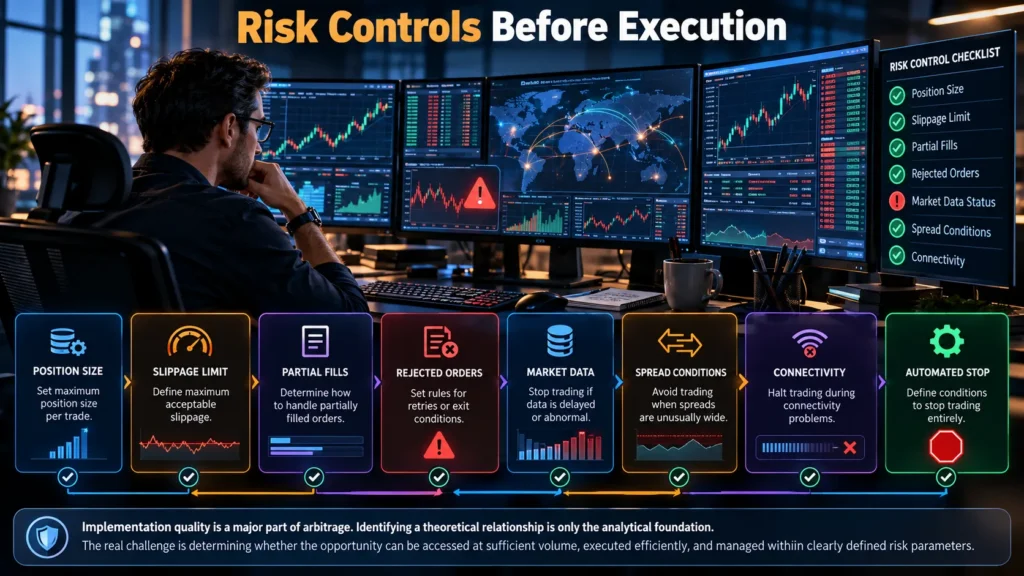
Risk Controls Before Execution
A disciplined arbitrage strategy should define what happens when execution does not proceed according to plan. For example, a system may need rules for maximum position size, maximum acceptable slippage, partial fills, rejected orders, delayed market data, abnormal spreads, or temporary connectivity problems.
Investors may also establish conditions under which automated trading stops entirely. Continuing to submit orders when market data is stale or one trading venue is experiencing technical problems can transform a normally controlled strategy into significant unintended exposure.
For traders exploring broader currency-market techniques, understanding Forex risk management can provide useful context for position sizing, leverage, execution risk, and capital protection.
Ultimately, implementation quality is a major part of arbitrage. Identifying a theoretical relationship is only the analytical foundation. The real challenge is determining whether the discrepancy can be accessed at sufficient volume, executed efficiently, and managed within clearly defined risk parameters.
Is Arbitrage Suitable for Every Investor?
Arbitrage can appear attractive because the strategy focuses on price discrepancies rather than making a conventional prediction about whether an asset will rise or fall. However, this does not mean every arbitrage approach is accessible or appropriate for every investor.
The practical requirements vary considerably. Some strategies require accounts with multiple trading venues, substantial capital, access to short selling, real-time market data, low transaction costs, and automated execution infrastructure. Others depend on specialized knowledge of derivatives, currency relationships, settlement procedures, or quantitative modeling.
For individual investors, understanding arbitrage may therefore be valuable even when directly competing for short-lived institutional opportunities is unrealistic. The concept provides useful insight into how interconnected markets establish prices, why discrepancies tend to disappear, and why execution costs are an essential part of evaluating any trading strategy.
Common Mistakes When Looking for Arbitrage Opportunities
Many apparent arbitrage opportunities disappear once realistic trading conditions are included in the calculation. Investors evaluating these strategies should be particularly careful about several common mistakes.
- Comparing the wrong prices: Last-traded prices or mid-market quotations may not represent prices at which the investor can actually trade.
- Ignoring transaction costs: A visible price discrepancy may be smaller than the combined commissions, spreads, financing expenses, and other costs.
- Ignoring available volume: A profitable quotation may apply to only a small quantity of the asset.
- Assuming simultaneous execution: Multi-leg strategies can create exposure if one transaction executes and another does not.
- Overlooking settlement differences: Instruments that appear identical may have different settlement conditions, contract specifications, or other characteristics.
- Using excessive leverage: Leverage can amplify losses when an expected pricing relationship does not behave as planned.
- Treating statistical relationships as guarantees: Historical correlation or convergence does not ensure that the same relationship will continue.
Key Takeaways for Investors
Arbitrage begins with a simple economic principle: related prices should generally remain consistent enough that obvious discrepancies attract market participants. Investors attempt to identify temporary deviations from those relationships and structure transactions that may benefit as prices remain mismatched or return toward alignment.
In practice, the process requires considerably more than spotting two different numbers. A meaningful analysis should consider executable bid and ask prices, transaction costs, market depth, liquidity, slippage, financing, technology, settlement, and the possibility that one side of a transaction does not execute as expected.
This is especially relevant in Forex, where exchange rates are interconnected and quotations can change rapidly. Triangular arbitrage demonstrates how three currency pairs can create a mathematical relationship, while cross-venue strategies illustrate how differences between liquidity sources can potentially create temporary discrepancies.
Investors should therefore distinguish between theoretical arbitrage and executable arbitrage. The first can be identified mathematically. The second must survive real-world costs and operational constraints.
Frequently Asked Questions
What is arbitrage in simple terms?
Arbitrage is a strategy that attempts to benefit from a price difference involving the same or closely related assets. A basic example is buying an asset where it is cheaper while simultaneously selling it where it is more expensive, provided the difference remains positive after costs.
Is arbitrage risk-free?
Textbook examples can describe arbitrage as locking in a price difference without conventional market exposure. Real-world execution can still involve liquidity risk, slippage, failed or partial orders, technology problems, counterparty exposure, and other operational risks.
What is Forex arbitrage?
Forex arbitrage attempts to exploit temporary inconsistencies in currency prices. It can involve comparing quotations from different sources or examining relationships among multiple currency pairs, as occurs in triangular arbitrage.
What is triangular arbitrage?
Triangular arbitrage involves three currencies. A trader compares the exchange rates among three currency pairs and determines whether converting from one currency to another, then to a third, and finally back to the original currency creates a positive difference after trading costs.
Can retail traders use arbitrage strategies?
Retail traders can study and potentially attempt certain arbitrage approaches, but practical limitations may include spreads, commissions, latency, liquidity, execution rules, and access to multiple markets. Professional firms may also use specialized infrastructure designed for rapid market-data processing and execution.
Why do arbitrage opportunities disappear quickly?
When market participants identify a meaningful discrepancy, buying activity can increase the lower price while selling activity can place pressure on the higher price. These actions can cause the two prices to converge, reducing or eliminating the opportunity.
Is statistical arbitrage the same as traditional arbitrage?
No. Traditional arbitrage generally focuses on a more direct pricing inconsistency, while statistical arbitrage uses modeled or historical relationships and typically depends on an expectation that prices will converge. That expectation can fail, so statistical arbitrage can involve significant market and model risk.
Why are transaction costs important in arbitrage?
Arbitrage opportunities are often based on relatively small price differences. Commissions, bid-ask spreads, financing, slippage, and other expenses can reduce or completely eliminate the apparent return. Calculations should therefore focus on estimated net results rather than gross price discrepancies.
Conclusion
Arbitrage illustrates how closely connected modern financial markets can be. Investors continuously compare prices, exchange rates, and related financial instruments, and their trading activity can help correct temporary inconsistencies between markets.
Yet identifying a discrepancy is different from successfully trading it. Effective arbitrage requires accurate pricing information, realistic cost calculations, sufficient liquidity, reliable execution, and disciplined risk controls. In highly competitive markets, technology and execution quality can be as important as the underlying trading idea.
For investors studying Arbitrage and Forex markets, the most useful starting point is understanding the relationship between theoretical prices and prices that can actually be executed. That distinction helps explain both the potential of arbitrage strategies and the practical limitations that investors encounter when attempting to implement them.