
Neural Networks in Forex : How AI Predicts Currency Prices
Neural Networks in Forex: How Artificial Intelligence Predicts Currency Prices
Neural networks in Forex are changing how traders, financial analysts, and quantitative researchers approach currency price prediction. Instead of relying exclusively on traditional technical indicators or manual chart analysis, these artificial intelligence models can examine historical exchange rates, recognize complex relationships between market variables, and generate predictions based on patterns learned from financial data.
The foreign exchange market is influenced by numerous interconnected factors, including interest rates, inflation, monetary policy, geopolitical developments, investor sentiment, and global economic conditions. Understanding how these variables interact is challenging, particularly when market relationships change unexpectedly. Neural networks offer a computational approach to analyzing these relationships, although their predictions remain uncertain and can become unreliable when market conditions shift.
As artificial intelligence in Forex becomes more accessible, interest in machine learning, deep learning, automated trading systems, and predictive analytics continues to grow. Neural network models are particularly interesting because they can learn nonlinear relationships that traditional statistical models may struggle to represent.
However, successful Forex forecasting requires much more than selecting an advanced algorithm. Data quality, model architecture, feature engineering, risk management, transaction costs, and realistic testing all influence whether an AI-based trading approach has practical value.
This comprehensive guide explains how neural networks work in Forex trading, which architectures are commonly used for currency price forecasting, what information these models analyze, and why prediction accuracy does not automatically translate into profitable trading.
What Are Neural Networks in Forex Trading?
A neural network is a machine learning model composed of interconnected computational units, often called artificial neurons. These units process numerical information through mathematical operations and learn relationships between inputs and outputs by adjusting internal parameters during training.
In Forex trading, neural networks can be trained to analyze exchange rate movements and estimate potential future market behavior. Depending on the system’s design, the model might predict the next closing price, estimate the probability of an upward movement, identify changes in volatility, or classify current market conditions.
For example, a neural network analyzing the EUR/USD currency pair might receive information about recent exchange rates, trading volume proxies, technical indicators, interest rate expectations, and historical volatility. The model processes these inputs and produces a prediction for a specified future period.
Unlike a simple trading rule that generates a buy signal whenever two moving averages cross, a neural network can combine multiple variables and learn relationships that change across different combinations of market conditions.
This flexibility is one of its main advantages. It is also a significant source of risk because highly flexible models can learn accidental patterns that appear meaningful in historical data but disappear in live trading.
How Artificial Neural Networks Process Forex Data
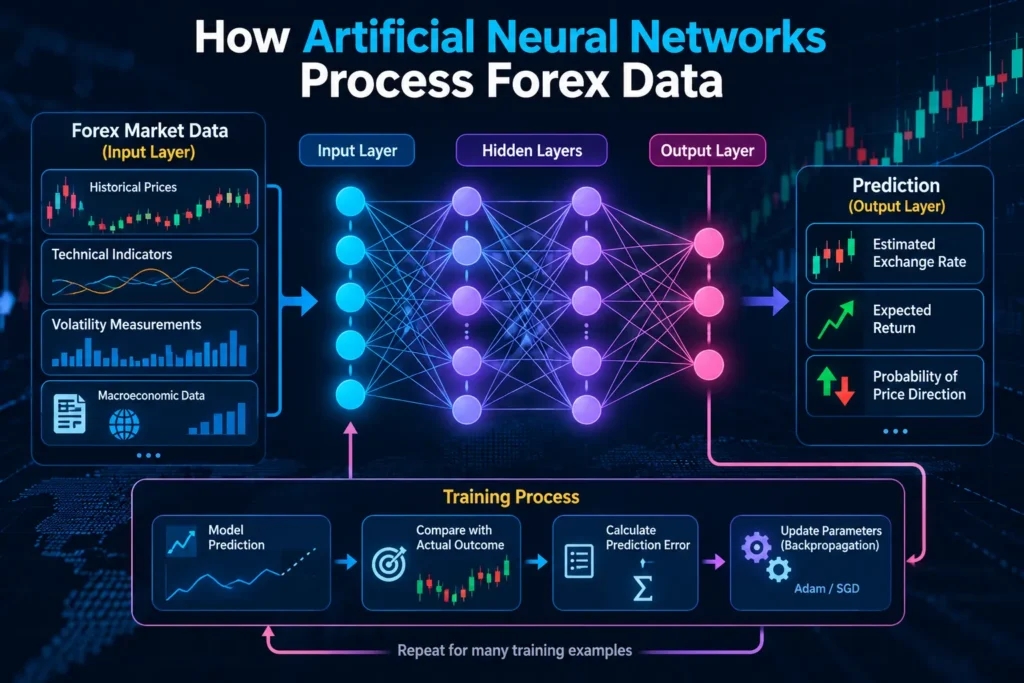
Most conventional neural networks organize information into layers. Each layer performs a different stage of mathematical processing, allowing the model to transform raw market information into increasingly complex representations.
The basic structure typically includes three components:
- Input layer: Receives market variables such as historical prices, technical indicators, volatility measurements, and macroeconomic data.
- Hidden layers: Apply mathematical transformations to identify relationships and combinations of features that may help explain future market movements.
- Output layer: Produces the model’s prediction, such as an estimated exchange rate, expected return, or probability of a particular price direction.
Suppose a neural network receives the previous 30 hourly EUR/USD closing prices, along with several volatility and momentum indicators. During training, the model compares its predictions with actual historical outcomes.
If the predicted value differs from the observed result, a mathematical optimization process adjusts the model’s parameters to reduce the selected error function. Repeating this procedure across many training examples helps the network learn statistical relationships within the dataset.
One common training approach uses backpropagation to calculate how changes in model parameters affect prediction errors. An optimization algorithm, such as Adam or stochastic gradient descent, then updates those parameters.
Importantly, this process does not give the neural network an understanding of economic events in the human sense. The model learns numerical associations from the information provided to it. Whether those associations remain useful in future markets must be established through careful evaluation.
Why Neural Networks Are Different From Traditional Forex Indicators
Traditional technical indicators generally follow predefined mathematical formulas. A moving average calculates an average price over a specified period, while the Relative Strength Index measures the magnitude of recent upward and downward price movements.
These indicators can help traders organize market information, but their calculation methods do not automatically adapt to new market conditions.
Neural networks operate differently. Their parameters are estimated from training data, allowing them to learn relationships between multiple indicators, price movements, and external variables.
Consider a trading system using RSI, moving averages, and volatility measurements. A conventional rule-based strategy might require RSI to fall below a specific threshold before generating a potential buying signal.
A neural network could instead learn that the usefulness of an RSI reading depends on several additional factors, including:
- The prevailing market trend.
- The current level of exchange rate volatility.
- The time of day and active trading session.
- The distance between short-term and long-term moving averages.
- Recent price momentum and market reversals.
- Upcoming economic announcements, when properly represented in the data.
The model may identify situations where the same RSI reading has different implications depending on the surrounding conditions.
Nevertheless, greater complexity does not guarantee superior performance. A relatively simple trading strategy can outperform an advanced neural network when the complex model suffers from overfitting, poor data quality, or unrealistic assumptions.
Why Neural Networks Are Used for Forex Price Prediction
Currency markets generate extensive streams of time-dependent information. Exchange rates change continuously during trading hours, and their movements reflect the interaction of economic expectations, liquidity, positioning, and market participants’ decisions.
These characteristics make Forex an interesting application for machine learning, especially models designed to analyze sequences and nonlinear relationships.
Neural networks are used in currency forecasting for several reasons, but each potential advantage must be considered alongside its limitations.
Identifying Nonlinear Market Relationships
Financial variables do not always interact in straightforward ways. For example, an increase in interest rates might support a currency under some circumstances but weaken it under others.
The market response may depend on whether the interest rate decision was expected, how the central bank communicates its future policy, and whether investors believe the decision will negatively affect economic growth.
Linear models can represent certain relationships efficiently, but more complicated interactions may require additional assumptions or carefully constructed features.
Neural networks can approximate nonlinear functions, making them suitable for investigating relationships involving multiple interacting market variables.
For instance, a forecasting model could examine whether the relationship between interest rate expectations and currency movements changes when volatility is unusually high.
However, a model’s ability to represent nonlinear relationships does not establish that a stable, profitable relationship exists. Financial markets contain substantial noise, and patterns can weaken or disappear after becoming widely recognized.
Analyzing Large and Diverse Datasets
Forex prediction systems may combine information from several sources rather than relying on exchange rate history alone.
Possible inputs include:
- Historical price data: Open, high, low, and closing prices across selected timeframes.
- Market activity: Tick counts, available liquidity information, and trading volume where reliable data exists.
- Technical indicators: RSI, MACD, moving averages, Bollinger Bands, and momentum measurements.
- Macroeconomic indicators: Inflation, employment, economic growth, and central bank policy rates.
- Interest rate expectations: Market-implied expectations derived from relevant financial instruments.
- Market sentiment: Quantified information from financial news or other appropriately validated sources.
- Cross-market variables: Bond yields, commodity prices, equity market indicators, and related currency pairs.
A neural network can combine these features into a single predictive model. This creates opportunities to investigate relationships that would be difficult to evaluate manually.
However, adding more variables is not automatically beneficial. Irrelevant features can increase noise, computational requirements, and the risk of overfitting.
Data availability is another important concern. A model must not use information that would have been unavailable at the moment a historical prediction was supposedly made.
For example, economic statistics are often revised after their initial publication. Training a model on revised values without preserving the original release information can create misleading backtest results.
Recognizing Patterns Across Multiple Timeframes
Forex traders frequently analyze several timeframes to understand both broader market trends and shorter-term price movements.
A trader might use daily charts to identify the general market direction, four-hour charts to evaluate momentum, and fifteen-minute charts to examine potential entry opportunities.
Neural networks can also process information from multiple timeframes, provided the input data is synchronized correctly.
A model could receive daily trend features, hourly volatility measurements, and recent fifteen-minute price movements. Its objective might be to estimate the probability of a positive return over the next hour.
Such a system may learn that a short-term price reversal behaves differently depending on the longer-term trend.
Careful data alignment is essential. For instance, a model making a prediction at 10:00 must not use the closing price of a daily candle that will not finish until later.
This seemingly small implementation error can introduce future information into historical training data, making a model appear substantially more accurate than it would be in actual trading.
Supporting Systematic Trading Decisions
Another reason traders investigate neural networks is their potential role in systematic decision-making.
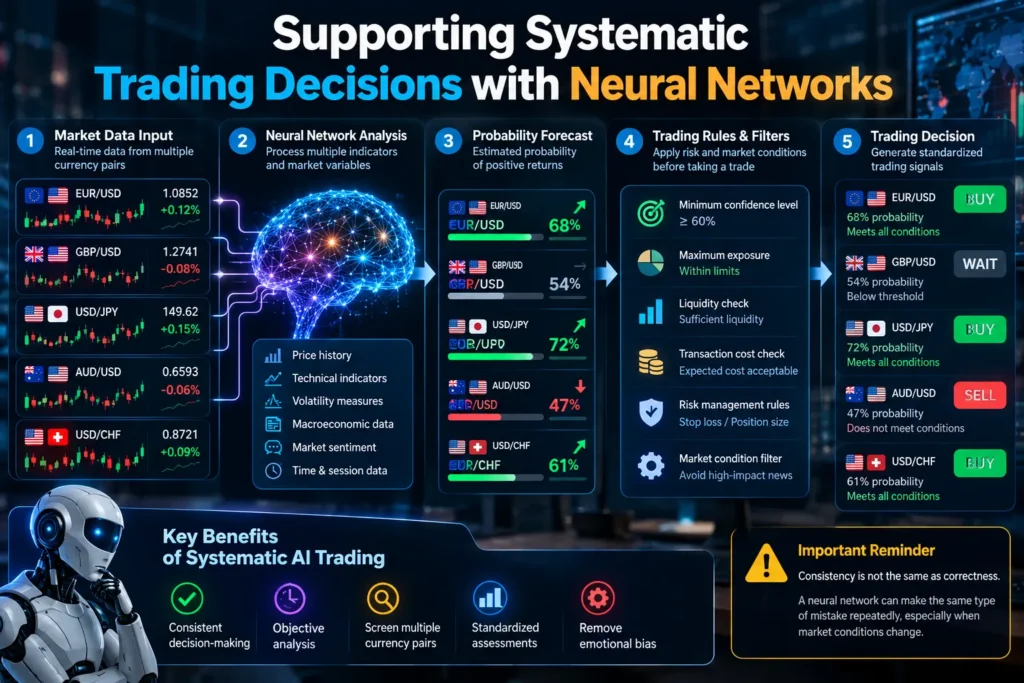
Human traders may interpret similar market conditions differently depending on experience, emotional state, or recent trading outcomes. A properly implemented model follows the same computational procedure when given the same inputs and configuration.
This consistency can be useful for screening currency pairs, ranking potential opportunities, and generating standardized market assessments.
For example, an AI-powered Forex system might evaluate several major currency pairs every hour and produce an estimated probability of positive returns for each one.
The trading strategy could then apply additional rules concerning minimum confidence levels, maximum exposure, liquidity, and expected transaction costs before considering any trade.
Importantly, consistency is not the same as correctness. An automated system can make the same type of mistake repeatedly, particularly when the market environment differs from the conditions represented in its training data.
Types of Neural Networks Used in Forex Forecasting
Not all neural networks process information in the same way. Different architectures are designed to handle different data structures, prediction objectives, and computational requirements.
In Forex research, several neural network architectures are commonly investigated for financial time-series forecasting.
Understanding their differences helps traders and developers select a model based on the actual problem rather than assuming the newest or most complex architecture will perform best.
Feedforward Neural Networks and Multilayer Perceptrons
A feedforward neural network processes information from its input layer through one or more hidden layers to its output layer. Information moves forward through the network without the recurrent connections found in some sequence-oriented architectures.
A multilayer perceptron, or MLP, is a widely used example of this structure.
In Forex forecasting, an MLP can receive a fixed set of features representing recent market conditions. These might include several historical returns, momentum indicators, moving average differences, and volatility estimates.
The network then generates a prediction based on the relationships learned during training.
For example, a simple MLP could be trained to classify whether the GBP/USD exchange rate will increase or decrease over the next four hours.
Its input variables might include:
- Returns over the previous 1, 4, and 12 hours.
- Current RSI and MACD measurements.
- The difference between selected moving averages.
- Recent realized volatility.
- Time-of-day information.
MLPs are often useful as baseline models because they are comparatively straightforward to implement and can represent nonlinear relationships.
Their main limitation is that they do not inherently model temporal order in the same way as recurrent or attention-based sequence models. Historical information must generally be represented through appropriately constructed input features.
For many forecasting problems, a well-designed MLP remains worth testing before introducing more complicated deep learning architectures.
Recurrent Neural Networks for Sequential Forex Data
Recurrent Neural Networks, commonly called RNNs, are designed to process sequences of information.
This makes them conceptually relevant to Forex because exchange rate observations occur in chronological order, and traders often want to understand how recent movements relate to future outcomes.
Unlike a conventional feedforward network, an RNN maintains a hidden state that carries information from earlier positions in the sequence.
For example, an RNN might analyze a sequence of hourly EUR/USD returns and update its internal representation as each observation is processed.
After receiving the complete sequence, the network can produce a prediction for the next observation or another specified forecasting horizon.
Traditional RNNs face difficulties when learning relationships across long sequences. During training, the gradients used to update model parameters can become extremely small or excessively large, creating optimization problems.
These issues helped motivate the development of more specialized recurrent architectures, including Long Short-Term Memory networks and Gated Recurrent Units.
Long Short-Term Memory Networks in Forex Trading
Long Short-Term Memory networks, or LSTMs, are a type of recurrent neural network designed to manage information across sequences using specialized gating mechanisms.
These mechanisms regulate how information is retained, updated, and used when producing predictions.
LSTMs are frequently investigated for financial time-series forecasting because they can learn patterns involving observations separated by multiple time steps.
Consider an LSTM model trained on 60 consecutive hourly observations of USD/JPY.
The model could receive normalized returns, volatility measurements, and selected technical features for each hour. It would then attempt to estimate the return over the following hour.
During training, the network learns which combinations of historical observations are useful for minimizing prediction error.
Potential applications include:
- Short-term exchange rate forecasting.
- Directional movement classification.
- Volatility estimation.
- Market regime classification.
- Forecasting sequences of future returns.
Although LSTMs can represent complex temporal relationships, they do not automatically distinguish meaningful market signals from random fluctuations.
They also require careful decisions about sequence length, feature selection, model capacity, regularization, and training procedures.
An LSTM that performs well on historical EUR/USD data may produce poor results after a major monetary policy shift or a sudden change in market liquidity.
For this reason, LSTM performance should always be compared against simpler alternatives, including naive forecasts, linear models, and conventional machine learning methods.
Gated Recurrent Units for Efficient Currency Forecasting
Gated Recurrent Units, or GRUs, are another recurrent neural network architecture designed to handle sequential information.
Like LSTMs, GRUs use gating mechanisms to control how information flows through the network. However, their internal structure is generally simpler, with fewer distinct gating components.
This can reduce parameter counts under comparable configurations and may make GRUs computationally attractive for certain forecasting tasks.
A GRU model could analyze recent AUD/USD returns, volatility features, and interest rate-related variables to estimate the probability of an upward price movement during the next trading session.
Whether a GRU performs better than an LSTM depends on the dataset, model configuration, training process, and evaluation criteria.
There is no universal rule establishing one architecture as consistently superior for Forex prediction.
In practical research, both models can be evaluated using the same chronological training, validation, and testing periods. This makes comparisons more meaningful than selecting a model based solely on its popularity.
What Neural Networks Can Actually Predict in Forex
One of the most important decisions in building a neural network for Forex trading is defining the prediction target.
The phrase “predicting Forex prices” can describe several different tasks, each requiring different datasets, model outputs, and evaluation methods.
A model designed to estimate the next exchange rate is not necessarily suitable for identifying profitable trades. Similarly, a system that predicts market direction may provide little information about the size of the expected movement.
Predicting Future Exchange Rates
Price regression is a forecasting task in which the model estimates a numerical exchange rate for a specified future time.
For example, suppose EUR/USD is currently trading at 1.0850. A neural network might generate a hypothetical forecast of 1.0870 for the following trading session.
This output represents the model’s estimate, not a guaranteed future price.
Price predictions are often evaluated using statistical measures such as Mean Absolute Error (MAE) or Root Mean Squared Error (RMSE).
However, exchange rate levels can be highly persistent over short horizons. A naive model that simply predicts the current price as the next price can therefore be difficult to outperform on these metrics.
A neural network should demonstrate meaningful improvements over such baselines before its complexity is considered justified.
Predicting Currency Price Direction
Directional forecasting attempts to determine whether an exchange rate is more likely to rise or fall over a defined period.
Instead of predicting a precise future price, a classification model might output a probability between zero and one.
For example, a model might estimate a 0.62 probability that EUR/USD will close higher after the next four-hour interval.
This value should not automatically be interpreted as a reliable 62% chance of success. The model’s probability estimates must be evaluated for calibration against observations that were not used during training.
Directional classification can be useful when the trading strategy is primarily concerned with the sign of future returns.
Nevertheless, predicting direction alone is insufficient for evaluating profitability. A strategy can correctly anticipate many small price movements while suffering large losses on fewer incorrect predictions.
The magnitude of gains and losses, trading costs, and risk exposure must also be considered.
Forecasting Volatility and Market Conditions
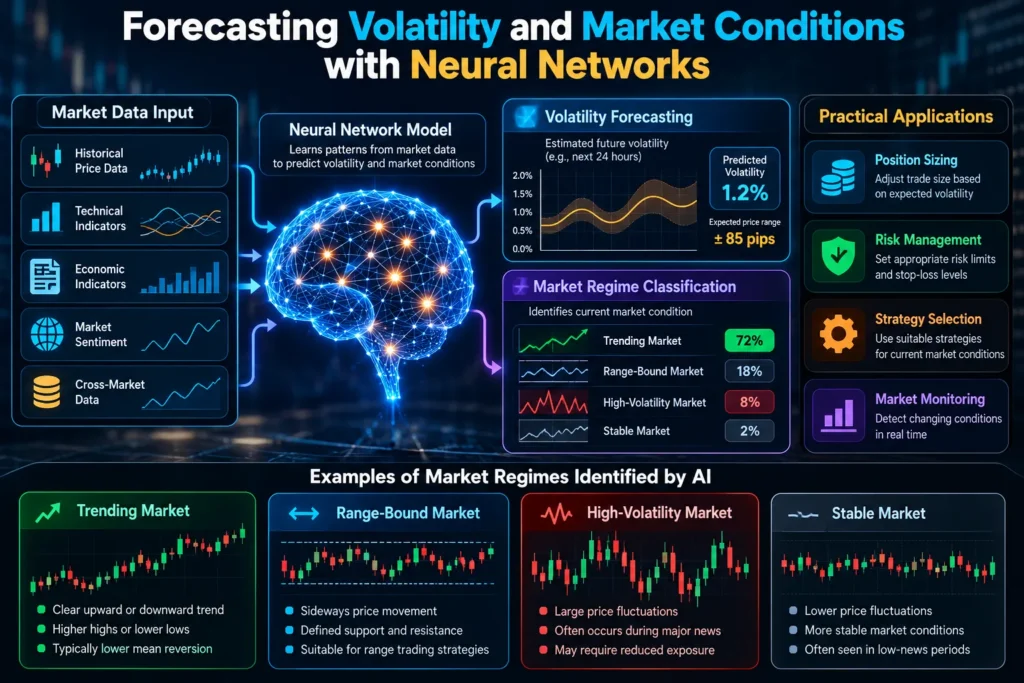
Neural networks can also be trained to predict market volatility rather than price direction.
Volatility forecasting attempts to estimate how much an exchange rate may fluctuate over a future period, without necessarily determining whether the movement will be upward or downward.
Such predictions can support position sizing, risk limits, and decisions about whether current market conditions are appropriate for a particular trading strategy.
Another related application is market regime classification. A model may attempt to distinguish between trending, range-bound, high-volatility, and relatively stable market conditions.
These categories must be defined carefully because different labeling methods can produce different training outcomes.
For instance, a neural network might identify that recent market behavior resembles historically volatile periods. A trading system could use this information to reduce exposure or avoid strategies that depend on stable price movements.
These applications demonstrate that artificial intelligence in Forex is not limited to generating buy and sell signals. Neural networks may also contribute to risk analysis, market monitoring, and the selection of trading conditions.
The practical value of any prediction ultimately depends on whether it remains reliable on unseen data and improves decisions after accounting for real-world trading constraints.
How to Build a Neural Network for Forex Price Prediction
Developing a neural network for Forex price prediction requires a structured process that combines financial market knowledge, data engineering, machine learning, and statistical evaluation. While modern deep learning frameworks make it relatively easy to create neural network architectures, building a model that performs reliably on unseen market data is considerably more challenging.
A successful forecasting project begins with a clearly defined objective. Developers must determine what the model should predict, which information will be available when predictions are generated, and how those predictions will eventually support trading decisions.
For example, a neural network designed to forecast the next hourly EUR/USD return requires a different approach from a model intended to identify long-term trends in GBP/USD. The choice of forecasting horizon affects data collection, feature engineering, network architecture, evaluation methods, and trading costs.
The following process explains how neural networks can be developed for currency forecasting while avoiding common methodological mistakes that frequently produce misleading results.
Step 1: Define the Forex Prediction Objective
Before collecting historical exchange rate data, the first step is to establish the model’s intended output. An unclear prediction objective can lead to inconsistent training labels and evaluation metrics that do not reflect the actual trading strategy.
Common forecasting objectives include:
- Price regression: Estimating a future exchange rate at a specified time.
- Return forecasting: Predicting the percentage or logarithmic change in an exchange rate.
- Directional classification: Estimating whether a currency pair will rise or fall.
- Volatility forecasting: Predicting the magnitude of future price fluctuations.
- Market regime identification: Classifying market conditions as trending, ranging, or unusually volatile.
Suppose the objective is to predict whether EUR/USD will increase during the next four hours. The model can be trained as a binary classifier using historical observations labeled according to the direction of the subsequent four-hour return.
Alternatively, a regression model might estimate the size of that return. This provides additional information about the expected movement, although numerical forecasts can be difficult to estimate accurately in noisy financial markets.
The prediction horizon must also be defined precisely. A model forecasting the next five-minute candle may face different market dynamics, transaction cost sensitivity, and data requirements than a system forecasting daily exchange rate changes.
For beginners, starting with one major currency pair and one clearly defined prediction horizon is usually more manageable than attempting to forecast several currency pairs across multiple timeframes simultaneously.
Step 2: Collect Reliable Historical Forex Data
Historical market data forms the foundation of a neural network forecasting system. The model can only learn from the information available during training, making data reliability one of the most important determinants of research quality.
Forex datasets commonly contain open, high, low, and close prices, often abbreviated as OHLC. Depending on the provider, additional information may include bid and ask prices, spreads, tick counts, and available liquidity measurements.
Potential data sources include broker trading platforms, institutional market data providers, and financial data services offering historical currency information.
When selecting a dataset, developers should consider several factors:
- Historical coverage: The dataset should include enough observations to represent different market environments.
- Timestamp consistency: All observations should use a clearly defined timezone and chronological order.
- Price representation: Bid, ask, and midpoint prices should not be mixed without appropriate adjustments.
- Missing observations: Gaps caused by weekends, holidays, or data collection failures must be identified.
- Spread information: Historical bid-ask spreads are useful for realistic trading simulations.
- Data licensing: The intended research or commercial application must comply with the provider’s usage terms.
One important characteristic of the Forex market is its decentralized structure. Unlike exchange-traded instruments with consolidated reporting, spot Forex does not have a single centralized source of total trading volume.
Consequently, the volume information displayed by many retail trading platforms represents tick activity or data from a particular broker or liquidity source rather than the entire global currency market.
This distinction matters when volume-related indicators are used as neural network inputs.
Historical data should also be inspected for abnormal spikes, duplicate records, inconsistent candle intervals, and incorrect prices. A single erroneous observation can influence technical indicators, volatility estimates, and model training.

Step 3: Clean and Prepare the Market Dataset
Raw Forex data is rarely ready for immediate use in a neural network. Before training begins, the dataset must be transformed into a consistent structure that supports reliable statistical analysis.
Data preprocessing typically includes removing duplicates, verifying chronological order, identifying missing observations, and checking whether timestamps correspond to the intended trading sessions.
Missing market data requires particular care. A weekend gap is not equivalent to a random missing observation during an active trading session. Filling both situations using the same method can create artificial price behavior.
Similarly, extreme price movements should not automatically be removed as outliers. Some large movements reflect genuine market events, such as unexpected monetary policy decisions or geopolitical developments.
Removing these observations indiscriminately may produce a dataset that no longer represents the risks encountered in actual Forex trading.
Another important preprocessing task is deciding whether to model raw exchange rates or transformed variables.
Many forecasting systems use returns rather than absolute price levels because returns can make certain comparisons across different market periods more meaningful.
For example, the simple return between two consecutive observations can be calculated as:
Return = (Current Price − Previous Price) / Previous Price
Logarithmic returns are another common representation and are calculated using the natural logarithm of the ratio between consecutive prices.
Neither transformation guarantees that a financial time series becomes stationary. The statistical properties of the resulting data must still be examined.
Step 4: Normalize Features Without Introducing Data Leakage
Neural networks generally benefit when numerical inputs have reasonably comparable scales. Without appropriate scaling, variables with large numerical magnitudes can influence optimization differently from variables expressed in much smaller ranges.
For example, an exchange rate, an RSI value, and an interest rate measurement may have substantially different numerical scales.
Two common preprocessing approaches are standardization and min-max normalization.
Standardization transforms a variable by subtracting its mean and dividing by its standard deviation. Min-max normalization rescales observations according to a selected minimum and maximum.
However, the timing of these calculations is critical in financial forecasting.
A common mistake is calculating normalization parameters using the complete historical dataset before dividing it into training and testing periods.
This allows information from the future testing period to influence the representation of earlier observations, creating data leakage.
A more appropriate procedure is:
- Divide the dataset chronologically into training, validation, and testing periods.
- Calculate normalization parameters using only the training period.
- Apply those parameters to the corresponding validation and testing observations.
- For walk-forward evaluation, refit preprocessing components only when the simulated training window advances.
Some normalized values may fall outside the original training range when market conditions change. This is not necessarily an error; it can indicate that new observations differ from the historical distribution.
The same principle applies to feature selection, dimensionality reduction, and other transformations that estimate parameters from data.
Feature Engineering for Neural Networks in Forex
Feature engineering is the process of transforming available market information into variables that may help a forecasting model identify useful relationships.
Although deep learning models can learn complex representations, carefully designed input features remain important, particularly when financial datasets contain substantial noise or relatively few independent market events.
The objective is not to include as many indicators as possible. Instead, developers should select variables that have a plausible relationship with the forecasting target and can be calculated using information available at prediction time.
Using Technical Indicators as Neural Network Inputs
Technical indicators summarize different aspects of historical price behavior. They can provide structured inputs for neural networks, especially when the model is designed to combine momentum, trend, and volatility information.
Frequently considered indicators include:
- Relative Strength Index (RSI): Measures the relative magnitude of recent upward and downward price changes.
- Moving Average Convergence Divergence (MACD): Represents relationships between selected exponential moving averages.
- Simple Moving Average (SMA): Calculates the arithmetic average of prices over a defined period.
- Exponential Moving Average (EMA): Assigns greater weight to more recent observations.
- Average True Range (ATR): Measures price range behavior and is commonly used as a volatility indicator.
- Bollinger Bands: Represent a moving average and bands based on a selected measure of price dispersion.
For example, a model predicting the next hourly GBP/USD return might receive RSI, recent returns, ATR, and the distance between two moving averages.
These variables describe different characteristics of recent market behavior, potentially helping the model identify interactions between momentum and volatility.
However, many technical indicators are derived from the same underlying price series. Including numerous highly correlated indicators may introduce redundancy without adding meaningful information.
Feature importance analysis, ablation experiments, and comparisons against simpler models can help determine whether individual indicators improve out-of-sample performance.
Integrating Macroeconomic Data Into Forex AI Models
Currency exchange rates are closely connected to macroeconomic conditions and expectations about future monetary policy.
Interest rates, inflation reports, employment figures, economic growth, and central bank communications can influence how market participants value currencies.
Neural networks can incorporate these variables, but the relationship between economic information and exchange rate movements is rarely straightforward.
For example, stronger-than-expected employment data may support a currency if investors believe it increases the likelihood of tighter monetary policy. However, the same announcement might have a different effect when economic growth concerns, inflation expectations, or broader risk sentiment dominate market behavior.
When constructing macroeconomic features, researchers should distinguish between:
- The actual economic figure reported.
- The market consensus forecast before publication.
- The difference between the actual result and expectations.
- Previously published values and subsequent revisions.
- The exact time the information became publicly available.
This distinction is particularly important because markets often react to surprises relative to expectations rather than to the reported number alone.
A neural network trained using final revised economic data may inadvertently learn from information unavailable to traders at the historical decision point.
Point-in-time datasets, which preserve the values known at each historical date, are therefore preferable when incorporating economic indicators into forecasting models.
Adding Market Sentiment and News Analysis
Artificial intelligence in Forex can extend beyond numerical market data through the integration of natural language processing.
Financial news articles, central bank statements, economic commentary, and other textual sources may contain information relevant to currency expectations.
Natural language processing models can convert text into numerical representations or sentiment classifications that become additional features in a forecasting system.
For example, a news analysis model might evaluate whether a central bank announcement communicates a more restrictive or accommodative monetary policy outlook than investors previously expected.
Its output could then be combined with exchange rate returns and volatility measurements in a separate neural network.
Nevertheless, sentiment analysis introduces several difficulties. Financial language is highly contextual, and a statement that appears positive in isolation may have a different meaning when compared with previous policy guidance.
News timestamps must also be handled carefully. A model should not use an article published after the prediction time, even if the article discusses an event that occurred earlier.
Furthermore, the existence of a sentiment signal does not establish that it can be traded profitably. Markets may incorporate public information extremely quickly, reducing the value of signals generated after publication.
Training a Forex Neural Network With Machine Learning
Once the dataset and features are prepared, the next stage is model training. During this process, the neural network adjusts its internal parameters to minimize a defined prediction error.
The training procedure must be designed to evaluate how well the model generalizes to future market conditions rather than how closely it reproduces historical observations.
Choosing the Right Neural Network Architecture
Architecture selection depends on the prediction objective, dataset size, sequence length, and available computational resources.
An MLP may be suitable when inputs consist of a fixed collection of engineered features. LSTM and GRU networks can be useful when the model processes ordered sequences of observations.
Attention-based architectures, including Transformers, provide another approach to sequence modeling and may be considered when investigating relationships across multiple time steps or variables.
However, model complexity should increase only when experiments demonstrate a meaningful benefit.
A practical development strategy is to begin with simple benchmarks, establish reliable validation procedures, and then test more advanced architectures under comparable conditions.
For example, a researcher might compare a naive return forecast, logistic regression, a multilayer perceptron, and an LSTM using the same prediction horizon and chronological test periods.
This comparison helps determine whether additional complexity provides measurable improvements rather than merely increasing training performance.
Understanding Loss Functions and Optimization
The loss function determines how the neural network measures prediction errors during training.
For exchange rate regression, commonly used loss functions include Mean Squared Error and Mean Absolute Error.
Mean Squared Error assigns greater penalties to larger prediction errors because differences are squared. Mean Absolute Error measures the average absolute difference between predictions and observed values.
For directional classification, binary cross-entropy is commonly used when the model produces a probability associated with one of two outcomes.
The selected loss function should reflect the prediction objective, but it does not necessarily measure trading profitability.
For example, minimizing average price prediction error does not automatically optimize trade execution, risk-adjusted returns, or transaction costs.
Training algorithms such as Adam update model parameters using gradients calculated from the loss function.
Important training settings include the learning rate, batch size, number of epochs, and regularization parameters.
These settings can strongly influence the model’s behavior, making systematic experimentation and validation necessary.
Preventing Overfitting in Forex Prediction Models
Overfitting occurs when a machine learning model learns details specific to its training data that do not generalize effectively to new observations.
This is a major concern in Forex forecasting because financial datasets contain noise, changing market conditions, and relationships that may not remain stable.
A neural network with excessive capacity can fit historical price movements closely while failing to predict future movements accurately.
Several techniques can help control overfitting:
- Early stopping: End training when validation performance stops improving according to a predefined rule.
- Dropout: Randomly deactivate selected units during training to reduce dependence on specific internal pathways.
- Weight regularization: Penalize overly large model parameters using methods such as L1 or L2 regularization.
- Reduced architecture complexity: Limit the number of layers or parameters when the available dataset does not justify a larger model.
- Feature selection: Remove unnecessary or redundant variables where validation evidence supports doing so.
- Chronological evaluation: Test performance on later periods that were not used for model fitting.
These techniques reduce certain risks but cannot eliminate overfitting completely.
Repeatedly testing different models against the same historical test period can also lead to overfitting at the research-process level. Eventually, developers may select a model that performs well on that particular period by chance.
Maintaining a final untouched test dataset helps provide a more credible estimate of generalization performance.
Why Time-Series Validation Matters in Forex Machine Learning
Conventional machine learning tutorials often divide datasets randomly into training and testing subsets. While random splitting is appropriate for some problems, it can be misleading when applied to financial time series.
Forex observations are chronological, and nearby samples often share overlapping information. Randomly mixing earlier and later observations may allow future market conditions to influence the training process.
For realistic forecasting, the model should be evaluated using information that would have been available at each historical decision point.
Chronological Training, Validation, and Testing
A straightforward evaluation procedure divides historical observations into consecutive periods.
For example, a hypothetical research project using EUR/USD data from 2018 through 2025 could use:
- Training period: 2018 through 2022.
- Validation period: 2023.
- Testing period: 2024 through 2025.
These dates are illustrative rather than a universally recommended split.
The model learns from the training period, while the validation period supports decisions about architecture and hyperparameters. The testing period is reserved for evaluating the final selected approach.
All preprocessing operations that estimate parameters must respect these boundaries.
Special care is required when prediction labels overlap across adjacent observations. Depending on the forecasting horizon and labeling method, an appropriate gap or purging procedure may be necessary to prevent information overlap between training and evaluation samples.
Walk-Forward Validation for Changing Market Conditions
Walk-forward validation provides a more realistic way to evaluate models in environments where market relationships may change over time.
Instead of training once and testing on a single future period, the model is repeatedly trained or updated using information available up to a particular historical date.
It is then evaluated on the next unseen period.
A simplified expanding-window procedure might follow these steps:
- Train the neural network using the earliest available historical period.
- Generate predictions for the next chronological evaluation window.
- Record the predictions and corresponding realized market outcomes.
- Expand the training dataset to include newly available historical observations.
- Retrain or update the model according to a predefined schedule.
- Repeat the process across subsequent evaluation windows.
A rolling-window approach follows a similar principle but removes older observations as new data becomes available.
Expanding windows preserve more historical information, while rolling windows may help models focus on more recent market behavior.
Neither approach is universally superior. Their usefulness depends on how quickly relevant relationships change and how much historical information the model requires.
Walk-forward validation can also reveal whether a forecasting method performs consistently or depends heavily on one favorable historical period.
Evaluating Neural Network Prediction Accuracy in Forex
Model evaluation should measure both statistical forecasting quality and practical trading relevance.
A neural network may achieve a low prediction error while producing signals that are unsuitable for trading. Conversely, a model with modest directional accuracy may still provide useful information when its correct predictions are associated with larger movements than its incorrect predictions.
Statistical Performance Metrics
Common evaluation metrics include:
- Mean Absolute Error (MAE): Measures the average absolute difference between predicted and observed numerical values.
- Root Mean Squared Error (RMSE): Measures prediction errors while assigning greater influence to larger deviations.
- Directional accuracy: Measures the proportion of observations for which the predicted direction matches the realized direction.
- Precision and recall: Evaluate different aspects of classification performance.
- Log loss: Assesses probabilistic classification predictions and penalizes confident incorrect forecasts.
- Brier score: Measures the quality of probabilistic predictions for binary outcomes.
The appropriate metric depends on the intended use of the model.
For example, a trading system that only acts when the model predicts a strong upward movement may benefit from evaluating precision and probability calibration for that specific signal category.
Class balance also matters. If one outcome occurs much more frequently than another, a high overall accuracy figure can be misleading.
Forecasting models should therefore be compared with simple benchmarks and evaluated using multiple complementary measures.
Why High Prediction Accuracy Does Not Guarantee Profitable Trading
One of the most important principles in AI-based Forex trading is that prediction accuracy and trading profitability are different objectives.
Consider a hypothetical strategy that correctly predicts the direction of 60 out of 100 trades.
If the average winning trade earns 5 pips and the average losing trade loses 10 pips, the gross result is:
Gross result = (60 × 5) − (40 × 10) = −100 pips
Despite achieving 60% directional accuracy, the strategy loses money before transaction costs.
Now consider a different hypothetical strategy that wins only 45 out of 100 trades but earns an average of 15 pips per winner while losing 8 pips per losing trade.
Gross result = (45 × 15) − (55 × 8) = +235 pips
This strategy has lower directional accuracy but a positive gross result in the simplified example.
These calculations assume equal position sizes and exclude spreads, commissions, financing charges, and execution effects. They are illustrations, not evidence of achievable market performance.
The comparison demonstrates why neural network evaluation must consider average gains, average losses, transaction costs, and the distribution of trading outcomes.
Additional trading performance measures may include maximum drawdown, profit factor, risk-adjusted returns, turnover, and exposure to unfavorable market conditions.
A model should also be evaluated for stability across currency pairs, market regimes, and independent historical periods.
Common Mistakes When Developing AI-Based Forex Prediction Systems
Many neural network projects produce impressive historical results but fail when exposed to live market conditions. This often happens because of weaknesses in research design rather than problems with the underlying neural network architecture.
Recognizing these mistakes early can help developers avoid spending time optimizing models that do not have credible predictive value.
Using Future Information During Training
Data leakage occurs when a model receives information that would not have been available at the historical prediction time.
Examples include calculating indicators using future candles, fitting scalers on the complete dataset, using revised economic figures without publication history, or creating overlapping samples without appropriate evaluation boundaries.
Leakage can make a model appear unusually accurate during backtesting.
The solution is to reconstruct the information environment that existed at each prediction point and ensure that every feature, label, and preprocessing operation respects chronological availability.
Ignoring Spreads, Slippage, and Execution Costs
Statistical forecasting models are often evaluated using midpoint or closing prices. However, actual Forex transactions generally involve buying at the ask price and selling at the bid price.
The difference between these prices creates a trading cost, while commissions, slippage, and overnight financing may add further expenses.
Short-term strategies can be particularly sensitive to these costs because their expected price movements may be small.
A realistic trading simulation should account for historical or appropriately modeled spreads, order execution assumptions, and the costs associated with the strategy’s trading frequency.
Assuming Complex Models Are Automatically Better
Deep learning architectures can contain large numbers of trainable parameters, but this flexibility can become a disadvantage when useful predictive signals are weak.
A large Transformer or multilayer LSTM may fit historical data more closely than a simple statistical model without producing better future forecasts.
Model selection should therefore be based on independent evaluation rather than architecture complexity.
Researchers should begin with transparent benchmarks and increase complexity only when improvements are reproducible and economically meaningful.
Failing to Account for Market Regime Changes
Forex markets evolve as monetary policy, liquidity, economic expectations, and investor behavior change.
A relationship observed during a period of low interest rates may not remain stable during a tightening cycle. Similarly, a model trained on relatively calm markets may perform poorly during periods of sudden volatility.
This phenomenon is often associated with distribution shift or concept drift.
Practical systems should monitor changes in input distributions, prediction errors, probability calibration, and realized trading outcomes.
When performance deteriorates, developers may need to investigate whether retraining, feature adjustments, or changes to the trading strategy are justified.
Automatic retraining alone is not a guaranteed solution. If the underlying market relationship has disappeared, fitting the same model to newer data may not restore its predictive value.
Confusing Backtest Optimization With Real-World Evidence
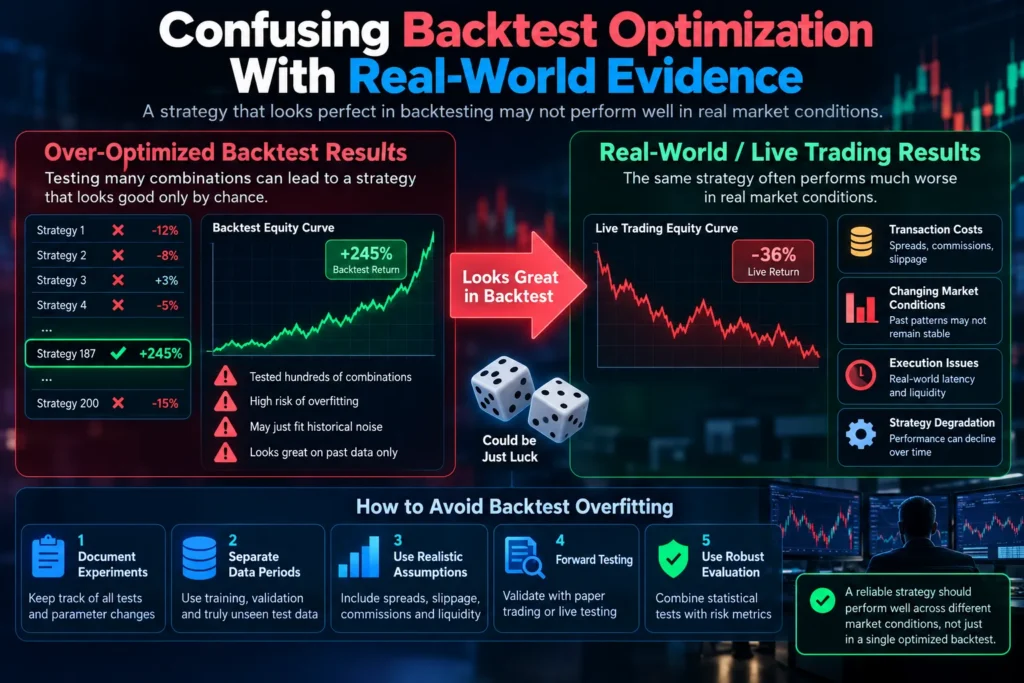
A neural network may appear successful after researchers test hundreds of feature combinations, prediction horizons, and model configurations.
However, repeatedly searching for the best historical result increases the likelihood of selecting a strategy that benefited from chance.
This problem is related to multiple testing and backtest overfitting.
To reduce the risk, researchers should document their experiments, separate model development from final evaluation, and preserve genuinely unseen data whenever possible.
Paper trading or forward testing can provide additional evidence about operational reliability and execution assumptions, although favorable paper-trading results still do not guarantee future profitability.
The strongest evaluation process combines sound statistical testing with realistic market assumptions and clearly documented limitations.
Practical Applications of Neural Networks in Forex Trading Strategies
Neural networks in Forex are not limited to predicting whether a currency pair will rise or fall. Their broader value lies in helping traders analyze market conditions, evaluate potential opportunities, estimate risks, and support systematic trading decisions. When integrated into a properly designed trading framework, neural networks can serve as analytical components rather than independent systems that make every decision automatically.
However, moving from a forecasting model to a functional trading strategy requires additional considerations. A statistically accurate prediction may have little economic value if the expected price movement is smaller than the transaction costs. Similarly, a model that performs well during trending markets may become unreliable when currency prices move sideways.
For this reason, practical applications of artificial intelligence in Forex should combine predictive modeling with execution rules, risk controls, and continuous performance evaluation.
Using Neural Networks to Identify Potential Entry and Exit Points
One application of neural networks is identifying market conditions that may justify opening or closing a position. Instead of relying exclusively on fixed technical indicator thresholds, a predictive model can evaluate several market variables simultaneously.
For example, consider a hypothetical EUR/USD trading system that analyzes recent returns, RSI, moving average relationships, volatility, and market session information.
The neural network estimates the probability that the exchange rate will increase over the next four hours. The strategy then applies additional conditions before considering a trade.
A simplified decision process could involve:
- Collecting the latest market observations after the relevant candle closes.
- Calculating technical indicators using only available historical information.
- Processing the features through the trained neural network.
- Evaluating the predicted direction and the model’s confidence.
- Comparing the estimated trading opportunity with expected transaction costs.
- Checking position limits, volatility conditions, and existing market exposure.
- Generating a trading signal only when all predefined requirements are satisfied.
Suppose the model produces an estimated 68% probability of an upward movement. This does not necessarily justify opening a long position. The probability must be appropriately calibrated, and the expected return must be sufficient to compensate for potential losses and trading expenses.
Exit decisions require similar discipline. A trading strategy may use predefined stop-loss and take-profit levels, volatility-based exits, or signals indicating that the original market conditions have changed.
Neural networks can contribute to these decisions, but the complete strategy must be evaluated rather than assuming that accurate directional forecasts automatically create profitable entry and exit points.
AI-Based Forex Scalping and Short-Term Trading
Scalping involves attempting to capture relatively small price movements, often through frequent trades held for short periods. Neural networks may be investigated for this purpose because they can process sequences of market observations and generate automated predictions.
A short-term forecasting model might analyze recent tick activity, bid-ask spreads, price momentum, and volatility to estimate the direction or magnitude of the next price movement.
However, scalping introduces operational challenges that are less significant for strategies operating over longer horizons.
- Transaction costs: Frequent trading increases the cumulative impact of spreads and commissions.
- Execution latency: Delays between generating and executing signals can reduce their usefulness.
- Slippage: Orders may execute at prices different from those assumed during backtesting.
- Market liquidity: Available liquidity and spreads can change rapidly around economic announcements.
- Signal instability: Very short-term price movements can contain substantial noise.
For example, a neural network might predict an average favorable movement of two pips. If realistic transaction costs and execution effects consume most of that movement, the strategy may have little or no positive expected value.
Consequently, the evaluation of AI-based scalping systems should place particular emphasis on realistic bid-ask prices, execution assumptions, and net performance after costs.
Neural Networks for Swing Trading in Currency Markets
Swing trading generally focuses on price movements developing over several trading sessions or longer periods. Neural networks designed for this approach may use daily or four-hour observations instead of extremely short-term data.
Potential inputs include medium-term momentum, interest rate expectations, volatility measurements, and relationships between currency pairs and broader financial markets.
For example, a swing trading model might evaluate whether GBP/USD has a higher probability of generating a positive return over the next three trading days.
The model could incorporate recent price behavior and macroeconomic variables that were publicly available when the forecast was generated.
Compared with high-frequency approaches, swing trading may involve fewer transactions, potentially reducing the relative importance of certain execution costs. Nevertheless, overnight financing charges, unexpected economic announcements, and price gaps remain relevant.
Holding positions for longer periods also introduces exposure to changing economic expectations and geopolitical developments that may not be captured by historical price patterns.
For these reasons, neural network forecasts should be combined with position sizing and risk controls appropriate to the intended holding period.
Combining Neural Networks With Traditional Forex Analysis
Neural networks and traditional market analysis do not need to be treated as competing approaches. A hybrid framework can use machine learning to evaluate relationships between technical indicators, macroeconomic variables, and market conditions while retaining transparent rules for trade execution and risk management.
This approach may be particularly useful for traders who want to incorporate artificial intelligence in Forex without surrendering every decision to an automated system.
Integrating AI Predictions With Technical Analysis
Technical analysis examines historical price behavior through charts, mathematical indicators, and market structure concepts. Neural networks can use some of these measurements as predictive features.
For instance, a hybrid strategy might identify a broader trend using moving averages and then consult a neural network to estimate the probability of a favorable short-term movement.
Consider a hypothetical system with the following conditions:
- The daily trend is classified as upward using predefined technical rules.
- The neural network estimates the probability of a positive four-hour return.
- The estimated opportunity exceeds a predefined threshold after expected costs.
- Current volatility remains within the strategy’s acceptable range.
- Portfolio exposure and maximum risk limits permit an additional position.
Such a framework provides a structured way to combine different analytical components.
However, adding filters does not necessarily improve results. Every additional condition reduces the number of eligible trades and may introduce further opportunities for overfitting.
The combined strategy must therefore be compared with its individual components using independent historical data.
Combining Fundamental Analysis and Deep Learning
Fundamental analysis examines the economic forces influencing currency valuations, including monetary policy, inflation, economic growth, and international capital flows.
Deep learning models can incorporate these variables alongside market prices, potentially identifying interactions between economic conditions and exchange rate movements.
For example, a model analyzing USD/JPY might include interest rate differentials, government bond yields, historical exchange rate returns, and measures of market volatility.
The model could investigate whether the relationship between bond yield movements and exchange rates changes during periods of elevated financial uncertainty.
However, economic variables are published at different frequencies. Exchange rates may update continuously, while inflation figures and employment reports are typically released monthly.
Combining these datasets requires careful timestamp alignment and a clear distinction between information available in real time and values revised later.
A model that ignores these details can produce apparently strong historical predictions that cannot be replicated in actual trading.
Risk Management When Using Neural Networks in Forex
Risk management remains essential even when a trading strategy uses advanced artificial intelligence. Neural networks cannot eliminate uncertainty, and their forecasts may become unreliable when market conditions differ from the training environment.
Forex trading can also involve substantial leverage, meaning relatively small exchange rate movements may produce large changes in account equity.
A responsible AI-based trading framework should therefore define risk limits independently of the model’s predictions.
Position Sizing and Exposure Limits
Position sizing determines how much capital is exposed to a particular trading opportunity. It should reflect account size, stop-loss distance, expected volatility, and the potential consequences of an incorrect prediction.
One common risk-based sizing approach begins with a predefined maximum amount of capital that may be lost if a stop-loss order executes at its intended price.
For example, a hypothetical trader with a $10,000 account might establish a maximum planned risk of 0.5% of equity per trade.
That corresponds to a planned risk budget of $50.
The appropriate position size would then depend on the currency pair, pip value, and distance between the entry price and the stop-loss level.
This example illustrates a calculation method, not a universally suitable risk percentage. Actual losses may exceed the planned amount because stop-loss orders are not guaranteed to execute at the specified price.
Neural network confidence scores should not automatically determine position size. A model that reports high confidence may still be poorly calibrated or operating outside the conditions represented in its training data.
Managing Correlated Currency Positions
Forex currency pairs are not independent instruments. Multiple positions may create overlapping exposure to the same underlying currency or economic factor.
For example, simultaneous positions in EUR/USD and GBP/USD can create substantial exposure to movements in the US dollar.
A neural network system that evaluates each currency pair independently may generate several signals that appear diversified but are actually influenced by similar market conditions.
Portfolio-level risk controls should therefore examine:
- Net exposure to individual currencies.
- Correlations between currency pair returns.
- Concentration in particular economic factors.
- Aggregate leverage and margin requirements.
- Potential losses during correlated market movements.
Historical correlations can change rapidly, particularly during periods of financial stress. Risk management should not assume that relationships observed in previous periods will remain constant.
Monitoring Model Performance and Detecting Degradation
A neural network that performs acceptably during initial testing may become less reliable after deployment.
Changes in monetary policy, liquidity conditions, volatility, and market participant behavior can alter the relationships learned by the model.
Monitoring should therefore examine both statistical forecasting quality and realized trading outcomes.
Useful monitoring measures include prediction errors, directional accuracy, probability calibration, transaction costs, drawdown, and the distribution of model inputs.
Developers may also establish predefined conditions under which automated trading is paused.
For example, a system might stop generating executable signals when required market data becomes unavailable, spreads exceed established limits, or model inputs fall substantially outside previously validated ranges.
Such controls do not guarantee safety, but they can reduce the likelihood that an operational failure or unexpected market condition leads to uncontrolled trading activity.
Tools and Technologies for Developing Forex Neural Networks
Building a neural network-based Forex forecasting system generally involves several software components. These tools support data collection, preprocessing, model training, backtesting, and potentially automated execution.
The appropriate technology stack depends on the developer’s experience, available infrastructure, and intended application.
Python for Forex Machine Learning
Python is widely used for machine learning and financial data analysis because it offers an extensive ecosystem of scientific computing libraries.
Several libraries are particularly relevant to Forex neural network development:
- NumPy: Supports numerical arrays and mathematical operations.
- pandas: Provides tools for processing time-series datasets and structured financial information.
- scikit-learn: Offers preprocessing methods, baseline machine learning algorithms, and evaluation metrics.
- TensorFlow: Supports the development and training of machine learning models, including neural networks.
- Keras: Provides high-level interfaces for constructing and training neural network architectures.
- PyTorch: Offers flexible tools for deep learning research and model development.
A typical Python workflow begins by importing historical currency prices into a structured dataset. The developer then calculates features, creates chronological training and testing periods, trains a model, and evaluates its predictions.
For beginners, a small forecasting experiment using one currency pair and a limited number of features is generally more useful than immediately attempting to build a fully automated trading platform.
Connecting AI Models to MetaTrader Platforms
MetaTrader 4 and MetaTrader 5 are widely recognized retail trading platforms that support algorithmic trading through Expert Advisors.
MetaTrader 5 also provides integration options that can support workflows involving Python and trading account data.
A forecasting application may use market information obtained through a compatible platform or data provider, process that information through a trained neural network, and return predictions to a trading application.
A simplified architecture might include:
- A market data component that retrieves historical and current price information.
- A preprocessing component that calculates features using the same rules applied during training.
- A neural network inference service that generates predictions.
- A strategy component that interprets predictions according to predefined trading rules.
- A risk management component that evaluates position limits and execution conditions.
- An execution component that communicates with the trading platform when authorized.
- A monitoring system that records predictions, orders, errors, and realized results.
The forecasting model should not be responsible for every operational function. Separating prediction, strategy evaluation, risk management, and order execution makes the system easier to test and maintain.
Before connecting such a system to a live trading account, developers should verify its behavior in a controlled testing environment and understand the execution rules and limitations of the selected broker.
The Future of Neural Networks and Artificial Intelligence in Forex
Research into neural networks for financial forecasting continues to evolve. New architectures, improved computational tools, and developments in natural language processing are expanding the range of methods available to quantitative researchers.
However, technological progress should not be confused with guaranteed improvements in trading profitability.
Financial markets are adaptive environments in which participants react to information, strategies compete for opportunities, and previously useful relationships can weaken.
Transformer Models for Currency Price Forecasting
Transformer architectures use attention mechanisms to model relationships between elements of a sequence. Originally developed for language-related tasks, attention-based approaches are now also investigated for time-series forecasting.
In Forex applications, Transformer-based models may process historical returns, volatility features, and other synchronized variables to generate predictions.
Attention mechanisms can help models represent relationships across different observations without relying exclusively on recurrent processing.
Nevertheless, Transformers can require substantial computational resources and careful regularization. Their performance depends on architecture design, dataset characteristics, and evaluation procedures.
They should be compared with simpler models rather than assumed to outperform LSTMs, GRUs, or traditional forecasting methods.
Reinforcement Learning and Adaptive Trading Agents
Reinforcement learning represents another area of interest in AI-powered Forex trading.
Unlike supervised learning models that predict predefined targets, reinforcement learning agents learn policies by interacting with an environment and receiving rewards or penalties associated with their actions.
A hypothetical Forex agent might choose among opening a long position, opening a short position, reducing exposure, or remaining inactive.
Its reward function could incorporate trading returns, transaction costs, and risk-related penalties.
However, reinforcement learning introduces additional challenges. A simulated trading environment may not accurately represent market liquidity, slippage, changing spreads, or the effects of large orders.
An agent may also discover behavior that exploits weaknesses in the simulation rather than identifying a genuine market opportunity.
For these reasons, reinforcement learning systems require carefully designed environments, realistic constraints, and independent evaluation before their results can be interpreted as evidence of practical usefulness.
Explainable AI in Forex Trading
One concern surrounding complex neural networks is that their internal decision processes can be difficult to interpret.
Explainable artificial intelligence, commonly abbreviated as XAI, attempts to provide information about the variables and relationships influencing model outputs.
Methods such as SHAP and feature attribution techniques can help researchers investigate which inputs contribute to particular predictions.
For example, an explanation tool might indicate that recent volatility and short-term momentum had substantial influence on a model’s forecast for EUR/USD.
Such explanations can support debugging, model monitoring, and the identification of unexpected dependencies.
However, an explanation of a model’s calculation is not necessarily a causal explanation of market behavior.
A feature may strongly influence a neural network prediction without being the underlying economic cause of an exchange rate movement.
Explainability should therefore be treated as an analytical tool rather than proof that a forecasting model understands financial markets.
Best Practices for Using Neural Networks in Forex Forecasting
Developing a useful Forex prediction model requires balancing technical sophistication with statistical discipline and realistic trading assumptions.
The following recommendations provide a practical framework for researchers and traders exploring neural networks in currency markets.
- Begin with a specific forecasting objective: Define the currency pair, prediction horizon, target variable, and evaluation criteria before training a model.
- Use reliable historical data: Verify timestamps, price sources, missing observations, and the availability of information at each prediction point.
- Establish simple benchmarks: Compare neural networks with naive forecasts and less complex statistical models.
- Prevent data leakage: Ensure that preprocessing, feature engineering, and model evaluation respect chronological boundaries.
- Use realistic backtesting: Account for spreads, commissions, slippage, financing costs, and trading frequency.
- Evaluate economic performance: Examine expected returns, drawdowns, and risk exposure rather than focusing exclusively on prediction accuracy.
- Monitor changing market conditions: Investigate deteriorating model performance and changes in input distributions.
- Maintain independent risk controls: Establish position limits, exposure restrictions, and operational safeguards outside the forecasting model.
- Document experiments: Record model configurations, datasets, evaluation periods, and changes made during development.
- Avoid guaranteed-profit claims: Treat historical results as evidence limited to the tested conditions, not promises of future performance.
These principles apply whether the forecasting system uses a relatively simple multilayer perceptron or a more sophisticated deep learning architecture.
Ultimately, the quality of the research process matters at least as much as the complexity of the model.
Frequently Asked Questions
Can neural networks accurately predict Forex prices?
Neural networks can identify statistical relationships in historical currency data and generate forecasts for future prices, returns, or market direction. However, Forex markets contain substantial uncertainty, and predictive performance varies across datasets, timeframes, and market conditions. No neural network can consistently predict every exchange rate movement, and historical accuracy does not guarantee future results.
Which neural network is best for Forex trading?
There is no universally best neural network architecture for Forex trading. LSTM and GRU models are commonly investigated for sequential financial data, while multilayer perceptrons and Transformer-based architectures provide alternative approaches. The most suitable model depends on the forecasting objective, dataset quality, computational resources, and out-of-sample performance. Simpler models should always be included in comparisons.
Is LSTM better than traditional machine learning for Forex prediction?
LSTM networks can learn temporal relationships from sequences of observations, making them useful candidates for Forex forecasting. However, they do not consistently outperform traditional machine learning models. Algorithms such as logistic regression, random forests, or gradient boosting may perform competitively on certain datasets. Reliable comparisons require identical prediction targets, chronological evaluation periods, and appropriate statistical metrics.
Can beginners use artificial intelligence in Forex trading?
Beginners can explore artificial intelligence in Forex through educational projects, historical data analysis, and simulated trading environments. Python libraries and machine learning frameworks make basic experimentation accessible. However, understanding financial markets, data leakage, overfitting, transaction costs, and risk management is essential before considering live automated trading.
Can ChatGPT predict Forex prices?
ChatGPT can help explain trading concepts, assist with Python programming, interpret provided market information, and support the development of research workflows. However, it should not be treated as a reliable standalone Forex price prediction system. Accurate forecasting requires properly sourced market data, defined predictive models, independent validation, and realistic performance evaluation.
How much historical data is needed to train a Forex neural network?
The required amount of data depends on the model architecture, number of input variables, prediction horizon, and diversity of market conditions. A complex neural network generally requires more informative training observations than a simple statistical model. Thousands of consecutive candles do not necessarily represent thousands of independent market situations. Dataset quality and coverage across different economic environments are more important than observation count alone.
Can neural networks generate Forex buy and sell signals automatically?
Yes. Neural networks can generate predictions that are converted into potential buy and sell signals using predefined strategy rules. However, automated execution should involve additional checks for transaction costs, available liquidity, position limits, and market exposure. A neural network prediction alone is not sufficient evidence that a trade has positive expected value.
What is the difference between machine learning and deep learning in Forex?
Machine learning is a broad field involving algorithms that learn relationships from data. Deep learning is a subset of machine learning that uses neural networks with multiple processing layers. In Forex, traditional machine learning methods may rely heavily on engineered features, while deep learning architectures can learn more complex representations from structured sequences. Both approaches require careful validation and can fail when market conditions change.
Are neural networks profitable in Forex trading?
Neural networks may support profitable trading strategies under certain conditions, but profitability cannot be inferred from model complexity or prediction accuracy alone. Real trading outcomes depend on the strength of the predictive signal, transaction costs, execution quality, position sizing, and changing market behavior. Any profitability claim should be supported by transparent, independently evaluated results after realistic costs.
What are the biggest risks of using AI in Forex?
Major risks include overfitting, data leakage, unreliable predictions, changing market conditions, excessive leverage, execution failures, and unrealistic backtesting assumptions. Automated systems may also amplify losses when they repeatedly act on incorrect signals. Independent risk controls, careful testing, and ongoing monitoring are essential components of responsible AI-based trading research.
Conclusion: Are Neural Networks the Future of Forex Price Prediction?
Neural networks have become an important area of research in Forex price prediction because they offer flexible methods for analyzing complex relationships between currency prices, technical indicators, economic variables, and market conditions.
Architectures such as multilayer perceptrons, recurrent neural networks, LSTMs, GRUs, and Transformers provide different approaches to forecasting exchange rates, estimating returns, and identifying changes in volatility.
Their potential applications extend beyond simple directional predictions. Neural networks can contribute to market classification, systematic signal generation, portfolio risk analysis, and the development of automated trading frameworks.
Nevertheless, the practical value of these technologies depends on the quality of the underlying data and the reliability of the evaluation process. A sophisticated model trained on inaccurate information or tested using unrealistic assumptions can produce misleading results regardless of its mathematical complexity.
For traders and developers exploring artificial intelligence in Forex, the most productive approach is to begin with a clearly defined forecasting problem, establish credible benchmarks, and evaluate models using chronological out-of-sample testing.
Transaction costs, market regime changes, leverage, and operational risks must remain central considerations throughout development.
Neural networks should ultimately be viewed as tools for improving financial analysis and supporting informed decisions, not as systems capable of eliminating uncertainty or guaranteeing trading profits.
As research methods and computational technologies continue to develop, neural networks may provide increasingly sophisticated ways to study currency markets. Their long-term usefulness, however, will continue to depend on disciplined experimentation, transparent evaluation, and realistic expectations about what artificial intelligence can achieve in financial forecasting.