AI Forex Trading: How It Works
AI Forex Trading: How It Works and Where to Run It
AI Forex Trading refers to the use of artificial intelligence, machine learning, data analysis, and automated decision-making systems to analyze currency markets and support or execute trading decisions. Instead of relying only on manually reading charts, economic news, and technical indicators, traders can use AI-powered systems to process large amounts of market information, identify patterns, evaluate possible trading opportunities, and in some cases automatically place and manage trades.
However, the term is often misunderstood. AI Forex Trading does not mean that a computer can reliably predict every movement in EUR/USD, GBP/USD, USD/JPY, or other currency pairs. Foreign exchange markets are influenced by interest rates, monetary policy, economic data, geopolitical events, liquidity, institutional order flow, and human behavior. These factors can change quickly, which makes consistent prediction extremely difficult.
A more realistic way to understand AI in forex is as a set of technologies that can help traders process information, recognize patterns, automate repetitive decisions, test strategies, and enforce predefined risk-management rules. The quality of the result still depends heavily on the data, trading logic, model design, execution environment, and risk controls behind the system.
This guide explains how AI Forex Trading works from the ground up, what happens between receiving market data and sending an order, which AI approaches can be used, and what traders should understand before deploying an AI-based system. Later sections will also examine the practical question that is frequently overlooked: where should an AI forex trading system actually run?
What Is AI Forex Trading?
AI Forex Trading is a broad category rather than a single trading strategy. It can describe anything from a machine-learning model that generates trading signals to a larger automated system that collects market data, analyzes multiple currency pairs, evaluates risk, and communicates with a trading platform.
Traditional algorithmic trading and AI trading also overlap, but they are not necessarily the same thing. A conventional trading algorithm may operate entirely through fixed rules. For example, a program could buy when a 20-period moving average crosses above a 50-period moving average and close the position when the opposite crossover occurs. The rules remain the same unless a developer changes them.
An AI or machine-learning system may instead learn relationships from historical data. The developer provides features, training data, objectives, and constraints, while the model attempts to discover patterns that could help classify or estimate future market conditions.
In practice, many sophisticated systems combine both approaches. Machine learning may generate a probability or market-state classification, while deterministic rules control position sizing, maximum exposure, stop-loss placement, execution, and emergency shutdown procedures.
AI Trading Is Not Necessarily Fully Automated Trading
One important distinction is the level of automation. An AI system does not have to control the entire trading process. It can operate as an analytical assistant while a human trader retains the final decision.
AI-based forex systems can generally be used in several ways:
- Market analysis: AI analyzes data but does not generate direct trade instructions.
- Signal generation: the system identifies potential long or short opportunities for a trader to review.
- Trade filtering: AI evaluates signals produced by another strategy and rejects lower-quality setups.
- Risk assistance: the system estimates volatility or market conditions to help adjust exposure.
- Automated execution: approved signals are converted into orders without requiring manual confirmation.
- Portfolio-level management: the system evaluates several currency pairs and attempts to control total exposure rather than treating every trade independently.
This distinction matters because the risks increase as more control is delegated to software. A model that displays a probability on a dashboard cannot directly lose money because of an execution bug. A fully automated system connected to a live trading account can.
How Does AI Forex Trading Work?
An AI Forex Trading system can be understood as a pipeline. Market information enters one side, several processing and decision-making stages occur, and the system eventually produces an output. That output could be a market classification, trading signal, recommended position size, or actual order.
The exact architecture differs between systems, but a practical workflow commonly contains the following stages:
- Collect market and relevant external data.
- Clean and synchronize the data.
- Create useful features for analysis.
- Run the data through a model or decision engine.
- Evaluate whether the output satisfies trading conditions.
- Apply risk-management rules.
- Generate or execute an order.
- Monitor the open position and market conditions.
- Record the results for evaluation and future development.
Understanding these stages is more useful than focusing only on the word “AI,” because failures can occur anywhere in the pipeline. An excellent predictive model combined with unreliable price data or poor execution logic can still produce poor real-world results.
1. Market Data Collection
Data is the foundation of any data-driven trading system. Forex models may analyze historical and real-time information at different frequencies depending on their intended strategy.
Basic market data can include open, high, low, and close prices, commonly known as OHLC data. Systems may also use tick data, bid and ask prices, spreads, trading volume where applicable, and derived information such as volatility.
For example, a model designed around hourly market behavior may receive a sequence containing historical EUR/USD candles. A short-term system may require much more granular information because price changes, spread variations, and execution delays become increasingly important at shorter time horizons.
More advanced systems can incorporate additional information such as:
- Technical indicators and price-derived features
- Interest-rate information
- Economic calendar events
- Macroeconomic data
- Cross-asset market information
- Volatility measurements
- Currency correlations
- News or textual information
- Market-session information
Adding more data does not automatically improve a model. Irrelevant or poorly synchronized information can introduce noise and increase the probability of overfitting. Data quality is generally more important than simply maximizing the number of inputs.
2. Data Cleaning and Preparation
Raw financial data is rarely ready to be passed directly into a machine-learning model. It may contain missing observations, inconsistent timestamps, abnormal values, duplicate records, or differences between data providers.
Forex also operates across global trading sessions, so time alignment deserves particular attention. Economic events, candles, broker server times, and external datasets may use different time zones. Incorrect synchronization can cause a model to receive information at the wrong point in its historical sequence.
This becomes especially dangerous during model development because it can accidentally introduce look-ahead bias. Look-ahead bias occurs when information that would not have been available at the time of a historical decision influences that decision during testing.
The resulting backtest can look remarkably successful while representing something that could never have happened in live trading.
3. Feature Engineering
Features are the variables that a model uses to make an inference. Instead of feeding only raw prices into a system, developers may transform market data into variables that describe momentum, volatility, trend behavior, price relationships, or other market characteristics.
Possible features include percentage returns, moving-average relationships, price distance from recent highs or lows, Average True Range (ATR), Relative Strength Index (RSI), rolling volatility, spread behavior, or changes across multiple timeframes.
A developer might also create time-related features that indicate whether the market is currently within the Asian, European, or North American trading session. Another feature could measure the amount of time remaining before a scheduled economic announcement.
Feature engineering should be based on a defensible market hypothesis rather than simply generating hundreds of indicators and allowing the model to search for accidental historical relationships.
4. Training the AI or Machine-Learning Model
Once the dataset has been prepared, a machine-learning model can be trained to perform a defined task. The target must be clearly specified because “predict the forex market” is not a precise machine-learning objective.
A model could instead attempt to answer a narrower question such as whether the next period’s return will be positive or negative, whether volatility is likely to increase, or which predefined market regime appears to be active.
Depending on the objective, developers may experiment with techniques such as:
- Logistic regression
- Decision trees
- Random forests
- Gradient boosting methods
- Support vector machines
- Artificial neural networks
- Recurrent neural networks
- Long Short-Term Memory networks (LSTMs)
- Transformer-based architectures
- Reinforcement learning approaches
The most complicated model is not automatically the best trading model. A simpler method with stable behavior, understandable inputs, and strong out-of-sample performance may be more useful than a deep neural network that performs exceptionally on historical training data but fails when market conditions change.
Machine Learning vs Deep Learning in Forex Trading
Machine learning and deep learning are frequently discussed as though they are interchangeable. Deep learning is actually a subset of machine learning that uses multi-layer neural-network architectures capable of learning complex representations from data.
Traditional machine-learning methods often work effectively with structured features. A developer might calculate volatility, momentum, trend strength, and other variables before supplying them to a model such as gradient boosting.
Deep-learning architectures can potentially learn more complex relationships from sequential or high-dimensional information. They can be useful when developers are working with large datasets or attempting to model complicated temporal relationships.
However, deep learning introduces additional challenges. Models can require more computational resources, larger datasets, careful hyperparameter selection, and stronger validation procedures. Their internal decision-making may also be harder to interpret.
For an individual trader or small development team, starting with a simpler baseline is often a sensible engineering approach. If a basic model cannot demonstrate useful out-of-sample behavior, increasing model complexity does not automatically solve the underlying problem.
What Can AI Actually Do in the Forex Market?
The practical value of AI is often found in specialized tasks rather than perfect price prediction. Financial markets contain substantial uncertainty, so a useful model may improve one component of a broader trading process without knowing exactly where the next candle will close.
Market Direction Classification
A classification model can estimate whether predefined conditions suggest a bullish, bearish, or neutral state. Instead of treating the prediction as a command to trade, the strategy can require additional conditions before an order is permitted.
For example, suppose a model assigns a relatively high probability to a bullish state for a currency pair. The execution strategy might still require acceptable spreads, sufficient liquidity, a predefined technical setup, and compliance with account-level risk limits before opening a position.
Market Regime Detection
Trading strategies frequently behave differently under different market conditions. A trend-following strategy may perform poorly when price is repeatedly moving within a narrow range, while a mean-reversion strategy can struggle when a strong directional move develops.
AI can potentially help classify market regimes using characteristics such as volatility, momentum, price dispersion, and relationships between multiple variables.
A larger system could then use the classification to determine whether a particular strategy is allowed to trade. This illustrates an important concept: AI does not necessarily need to predict the next price to provide useful information.
Volatility Estimation
Volatility affects position sizing, stop distances, expected price movement, and overall portfolio risk. Machine-learning systems can be designed to estimate future volatility or categorize the current volatility environment.
The result can then feed into deterministic risk rules. Higher estimated volatility, for example, might result in smaller position sizes rather than a directional prediction.
Trade Filtering
One practical architecture is to retain an existing rule-based strategy while adding a machine-learning model as a filter.
Imagine that a traditional strategy identifies 100 historical setups. Instead of asking AI to discover trades from scratch, a model attempts to distinguish conditions associated with stronger and weaker setups. Only signals that pass both the original rules and the model’s threshold proceed to the next stage.
This architecture can be easier to evaluate because the responsibilities of the trading rule and AI model remain relatively clear.
Natural Language and News Analysis
Natural language processing can analyze textual information and classify content according to predefined objectives. In a forex context, this may include central-bank communications, financial news, economic commentary, or other text sources.
Large language models can also assist researchers with summarization, information extraction, coding, strategy documentation, and exploratory analysis. However, directly converting generated text into live trading orders introduces significant reliability concerns. Language-model output can be inconsistent or factually incorrect, so critical trading decisions should not depend on unconstrained generated responses without validation and deterministic safeguards.
The Difference Between Prediction and a Complete Trading System
A common mistake in AI Forex Trading is spending most of the development effort on prediction accuracy while treating execution and risk management as secondary concerns.
A predictive model is only one component of a complete trading system.
Suppose a model produces an output suggesting that EUR/USD is more likely to rise than fall during a defined future interval. That information alone does not answer several essential questions:
- Should a trade actually be opened?
- What position size should be used?
- Where should the stop loss be placed?
- What happens if the spread suddenly increases?
- Should trading be disabled before major economic news?
- How much total USD exposure already exists across other positions?
- What happens if the connection to the broker fails?
- How should the system respond if the model stops returning valid outputs?
- When should the position be closed?
These questions belong to trading logic, execution infrastructure, and risk management rather than prediction alone.
A robust architecture therefore separates responsibilities. The AI model can generate information or probabilities, while another layer determines whether that output is actionable. A dedicated risk-management component can enforce limits regardless of what the model recommends.
This separation also makes troubleshooting easier. If performance deteriorates, developers can investigate whether the problem originated from the data feed, model, strategy rules, transaction costs, execution, or risk controls instead of treating the system as one opaque black box.
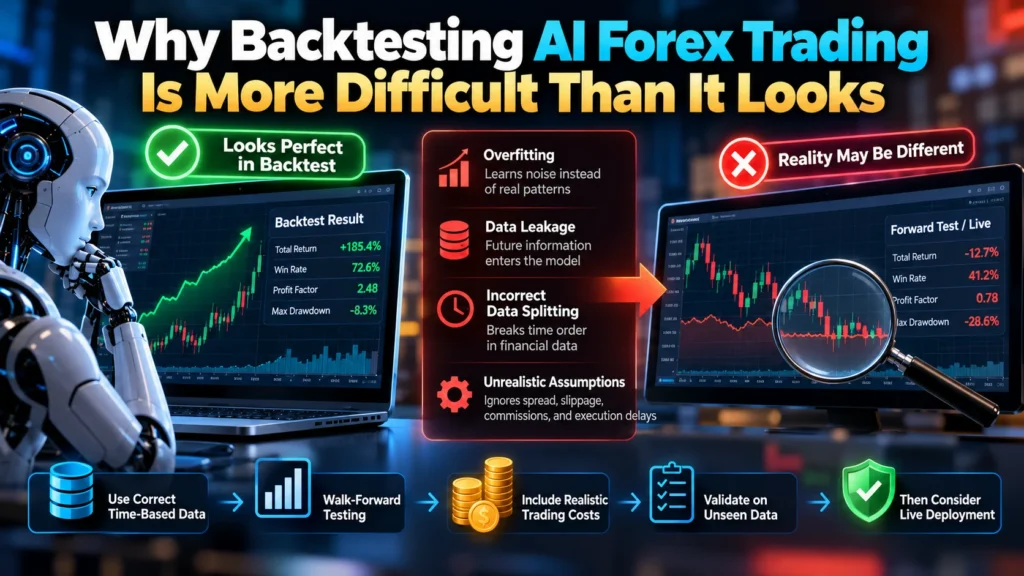
Why Backtesting AI Forex Trading Systems Is More Difficult Than It Looks
Historical testing is essential, but machine-learning strategies introduce several opportunities for misleading results. A model can appear highly effective in a backtest without possessing a durable advantage in unseen market conditions.
One major risk is overfitting. This happens when a model learns the peculiarities and noise of historical training data so closely that it cannot generalize effectively to new observations.
Another issue is data leakage. Information from the future can unintentionally enter the training process through preprocessing, normalization, feature construction, or improper dataset splitting.
Financial time series also require special attention because their chronological structure matters. Randomly mixing historical observations into training and test datasets can produce misleading results when the method allows information relationships that would not exist in a realistic forward-running environment.
A more disciplined research process separates training and evaluation periods chronologically and examines performance on data the model did not use for fitting. Developers may also use walk-forward evaluation to study how a strategy behaves when models are repeatedly trained using information available up to a particular point and then evaluated on subsequent periods.
Even then, a historical simulation needs realistic trading assumptions. Spread, slippage, commissions where applicable, execution delays, and order behavior can materially affect results. The shorter the strategy’s expected profit per trade, the more important these implementation details can become.
For this reason, the next stage after model development is not simply choosing the strategy with the most attractive historical equity curve. The more important task is determining whether the apparent advantage survives realistic testing, unseen data, changing market conditions, and eventually a live execution environment.
That leads directly to two of the most practical questions in AI Forex Trading: how should an AI strategy be tested without fooling yourself, and what infrastructure should you use to run it continuously and connect it safely to platforms such as MetaTrader or broker APIs?
How to Test an AI Forex Trading System Properly
Building a model is only the beginning. Before an AI Forex Trading system is allowed to interact with real capital, developers need evidence that its behavior is not simply the result of overfitting, data leakage, unrealistic execution assumptions, or favorable market conditions during a particular historical period.
A useful testing process therefore moves through several stages. Historical backtesting is important, but it should normally be followed by out-of-sample evaluation, realistic transaction-cost modeling, forward testing, and controlled deployment. Each stage answers a different question about the system.
Separate Training, Validation, and Test Data
Machine-learning models need data for training, but evaluating the model on the same observations used to train it tells you very little about its ability to handle future markets.
A better approach is to divide historical data chronologically. The oldest observations can be used for training, a later period can support model selection and parameter tuning, and a final unseen period can be reserved for testing.
For example, imagine that a developer has several years of historical data. Rather than randomly distributing candles across different datasets, the developer could use an earlier period for training, a subsequent period for validation, and the newest untouched period for final evaluation.
The exact dates are less important than maintaining chronological integrity. The model should not gain knowledge of future market behavior while learning how to make decisions about the past.
Use Walk-Forward Testing
Forex markets evolve. Relationships that existed several years ago may weaken, disappear, or behave differently under new monetary and economic conditions. A single static train-test split may therefore provide an incomplete picture.
Walk-forward testing attempts to simulate the way a model would have been developed and used over time.
A simplified process might look like this:
- Train the model using historical information available up to a specific date.
- Evaluate it on the following unseen period.
- Move the training window forward.
- Retrain or update the model according to the predefined methodology.
- Evaluate the next unseen period.
- Repeat the process across multiple market environments.
This does not guarantee future profitability, but it provides a more realistic view of how the research process behaves as new information becomes available.
Include Spread, Slippage, and Trading Costs
A strategy can look profitable when tested against idealized market prices and fail once realistic trading conditions are introduced.
The bid-ask spread is particularly important in forex. A backtest that assumes every trade can be opened and closed at an ideal reference price may significantly overestimate performance, especially for short-term strategies targeting relatively small price movements.
Slippage also matters. The price requested by a trading algorithm is not necessarily the exact price at which the order will be filled. Market movement, available liquidity, order type, execution conditions, and latency can affect the actual fill.
Testing assumptions should therefore reflect the intended trading environment as closely as practical. If the strategy depends on tiny price movements, even modest differences between simulated and real execution can change its economics substantially.
Evaluate More Than the Win Rate
A high percentage of winning trades can look attractive, but win rate alone says very little about the quality of a strategy.
A system could win frequently while generating small profits and occasionally experiencing losses large enough to erase many previous gains. Another strategy might win less frequently but maintain a favorable relationship between average gains and losses.
Depending on the strategy, useful evaluation metrics can include:
- Total and annualized returns, interpreted within the tested period
- Maximum drawdown
- Average profit and loss per trade
- Profit factor
- Risk-adjusted performance measures
- Trade frequency
- Exposure over time
- Performance after estimated transaction costs
- Results across individual currency pairs
- Results across different market regimes
No single metric proves that a strategy is robust. The goal is to understand how returns were generated and what risks were required to generate them.
From Backtesting to Forward Testing
After a strategy survives historical evaluation, it should still not be assumed that live performance will match the backtest. A useful intermediate stage is forward testing, often through a demo account or another controlled environment where the system processes current market data in real time.
Forward testing exposes problems that historical simulations may not reveal. Data feeds can disconnect. API requests can fail. Orders can be rejected. Spreads can expand. A server can restart. Trading software can freeze or update. An AI inference service can become unavailable.
These are engineering problems rather than prediction problems, but they are part of real automated trading.
What to Monitor During Forward Testing
Instead of looking only at profit and loss, developers should monitor the entire operational pipeline.
- Are market prices arriving at the expected frequency?
- Are timestamps correct?
- Are features being calculated correctly in real time?
- Does the live model receive data in the same format used during development?
- Are signals generated when expected?
- Are duplicate signals prevented?
- Are orders acknowledged correctly?
- Do actual execution prices differ significantly from expected prices?
- Does the system correctly recognize existing positions?
- Can it recover after a network or application restart?
- Are errors written to persistent logs?
A system that cannot reliably answer these operational questions is not ready for unattended live trading, regardless of how impressive its historical model metrics appear.
Risk Management in AI Forex Trading
Risk management should normally be separated from the predictive model. An AI model may estimate that a particular trade has favorable characteristics, but it should not automatically receive unlimited authority over account exposure.
Hard limits can be implemented outside the model so they remain active even when predictions become unreliable.
Position Size Controls
Every potential trade needs an appropriate position size. The size can be determined according to account equity, intended risk, stop distance, volatility, currency-pair characteristics, and other predefined rules.
The important principle is that model confidence should not be interpreted as certainty. If a model reports a high probability for a particular outcome, the possibility of being wrong still exists.
Allowing a machine-learning confidence score to produce unrestricted position sizes can create dangerous behavior, particularly when the model encounters market conditions that differ from its training data.
Maximum Account Exposure
Multiple forex positions may represent the same underlying currency risk.
For example, a system could independently identify opportunities across EUR/USD, GBP/USD, and another USD-related pair. Treating each position as completely independent may hide the fact that the portfolio has accumulated substantial exposure to movements in the US dollar.
Portfolio-level risk controls should therefore consider aggregate exposure rather than checking each trade in isolation.
Daily Loss Limits
An automated strategy can continue trading much faster than a human can investigate why something has gone wrong. A daily or session-level loss threshold can act as an additional circuit breaker.
If losses exceed a predefined boundary, the system can prevent new entries and require a review before trading resumes.
The objective is not to predict exactly when a strategy will stop working. It is to limit damage when live behavior deviates significantly from expectations.
Emergency Kill Switch
A production automated trading system should have a reliable method for stopping trading activity.
Depending on the architecture, an emergency control may disable new orders, cancel pending orders, or trigger another predefined safety procedure. The correct behavior depends on the strategy because automatically closing every open position during an infrastructure incident is not always the safest response.
The important point is that developers should define failure behavior before a failure occurs.
Common AI Forex Trading Architecture
It helps to think of an AI trading system as several independent services rather than one large script.
A simplified architecture could contain the following components:
- Data feed: obtains live and historical market information.
- Data processor: validates, cleans, synchronizes, and transforms the incoming information.
- Feature engine: calculates the inputs required by the model.
- AI model: produces predictions, classifications, scores, or probabilities.
- Strategy engine: decides whether the model output represents an actionable setup.
- Risk engine: checks position size, exposure, drawdown, and other limits.
- Execution engine: communicates with the trading platform or broker.
- Position monitor: tracks orders and open positions.
- Logging and monitoring layer: records decisions, failures, execution results, and system health.
This modular structure provides an important engineering advantage. The AI model does not need direct unrestricted control over the trading account.
The model might simply produce an output such as a probability or classification. The strategy engine interprets that result, the risk engine determines whether the proposed action is permitted, and only then does the execution layer communicate with the trading platform.
How AI Can Connect to MetaTrader
MetaTrader is widely used for retail forex trading, so developers frequently want to connect external AI applications to a MetaTrader environment. The architecture depends on the platform version, broker environment, programming language, and deployment requirements.
One approach is to keep most trading logic inside an Expert Advisor, commonly called an EA. MetaTrader handles market information and execution while the EA applies predefined trading rules.
For more advanced AI systems, developers may prefer to run machine-learning components externally. Python is particularly common in data science because of its extensive ecosystem for data processing and machine learning.
External AI Engine with MetaTrader Execution
Consider an architecture where a Python application performs AI inference while MetaTrader remains responsible for trading execution.
The workflow could conceptually operate like this:
- MetaTrader or another market-data source provides current market information.
- The information is passed to the external AI service.
- The service calculates features and performs model inference.
- The strategy layer evaluates the prediction.
- Risk-management rules approve or reject the proposed action.
- An approved instruction is passed to the execution environment.
- The trading platform sends the order according to the configured logic.
- The resulting status is returned and stored in logs.
This design allows developers to use Python-based libraries without trying to implement the entire machine-learning stack directly inside the trading platform.
However, every additional communication layer introduces potential failure points. The application needs to handle timeouts, malformed messages, duplicate instructions, stale prices, authentication, network interruptions, and cases where the execution status is uncertain.
Never Assume an Order Failed Just Because a Request Timed Out
This is an important issue in automated execution systems.
Imagine that the AI server sends an instruction to open a position. MetaTrader receives it and successfully places the order, but the response is lost because of a temporary connection problem.
If the AI server simply assumes that the trade failed and immediately repeats the request, it could unintentionally open another position.
Reliable execution architectures therefore need mechanisms for identifying requests and reconciling actual account state. Before retrying a sensitive operation, the system should be able to determine whether the original request may already have been processed.
Using Broker APIs for AI Forex Trading
MetaTrader is not the only possible execution environment. Some brokers and trading providers offer APIs that allow applications to request market information, inspect accounts, submit orders, and manage positions programmatically.
An API-based architecture can be attractive because the AI system communicates directly with an officially supported programmatic interface rather than depending on graphical interaction with a desktop trading application.
The availability and functionality of APIs vary considerably between providers, however. Authentication methods, rate limits, supported order types, account restrictions, streaming capabilities, and execution behavior should be checked directly against the current documentation of the intended provider.
API credentials should also be treated as sensitive secrets. They should not be hard-coded into publicly accessible source code, committed to public repositories, or exposed through a web frontend.
Where Should You Run an AI Forex Trading System?
Once an AI model and execution architecture have been designed, infrastructure becomes an important consideration. A system that is expected to analyze markets or manage trades continuously needs a suitable environment in which to operate.
The main choices generally include:
- A personal desktop or laptop
- A dedicated local computer or server
- A Virtual Private Server (VPS)
- A cloud virtual machine
- A larger cloud architecture using multiple managed services
There is no universally best option. The appropriate environment depends on whether the system needs to run continuously, whether MetaTrader is involved, how much computational power the model requires, how latency-sensitive the strategy is, and how much infrastructure the developer wants to manage.
Running AI Forex Trading on a Personal Computer
A personal computer is often the easiest environment for development and initial experimentation. Python, development tools, historical datasets, MetaTrader, and monitoring applications can all run locally.
This is perfectly reasonable for research and may also be sufficient for strategies that do not need continuous unattended operation.
The disadvantages become more important when the computer is expected to function as a production trading server. Power interruptions, operating-system updates, accidental restarts, unstable internet connectivity, and normal personal use can interrupt the trading process.
A laptop also should not be considered highly available infrastructure simply because it can remain powered on for long periods.
Running the System on a VPS
A VPS is one of the most practical environments for relatively lightweight automated forex systems. It provides a virtual machine in a data center that can remain online independently of a trader’s home computer.
A VPS can host components such as:
- MetaTrader terminals
- Expert Advisors
- Python applications
- Lightweight machine-learning models
- Databases
- Logging services
- Monitoring applications
A Windows VPS can be convenient when the architecture depends heavily on MetaTrader desktop software. A Linux VPS may be attractive when the trading stack primarily consists of Python services, APIs, containers, databases, and web applications.
Some architectures use both: a Windows environment for MetaTrader execution and a separate Linux service for AI inference, data processing, or dashboards.
Latency and Server Location
Latency describes the delay involved in transmitting information between systems. For many medium- or longer-term strategies, a relatively small difference in network latency may not materially determine the strategy’s outcome. For very short-term systems, however, execution delay can become much more important.
If latency is operationally significant, developers may consider infrastructure with reliable connectivity to the relevant trading environment. But simply choosing a geographically nearby server does not guarantee superior execution. Network routing, broker infrastructure, market conditions, and the strategy’s own processing time also matter.
Claims about extremely low execution times should therefore be measured in the actual intended environment rather than assumed from a hosting provider’s location alone.
Cloud Servers for More Advanced AI Trading
A cloud virtual machine can provide similar functionality to a traditional VPS while offering a broader ecosystem for scaling, storage, monitoring, networking, and specialized computation.
Cloud infrastructure becomes particularly useful when the AI component requires resources that would be inconvenient to maintain on a small VPS.
For example, a larger research environment might need significant CPU capacity, substantial memory, or GPU resources while training a model. That does not necessarily mean the live trading system needs the same hardware.
This distinction can significantly reduce infrastructure complexity and cost.
Training and Inference Do Not Need the Same Server
Model training and model inference are different workloads.
Training can be computationally expensive. Depending on the model, it may require processing a large historical dataset through many iterations.
Inference is the process of giving an already trained model new data and receiving its output. For many models, inference requires far fewer computational resources than training.
An efficient architecture might therefore train models on a powerful workstation or temporary cloud instance and deploy the final validated model to a smaller production server.
For example, a deep-learning model could be trained using GPU resources and later exported for inference on a server that requires only CPU processing. Whether this is possible depends on the size and architecture of the model, but it prevents an unnecessary assumption that every AI trading server needs an expensive GPU.
Should You Use a GPU for AI Forex Trading?
Not necessarily. The need for a GPU depends much more on the machine-learning workload than on forex trading itself.
Many models used with structured financial features can run efficiently on ordinary CPUs. Logistic regression, tree-based models, and relatively small neural networks may require little computational power for real-time inference.
GPU acceleration becomes more relevant when training large neural networks, processing very large datasets, running complex deep-learning architectures, or performing computationally intensive research.
Buying or renting GPU infrastructure simply because a project contains the term “AI” can therefore waste resources.
The appropriate approach is to benchmark the actual workload. Measure how long feature generation and model inference take on CPU hardware and compare that result with the strategy’s timing requirements. Upgrade the infrastructure only when there is a measurable bottleneck.
A Practical Deployment Architecture
For many independent developers, a relatively simple architecture can provide a better starting point than an unnecessarily complex collection of cloud services.
A practical deployment might use one environment for execution and another for analysis when necessary.
For example:
- A Windows VPS runs MetaTrader and the execution component.
- A Python service calculates features and performs AI inference.
- A local database records predictions, signals, orders, and system events.
- A risk engine sits between model output and order execution.
- A monitoring process checks connectivity and application health.
- Critical failures generate notifications.
For a smaller model, all of these components could potentially run on the same appropriately secured server. As the system grows, services can be separated where doing so improves reliability, security, or scalability.
The key principle is to avoid complexity without a clear benefit. A system containing dozens of services is not automatically more professional than a well-designed application running on one or two reliable servers.
Security Considerations for Automated Forex Systems
An AI trading server can have access to sensitive account information and potentially the ability to place financial orders. Security should therefore be treated as part of the architecture rather than something added after development.
Basic controls should include strong authentication, restricted network access, secure secret storage, regular software updates, encrypted connections where supported, and careful management of API credentials.
Administrative services should not be exposed publicly without a legitimate need. Firewall rules can restrict unnecessary ports, while remote administrative access should use appropriately secured methods.
Logs also need attention. Developers sometimes protect API credentials correctly but accidentally write tokens, passwords, account details, or other sensitive information into debug logs.
Separate Trading Permissions Where Possible
If a broker or service provides granular API permissions, an application should receive only the capabilities it actually needs.
A market-analysis service that only reads prices does not need trading privileges. Likewise, a public dashboard should not need direct access to execution credentials.
This follows the principle of least privilege: each component receives only the permissions required for its role.
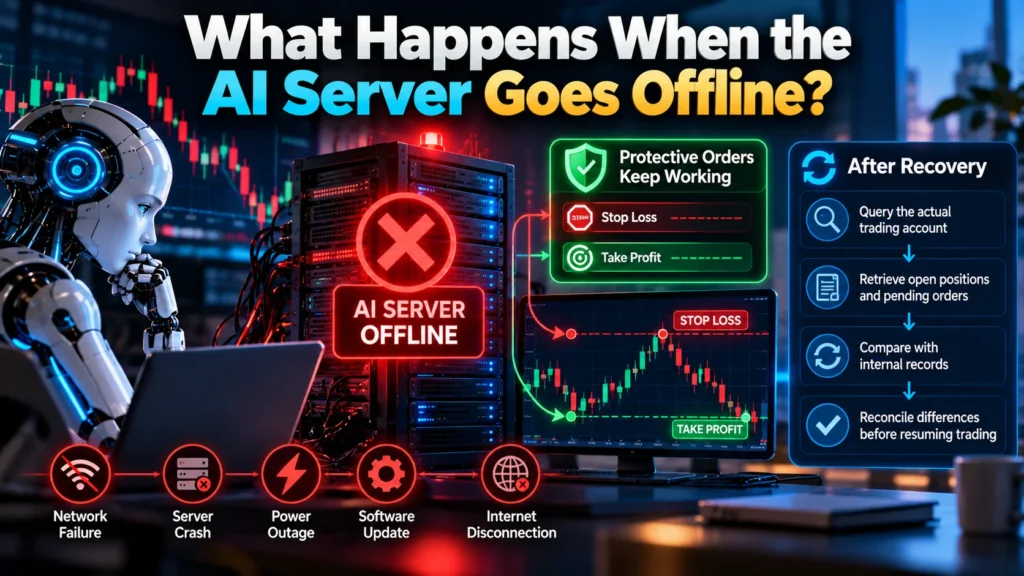
What Happens When the AI Server Goes Offline?
Failure planning is one of the differences between a prototype and a production system.
Imagine that an AI model opens a position and the server then becomes unreachable. What manages that position?
The answer should be designed before deployment.
Where supported by the trading environment and compatible with the strategy, protective orders such as stop-loss and take-profit instructions may be placed in a way that does not depend entirely on the AI application remaining connected. The exact behavior of orders should always be verified for the specific broker and platform.
The system should also define what happens after recovery. It must not blindly assume that its locally stored state still represents the trading account.
A safer recovery process can query the actual account, retrieve open positions and pending orders, compare them with internal records, and reconcile differences before new trading decisions are permitted.
This becomes especially important when an automated system is expected to operate for weeks or months. Eventually, networks fail, processes crash, operating systems restart, or external services become temporarily unavailable.
AI Model Drift and Changing Forex Markets
Even a correctly developed model can lose effectiveness over time. Financial markets are not static environments.
Interest-rate regimes change. Volatility changes. Monetary policies change. Relationships between currencies and other assets can strengthen or weaken. Market participants adapt.
As a result, the statistical relationships learned during model training may become less representative of current conditions. This problem is commonly associated with model or data drift.
A production AI Forex Trading system should therefore monitor more than account profit. Developers can also examine whether incoming features have changed materially from the distributions observed during development and whether prediction behavior has shifted.
Retraining can be part of the solution, but automatic retraining should not be treated as a guaranteed fix. A newly trained model can be worse than the existing one. Updated models should pass predefined evaluation and deployment criteria before replacing a production model.
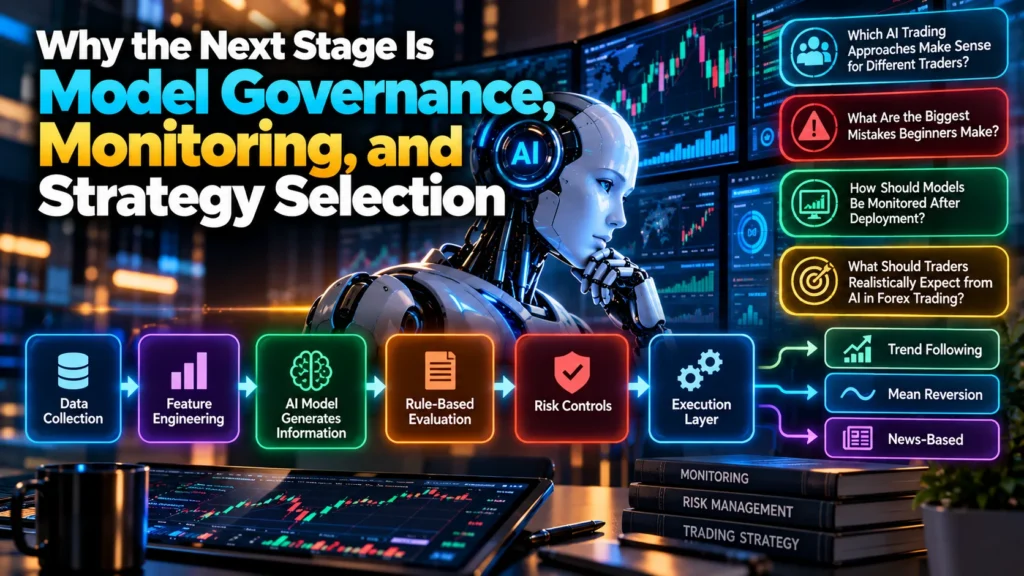
Why the Next Stage Is Model Governance, Monitoring, and Strategy Selection
At this point, the core architecture is becoming clear. Data enters the system, features are created, AI generates information, deterministic rules evaluate the signal, risk controls determine whether trading is permitted, and an execution layer communicates with the trading environment.
But several practical questions remain. Which AI trading approaches make sense for different types of traders? What are the biggest mistakes beginners make when building these systems? How should models be monitored after deployment? And perhaps most importantly, what should traders realistically expect AI to achieve in the forex market?
The final section will address these questions, compare practical deployment approaches, cover common AI Forex Trading mistakes, explain realistic expectations, and conclude with frequently asked questions based on common search intent around AI-powered forex trading.
Choosing the Right AI Forex Trading Approach
There is no single AI model or trading architecture that is suitable for every trader. The right approach depends on the strategy’s timeframe, available data, technical skills, computing resources, risk tolerance, and the specific problem the system is intended to solve.
One of the most common mistakes is beginning with a technology rather than a trading problem. A developer may decide to build a neural network, reinforcement-learning agent, or large language model before clearly defining what the system should accomplish. A better process starts with a specific question and then selects technology capable of addressing it.
For example, if the objective is to determine whether current volatility is unusually high, a relatively simple statistical or machine-learning model may be sufficient. If the objective involves extracting information from central-bank statements, natural language processing becomes more relevant. If the system must recognize complex relationships across long sequences of market observations, more advanced time-series models may be worth investigating.
Rule-Based Trading with an AI Filter
For many developers, one of the most practical starting points is combining a traditional algorithmic strategy with an AI filter.
The original strategy continues to identify trading setups according to transparent rules. The machine-learning model then evaluates those setups and produces an additional score or classification.
Consider a hypothetical trend-following strategy. Its normal conditions might require price to be above a long-term moving average while short-term momentum satisfies another predefined condition. Instead of immediately opening a position whenever those rules are satisfied, the strategy could send the current market features to a trained model.
The model might estimate whether the setup resembles historical conditions associated with stronger or weaker outcomes. Only signals meeting the required model threshold proceed to the risk engine.
This architecture has several advantages. The underlying trading hypothesis remains understandable, AI has a narrowly defined responsibility, and developers can compare performance with and without the machine-learning filter.
AI as the Primary Signal Generator
A more ambitious approach allows the model itself to generate trading signals.
The model might receive recent price behavior, volatility measurements, technical features, time information, cross-market variables, and other inputs before producing probabilities for different outcomes.
For example, the output could conceptually represent probabilities for bullish, bearish, and neutral conditions over a predefined horizon.
The strategy engine could then apply minimum confidence thresholds and additional rules before considering a position.
Even in this architecture, the predictive model should not necessarily control position sizing or account-level risk. Separating prediction from risk management makes it possible to impose hard limits that remain active regardless of the model’s confidence.
AI for Market Regime Detection
Another useful application is regime classification.
Rather than predicting whether the next price movement will be up or down, the model attempts to determine what type of market environment currently exists.
Possible classifications might include:
- Strong directional trend
- Weak directional trend
- Range-bound market
- High-volatility environment
- Low-volatility environment
- Abnormal or uncertain conditions
Different strategies can then be enabled or disabled according to the detected regime.
For example, a trend-following strategy could remain inactive during conditions classified as strongly range-bound. A mean-reversion system might do the opposite.
This illustrates why successful AI Forex Trading does not necessarily depend on predicting exact future prices. Improving strategy selection or avoiding unfavorable conditions can also be a legitimate modeling objective.
Using Generative AI and Large Language Models in Forex
Generative AI has introduced another category of tools into trading research. Large language models can process natural language, summarize documents, extract structured information, generate code, explain market concepts, and assist with research workflows.
They can therefore be useful around a trading system without necessarily being the component responsible for deciding whether money should be placed at risk.
Possible applications include:
- Summarizing central-bank statements
- Extracting important information from economic reports
- Classifying financial news
- Generating research code for human review
- Explaining unusual system logs
- Producing daily trading-system reports
- Organizing large amounts of textual market information
- Helping developers document trading strategies
However, language models can generate incorrect or unsupported information. This characteristic makes unconstrained language-model output unsuitable as the sole authority for critical live trading actions.
A safer architecture is to use generative AI for information processing while deterministic software verifies critical values and enforces trading and risk rules.
Why AI Does Not Guarantee Profitable Forex Trading
One of the most important facts about AI Forex Trading is that artificial intelligence does not remove market uncertainty.
AI can analyze historical patterns, but historical relationships do not guarantee future results. Currency markets respond to changing economic expectations, interest rates, central-bank decisions, geopolitical events, liquidity conditions, and the behavior of millions of market participants.
The U.S. Commodity Futures Trading Commission has specifically warned consumers about claims that AI trading bots can produce unusually high or guaranteed returns, emphasizing that AI cannot predict the future or sudden market changes. :chatgpt-content-reference{index=”0″}
This distinction is important for evaluating commercial AI trading products. Terms such as “artificial intelligence,” “neural network,” “deep learning,” or “quantum AI” do not provide evidence that a strategy has a sustainable trading advantage.
A legitimate evaluation should focus on methodology, risk, execution assumptions, costs, transparency, and evidence rather than marketing terminology.
Be Skeptical of Guaranteed Returns
Claims such as guaranteed monthly returns, near-perfect accuracy, risk-free automated income, or extremely high win rates should be treated with considerable skepticism.
The CFTC has warned that fraudsters have used public enthusiasm around AI to promote trading bots and signal systems with unrealistic return claims. Its consumer guidance recommends researching the company or trader and considering the effect of fees, spreads, and other costs rather than relying on promotional claims. :chatgpt-content-reference{index=”1″}
Forex itself also carries substantial risk. Investor.gov notes that leverage can magnify losses and that transaction costs can turn otherwise profitable trades into losing transactions. It also warns that automated trading systems can behave unexpectedly because of incorrect data, misunderstood parameters, or other operational problems. :chatgpt-content-reference{index=”2″}
AI changes the tools available to traders. It does not change these fundamental characteristics of the market.
Common AI Forex Trading Mistakes
Many unsuccessful AI trading projects fail because of research or engineering problems rather than because the chosen machine-learning algorithm was too simple.
Overfitting Historical Data
Overfitting occurs when a strategy becomes excessively adapted to historical observations. The resulting model may look impressive on familiar data while performing poorly when exposed to new market conditions.
Repeatedly modifying a strategy until the historical equity curve looks attractive can create another form of the same problem. Even if the final test period was not technically used for model training, repeatedly inspecting it and adjusting the strategy based on its results effectively leaks information into the development process.
Optimizing Too Many Parameters
Every additional parameter creates more opportunities to find combinations that happened to perform well historically.
Suppose a strategy simultaneously optimizes indicator periods, entry thresholds, exit thresholds, stop distances, trading hours, model parameters, confidence thresholds, and dozens of features. Searching enough combinations can eventually uncover an attractive historical configuration simply by chance.
Reducing unnecessary complexity makes a strategy easier to understand, validate, and maintain.
Ignoring Trading Costs
Gross theoretical returns are not the same as realizable trading results.
Spreads, commissions where applicable, slippage, financing costs, infrastructure expenses, and other trading costs can affect net performance. This becomes especially important for strategies that execute frequently or target small price movements.
A strategy should therefore be evaluated using assumptions that reasonably approximate its intended execution environment.
Using Poor-Quality Data
An advanced model trained on unreliable data remains unreliable.
Problems can include missing candles, incorrect timestamps, duplicated observations, inconsistent spreads, survivorship issues in broader datasets, and differences between historical data and the live feed used in production.
Data validation should therefore be part of the trading pipeline rather than an occasional manual task.
Allowing AI to Bypass Risk Controls
A predictive model should not be able to ignore account-level safety rules simply because it reports unusually high confidence.
Maximum position size, aggregate exposure, loss limits, allowed instruments, trading hours, and emergency restrictions can be implemented independently from the model.
If the model produces an invalid output or behaves unexpectedly, the risk engine should be capable of rejecting the proposed action.
Deploying Directly to a Large Live Account
Historical testing cannot reproduce every aspect of live trading.
A safer deployment path moves progressively from research to realistic simulation, then to forward testing, and only afterward to carefully controlled live operation if the strategy remains suitable.
Even after deployment, increasing exposure should be treated as a separate risk decision rather than an automatic reward for short-term profitability.
Monitoring an AI Forex Trading System After Deployment
Production deployment should not be the end of model evaluation. It begins a new phase in which both trading performance and system health need ongoing monitoring.
Monitor the Infrastructure
Operational monitoring can include:
- Server availability
- CPU and memory usage
- Disk space
- Application status
- Market-data connectivity
- Broker or platform connectivity
- API response failures
- Database health
- Model inference errors
- Unexpected process restarts
A trading model cannot operate correctly if the infrastructure supplying its data or executing its decisions is unreliable.
Monitor Trading Behavior
The trading layer also needs dedicated monitoring.
Useful checks may include abnormal trade frequency, unexpected position sizes, repeated order rejections, differences between expected and actual execution prices, unusual changes in spreads, and divergence between the application’s internal state and the actual trading account.
Alerts should focus on conditions requiring attention rather than generating excessive notifications for routine events.
Monitor Model Behavior
Model monitoring goes beyond measuring profit and loss.
Developers can examine whether input distributions have changed, whether prediction frequencies have shifted, whether confidence scores have become unusually concentrated, and whether performance has deteriorated in particular regimes.
If a model historically generated a relatively balanced distribution of classifications and suddenly begins predicting the same state almost continuously, that change deserves investigation even before significant trading losses occur.
AI Forex Trading for Beginners vs Experienced Developers
Beginners do not need to start with the most sophisticated architecture available.
A useful learning path is to begin with market data and a simple rule-based strategy. Build a correct backtest, include realistic trading costs, understand position sizing, and learn how orders and trading platforms behave.
Machine learning can then be introduced to solve a clearly defined problem.
A gradual development sequence could be:
- Learn basic forex market mechanics and risk.
- Collect and validate historical data.
- Create a simple rule-based baseline strategy.
- Build a realistic backtesting framework.
- Add a small set of meaningful features.
- Train a simple machine-learning model.
- Compare the AI-enhanced strategy with the baseline.
- Perform out-of-sample and walk-forward evaluation.
- Forward-test the system without relying on historical assumptions.
- Add production monitoring and hard risk controls before considering live deployment.
This process may appear slower than downloading an AI trading bot and immediately connecting it to an account. In reality, it provides something far more valuable: an understanding of how the system reaches decisions and where it can fail.
Which Programming Languages Are Best for AI Forex Trading?
Python is one of the most practical languages for AI trading research because of its mature ecosystem for numerical computing, data processing, machine learning, visualization, and API development.
It is particularly useful for model training, feature engineering, historical analysis, and AI inference.
However, a complete trading system does not need to use only one language.
MetaTrader environments commonly use MQL for Expert Advisors and platform-specific trading logic. An architecture can therefore combine MQL for platform interaction with Python for AI processing.
Other languages can also be appropriate depending on performance requirements, existing infrastructure, broker APIs, and the development team’s expertise.
The best language is ultimately the one that satisfies the system’s technical requirements while remaining maintainable and testable.
VPS vs Local PC vs Cloud for AI Forex Trading
The deployment options discussed earlier can now be compared more directly.
- Local PC: suitable for development, research, backtesting, and experiments where continuous availability is not required.
- Windows VPS: often convenient for continuously running MetaTrader-based systems and relatively lightweight AI services.
- Linux VPS: well suited to Python services, databases, APIs, containers, monitoring systems, and broker-API architectures.
- Cloud virtual machines: useful when flexible resource allocation, infrastructure services, or scalable computing is required.
- GPU infrastructure: primarily relevant to computationally intensive machine-learning workloads rather than being a universal requirement for AI trading.
For many individual projects, a VPS with sufficient resources can be enough for live inference. More powerful machines can be used separately for model training when required.
Infrastructure should follow the actual workload rather than marketing assumptions about what an “AI server” is supposed to look like.
Can AI Forex Trading Replace Human Traders?
AI can automate tasks that humans perform slowly or inconsistently. Software can monitor multiple instruments continuously, calculate hundreds of variables rapidly, follow predefined rules without fatigue, and process large datasets more efficiently than manual analysis.
That does not mean human oversight becomes irrelevant.
Humans still define objectives, choose datasets, decide what the model should predict, evaluate whether results are credible, configure risk limits, maintain infrastructure, investigate failures, and determine whether the system should remain active.
The CFTC’s work on responsible AI in financial markets has also highlighted risks associated with erroneous outputs, data governance, autonomous decision-making, cybersecurity, and operational resilience. :chatgpt-content-reference{index=”3″}
A practical way to think about AI is therefore as another layer of quantitative automation. It can enhance specific aspects of research and execution, but responsibility for designing and supervising the system remains with the people operating it.
Building a More Reliable AI Forex Trading Workflow
A reliable workflow connects everything discussed throughout this guide into one disciplined process.
- Define a narrow trading or analytical problem.
- Acquire reliable historical data.
- Clean and synchronize the dataset.
- Create economically meaningful features.
- Establish a simple baseline.
- Train candidate models without exposing them to future information.
- Validate performance on unseen data.
- Include realistic spreads, slippage, and relevant costs.
- Use walk-forward testing where appropriate.
- Forward-test the complete execution pipeline.
- Separate predictions from risk management.
- Deploy the system on reliable infrastructure.
- Log model decisions and execution events.
- Monitor infrastructure, account behavior, and model behavior.
- Review changes before replacing production models.
The purpose of this process is not to make losses impossible. No engineering process can remove market risk. Instead, it reduces avoidable errors and makes the system easier to understand, audit, and improve.
Is AI Forex Trading Worth It?
AI Forex Trading can be valuable when artificial intelligence solves a genuine problem. Machine learning can help classify market conditions, analyze large datasets, estimate volatility, process textual information, filter trading opportunities, and automate parts of a quantitative workflow.
Its usefulness declines when AI becomes a marketing label rather than a measurable component of a trading methodology.
Traders should therefore avoid asking only, “Which AI can make the most money?” A more productive set of questions is: What information does the model receive? What exactly does it predict? How was it tested? What happens when it is wrong? How are transaction costs modeled? What limits its authority? And what happens when the infrastructure fails?
Those questions reveal much more about the quality of an AI trading system than the complexity of its neural network.
It is also important to maintain realistic expectations. The CFTC warns that automated or AI-enabled trading programs cannot consistently predict future market conditions, while its forex guidance notes that retail forex trading is highly risky. :chatgpt-content-reference{index=”4″}
AI should therefore be viewed as a technology for analysis and automation, not as a mechanism for eliminating uncertainty.
Frequently Asked Questions
What is AI Forex Trading?
AI Forex Trading is the use of artificial intelligence or machine-learning techniques to analyze forex market information and support trading decisions. Depending on the system, AI may classify market conditions, estimate volatility, generate signals, filter trades, analyze textual information, or participate in automated execution.
Can AI predict forex prices accurately?
AI can identify statistical patterns and produce forecasts or probabilities, but it cannot reliably know future currency prices. Unexpected economic announcements, central-bank decisions, geopolitical developments, liquidity changes, and shifts in market behavior can invalidate historical relationships. Regulators such as the CFTC have specifically warned against claims that AI trading systems can predict the future or guarantee returns. :chatgpt-content-reference{index=”5″}
Can AI Forex Trading be fully automated?
Yes, software can technically automate data collection, model inference, signal generation, risk checks, order submission, and position monitoring. However, increasing automation also increases the importance of testing, monitoring, error handling, security, and independent risk controls.
Where can I run an AI forex trading bot?
An AI trading system can run on a local computer, dedicated server, VPS, or cloud virtual machine. A VPS is often practical for systems requiring continuous availability. Windows environments can be convenient for MetaTrader-based architectures, while Linux environments are commonly used for Python services, APIs, databases, and containerized applications.
Do I need a GPU for AI Forex Trading?
Not necessarily. Many machine-learning models can perform live inference efficiently on CPUs. GPUs become more useful for computationally intensive model training and larger deep-learning architectures. Training and live inference can also run on different machines.
Can Python be used for AI Forex Trading?
Yes. Python is widely used for financial data processing, machine learning, backtesting, model training, APIs, and automated analysis. Depending on the execution platform, Python may communicate with another component responsible for sending actual trading orders.
Can AI connect to MetaTrader?
AI-based applications can be integrated into MetaTrader-oriented architectures in several ways. For example, an external Python service can perform model inference while an Expert Advisor or another execution component handles platform-specific trading operations. The exact implementation depends on the MetaTrader version, broker environment, and system design.
Is AI Forex Trading profitable?
AI does not guarantee profitability. A model may discover useful historical patterns, but profitability also depends on whether those patterns persist, how the strategy manages risk, transaction costs, execution quality, market conditions, and operational reliability. Historical profitability should never be interpreted as guaranteed future performance.
What is the biggest risk of using AI for forex trading?
There is no single risk. Important risks include overfitting, leverage, unexpected market changes, data errors, model drift, unrealistic backtests, execution failures, excessive exposure, infrastructure outages, and relying on AI outputs without adequate safeguards.
Is AI better than traditional algorithmic trading?
Not automatically. Traditional rule-based algorithms can be transparent, fast, and relatively easy to test. Machine learning can potentially identify more complex relationships but introduces additional data and validation challenges. Hybrid architectures that combine deterministic rules with machine-learning components can provide a practical compromise.
Should beginners use an AI trading bot?
Beginners should first understand forex mechanics, leverage, order execution, risk management, and basic strategy testing. Using an automated system without understanding how it makes decisions can hide rather than reduce risk. A demo or controlled testing environment is more appropriate for learning than immediately committing significant capital.
How much computing power does an AI trading system need?
Requirements vary considerably. A small model analyzing hourly market data may need very little processing power, while training a large neural network on extensive high-frequency data can require substantially more CPU, memory, storage, or GPU resources. Infrastructure should be selected after measuring the actual workload.
What is the best AI model for forex trading?
There is no universally best model. The appropriate choice depends on the objective, dataset, features, timeframe, amount of training data, interpretability requirements, and deployment constraints. A simpler model that generalizes well can be more useful than a complex deep-learning architecture that performs better only on historical training data.
How often should an AI forex model be retrained?
There is no universal retraining schedule. It should be determined by the strategy, data frequency, observed model behavior, market changes, and validation methodology. Retraining more frequently does not necessarily improve performance. Every replacement model should be evaluated before production deployment.
Can ChatGPT or another generative AI trade forex automatically?
A language model can assist with research, coding, document analysis, news processing, and other components of a trading workflow. Using unconstrained generated responses as direct live trading instructions is much riskier because generative models can produce incorrect or inconsistent information. Critical execution and risk rules are better handled through deterministic, validated software.
Final Thoughts on AI Forex Trading
AI Forex Trading is most useful when artificial intelligence is treated as an engineering and analytical tool rather than a shortcut to guaranteed profits. Machine learning can process large datasets, identify statistical relationships, classify market environments, estimate risk variables, and automate tasks that would be difficult to perform manually at scale.
But the AI model is only one piece of the system.
Reliable market data, careful feature engineering, realistic backtesting, out-of-sample validation, transaction-cost modeling, risk management, execution logic, server reliability, security, logging, and ongoing monitoring are equally important. A sophisticated model running inside a poorly designed trading system can still fail quickly.
The strongest architecture therefore separates responsibilities. AI generates information. Strategy logic determines whether that information is actionable. Independent risk controls limit exposure. The execution layer communicates with the broker or trading platform. Monitoring systems verify that every component continues to behave as expected.
Where the system runs should follow the same practical philosophy. A local computer may be sufficient for research. A VPS can provide an efficient environment for continuous MetaTrader or Python-based operation. Cloud infrastructure can support larger workloads, while GPU resources can be reserved for models that genuinely benefit from them.
Ultimately, the goal is not to create an AI that claims to know what the forex market will do next. The more realistic objective is to build a measurable, testable, controlled system that processes information consistently and manages uncertainty better than an undisciplined trading process.
That distinction is what separates serious AI Forex Trading research from the promise of a “money-making AI bot.”


1 Comment
Neural Networks in Forex: How AI Predicts Currency Prices - QMMFX LIMITED
October 24, 2026[…] As artificial intelligence in Forex becomes more accessible, interest in machine learning, deep learning, automated trading systems, and predictive analytics continues to grow. Neural network models are particularly interesting because they can learn nonlinear relationships that traditional statistical models may struggle to represent. […]