Market Order in Modern Trading Explained
Introduction
A market order—or market order—is one of the most important concepts every trader must understand before entering the financial markets. Whether you trade forex, crypto, stocks, or commodities, the market order is the foundation of fast execution. It tells the platform or exchange to buy or sell at the best available price at that exact moment. Because speed is crucial in active trading, knowing how a market order works can determine the success or failure of a trade.
In today’s world of high-speed trading engines, volatile price movements, and algorithm-driven markets, the use of market orders has become even more strategic. Traders choose a market order when they want execution above all else. They accept the current price—whatever it is—because they believe the opportunity is strong enough to justify the cost of instant entry. Understanding the strengths, weaknesses, and correct usage of market orders is essential for both beginners and experienced traders. It enhances precision, risk control, and overall performance.
This article explores the full mechanics of a market order, its role in modern trading, how professionals use it, and how you can incorporate it into your strategy. You will learn when to use this order type, when to avoid it, how slippage affects execution, and how market depth changes your final fill price. Our goal is to help you understand both the practical and technical sides of market orders to trade with more confidence and discipline.
Understanding What a Market Order Really Is
A market order is an instruction to buy or sell an asset immediately at the best available price. It does not require you to specify the price. Instead, it prioritizes speed and certainty of execution. The moment you click “Buy” or “Sell,” the system matches your order with the closest available liquidity on the order book.
Traders often view a market order as the fastest way to enter or exit a trade. Unlike limit orders, which wait for a specific price, a market order “takes liquidity” from the market. You get filled instantly, but you may not receive the exact price you saw on the screen a moment earlier. This is normal because prices change rapidly, especially in volatile markets.
A market order is used in:
- High-volatility situations
- Breakout trades
- News releases
- Sudden market reversals
- Urgent exits from losing positions
Professional traders always understand that a market order carries a cost: the cost of immediacy. That cost can come in the form of slippage, spread, or small execution inefficiencies. But when speed matters, the market order is unmatched.
How a Market Order Works Behind the Scenes
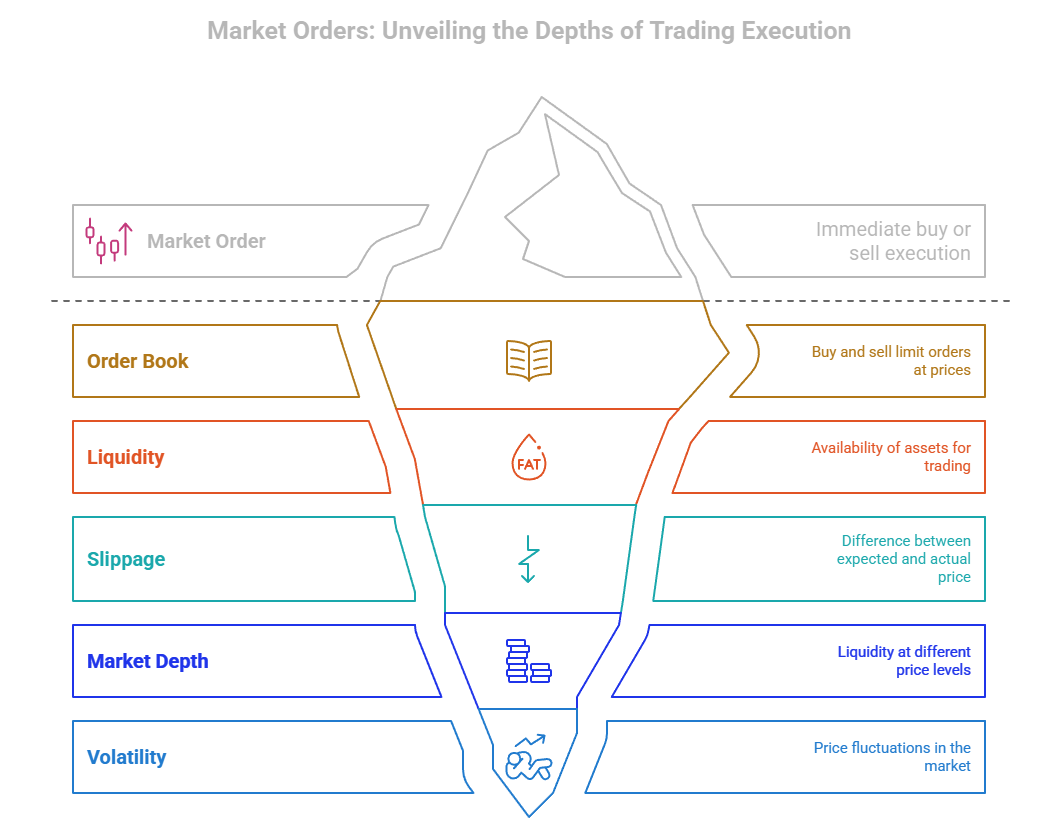
To understand a market order deeply, you must know how it interacts with the order book, also known as the depth of market (DOM). The order book contains all the buy and sell limit orders waiting at specific prices. When you place a market order, you remove liquidity from this book.
Here’s what happens step-by-step:
- You click BUY (market order).
Your order seeks the lowest available sell price in the order book. - The system checks the first sell limit order.
If the volume available is enough to fill your entire order, you get filled instantly at that price. - If not enough liquidity is available, your market order moves to the next best price.
This continues until your entire order is filled. - The same logic applies in reverse when you click SELL.
This process explains why sometimes your execution price is slightly different from the quote you saw. If the market is moving fast or if the asset has low liquidity, your market order “walks up” or “walks down” the order book, causing slippage.
Why Traders Use Market Orders
Despite the risks, market orders are used by professionals across all markets. The reasons include:
✔ Instant Execution
Execution certainty is the #1 reason traders use market orders. When you need to be in or out immediately, there is no time to wait for a limit price.
✔ Higher Probability of Entering a Breakout
Breakout strategies depend on speed. A limit order might miss the move, but a market order gets you in instantly.
✔ Protecting Capital in Fast Markets
If the market is crashing or spiking, a market order ensures your position closes before the loss grows.
✔ Simplifying the Trading Process
Some traders prefer simplicity. They do not want to calculate exact prices during high-stress moments.
Understanding these reasons helps you know when a market order is appropriate and when it becomes a dangerous choice.
Market Orders vs. Limit Orders: Key Differences
To fully understand market order, you must compare it to its opposite: the limit order. These two order types work together to create market structure.
Feature | Market Order | Limit Order |
Execution Priority | Immediate | Price-specific |
Price Certainty | Low | High |
Speed | High | Medium to Low |
Liquidity Role | Takes liquidity | Provides liquidity |
Best For | Fast entries/exits | Precise entries |
A beginner may rely heavily on market orders because they appear simple. However, the more experience you gain, the more you understand when a limit order gives you better control. The most skilled traders use both intelligently depending on market conditions.
The Impact of Slippage on Market Orders
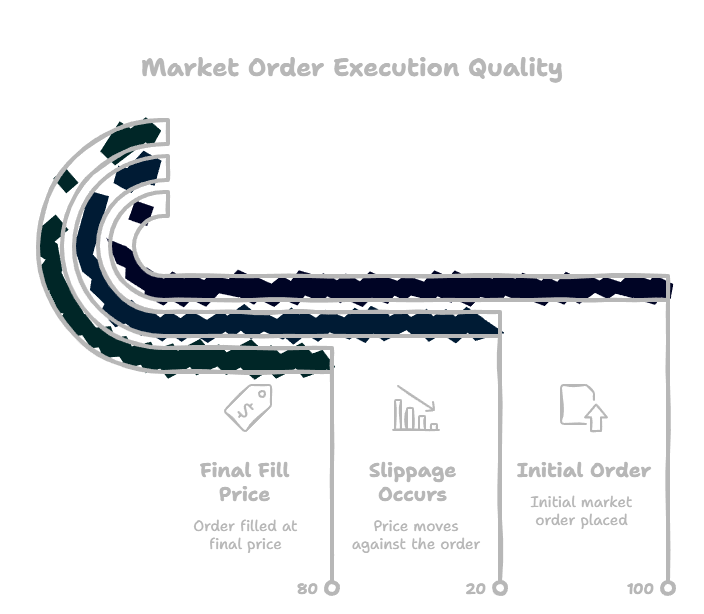
Slippage is one of the most important concepts connected to market order. Slippage occurs when your market order executes at a different price than expected. It happens because:
- The market moves too fast
- Liquidity is low
- Large orders exceed available volume
- News events cause rapid imbalances
Example:
You want to buy at $100, but the best available sell price jumps to $101 at the moment of execution. You get filled at $101. That $1 difference is slippage.
Slippage is normal and cannot be eliminated, but you can manage it through strategies like:
- Trading during high liquidity sessions
- Avoiding major news events
- Reducing position size
- Using limit orders when possible
Understanding slippage helps traders avoid unexpected costs and manage risk more effectively.
Market Depth and Its Influence on Market Orders
Market depth shows how much liquidity exists at each price level. When depth is high, market orders fill smoothly with minimal slippage. When depth is thin, even a small market order can push price levels significantly.
For example:
- In forex, depth is usually high.
- In crypto altcoins, depth can be extremely thin.
- In low-volume stocks, a market order can move the price dramatically.
This is why professional traders always check:
- Order book
- Volume
- Spread
- Liquidity zones
Before placing a large market order.
Good market order execution depends on choosing the right asset, time, and market conditions.
Market Orders in Different Markets
Not all markets behave the same. The effect of a market order can differ depending on the asset class.
Forex
High liquidity, low slippage during active sessions.
Liquidity varies. Major coins = stable execution. Small coins = dangerous slippage.
Stocks
Market orders during premarket or after-hours can be very risky.
Commodities
Often trade through futures contracts; volatility can affect execution.
Understanding each market’s nature allows for safer and more effective use of market orders.
In this first section, we explored the foundations of market order, its mechanics, advantages, and critical role in modern trading. You now understand how market orders interact with liquidity, slippage, and real-time pricing. This knowledge is essential before moving into advanced concepts.
Advanced Concepts Behind Market Orders in Modern Trading
In this section, we move beyond the basics and explore the deeper mechanics that shape how a market order (market order) behaves in real trading environments. Many traders know what a market order is, but very few understand why it behaves differently under various market conditions. Understanding these advanced principles will help you execute trades more accurately, reduce unnecessary losses, and improve your strategic timing.
Professional traders—and even automated trading systems—rely heavily on market orders when certain criteria are met. These criteria depend on liquidity, volatility, time of day, institutional activity, and the overall structure of the order book. In this part, we examine how all of these variables interact with your market orders.
This is a crucial step toward mastering execution, minimizing slippage, and making smarter decisions in high-pressure scenarios.
The Psychology of Execution: Why Market Orders Matter
Many traders underestimate the role of psychology in choosing order types. Trading is not only a technical activity; it is a mental discipline. Fear, greed, stress, and urgency all affect decision-making.
Why traders often default to market orders:
Fear of Missing Out (FOMO)
When a price moves quickly, new traders panic and slam the market order button.
Desire for Speed
In emotional moments, traders believe speed guarantees success—even when it doesn’t.
Panic Selling
During sharp drops, fear pushes traders to exit immediately using a market order.
Lack of Knowledge
Some traders simply do not understand the benefits of limit orders or stop-limit orders.
These emotional triggers often lead to poor timing. Master traders control these impulses and use market orders only when they strategically align with the market environment.
To become a consistent trader, you must reconnect execution with logic rather than emotion.
Liquidity Pools and Their Effect on Market Orders
Liquidity pools are clusters of pending orders—often created by institutions, market makers, and algorithmic trading bots. These pools influence how a مارکت اوردر fills and how much slippage you may experience.
Two major types of liquidity pools:
1. Visible liquidity:
Displayed on the Level 2 order book or DOM.
2. Hidden liquidity:
Orders that exist but do not appear publicly, such as:
- Iceberg orders
- Dark pool orders
- Hidden limit orders
These hidden layers of liquidity can affect your execution in ways you cannot see. For example, a sudden lack of visible orders may cause slippage, yet hidden liquidity might provide smoother execution unexpectedly.
Why liquidity pools matter:
- They determine how far your order “walks” in the book
- They influence volatility
- They show where smart money is placing bets
- They affect breakout and reversal conditions
Trades executed with market orders should always consider liquidity pools because they determine how much you will ultimately pay or receive.
Market Makers and Their Role in Market Order Execution
Market makers are entities responsible for providing liquidity. They constantly place buy and sell orders across multiple levels of the order book. Their actions maintain orderly markets.
When you place a market order, it is often filled directly against a market maker’s limit order.
How market makers interact with your market orders:
- They absorb your order with their existing liquidity
- They adjust spreads based on volatility
- They manage risk by hedging your trades
- They sometimes widen spreads during uncertainty
Understanding market makers is crucial because they influence:
- Execution quality
- Spread size
- Slippage
- Market behavior during news
A well-timed market order during stable periods will often be filled by market makers with minimal price impact. But during volatility, these same market makers may pull liquidity, leading to extreme slippage.
Different Types of Market Orders
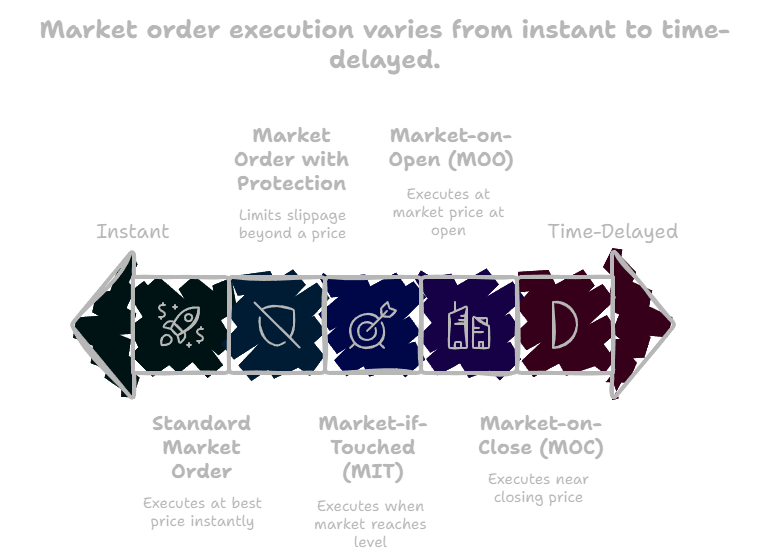
Many traders believe there is only one type of market order, but modern platforms offer variants designed to reduce risk and improve execution.
- Standard Market Order
Executes at the best available price instantly.
- Market Order with Protection
Limits slippage by capping execution beyond a certain price.
- Market-if-Touched (MIT)
Triggers a market order once the market reaches a specified level.
- Market-on-Open (MOO)
Executes at market price when the session opens.
- Market-on-Close (MOC)
Executes near the closing price.
These variations give traders flexibility and allow them to tailor the order type to different strategies and risk levels.
How Volatility Affects Market Orders
Volatility directly impacts the behavior of market order. When markets move fast, order books shift quickly, spreads widen, and liquidity disappears.
High volatility conditions include:
- Major economic news releases
- Unexpected geopolitical events
- Earnings reports (for stocks)
- Crypto flash crashes
- Sudden liquidity gaps
In these environments, a market order may experience:
- Higher slippage
- Partial fills
- Multiple fill prices
- Fast-moving spreads
On the other hand, moderate volatility with stable liquidity provides excellent conditions for market order execution.
Golden rule:
Never use a large market order during extremely volatile events unless absolutely necessary.
Time-of-Day Impact on Market Orders
The time you trade affects the execution quality of your market order. This is especially true in forex, stocks, and crypto.
Forex: Best times for market orders
- London session
- New York session
- London–New York overlap (highest liquidity)
Stock markets: Dangerous times for market orders
- First 5–10 minutes of market open (high volatility)
- Last 10 minutes before close
- Premarket and postmarket hours
Crypto: Liquidity patterns
Crypto trades 24/7, but liquidity is highest when:
- US market is active
- Major exchanges overlap
- Institutional algorithms operate
Knowing when liquidity is strong helps reduce slippage.
Spread and Its Relationship With Market Orders
The spread is the difference between the buy and sell price. Because market orders take liquidity, they always pay the full spread.
A wider spread means:
- Higher entry cost
- Greater slippage risk
- Less efficient execution
Spreads widen during:
- Low liquidity
- Volatility events
- After-hours trading
- Major market gaps
Smart traders always check the spread before sending a market order. Even a 1-second delay can save money during volatile movements.
Partial Fills: Why They Happen
A partial fill occurs when your market order is too large for available liquidity at the best price. The remaining volume spills over to the next price level.
Partial fills happen due to:
- Thin order book
- Large order size
- High volatility
- Hidden liquidity behavior
Most retail traders never encounter major partial fills unless trading large sizes in low-liquidity markets, but understanding them is key to building institutional-level awareness.
Slippage Control Strategies
Although slippage cannot be eliminated, it can be minimized. Professional traders use several methods to control slippage effectively.
Trade during high liquidity
More liquidity = smoother execution.
Avoid major news events
Slippage spikes dramatically during news.
Use limit orders when possible
Especially during breakouts.
Keep order size reasonable
Large orders “walk” deeper into the book.
Use market protection features
If your platform offers it.
Avoid aggressive chasing
Do not send emotional market orders after missing a move.
These practices help you control costs and trade more efficiently.
Market Orders in High-Frequency Trading (HFT)
High-frequency trading firms use advanced algorithms to execute thousands of orders per second. They interact with retail market orders constantly.
HFT effects on your market order:
- Improved liquidity
- Faster execution
- Tighter spreads
- Occasional micro-slippage
While HFT firms often get blamed for volatility, they generally make market order execution smoother and more accessible.
Market Orders in Algorithmic and Automated Trading
Automated systems such as bots, EAs, and algorithmic strategies often use market orders for rapid execution.
Common uses of market orders in algo trading:
- Closing losing positions instantly
- Executing breakout strategies
- Trading news reactions
- Hedging in correlated markets
Algorithms rely on speed and certainty, making the market order ideal for their logic.
However, poorly coded bots may overuse market orders, causing unnecessary slippage and high transaction costs.
In this part, we explored the deeper mechanics of market order, including liquidity pools, market makers, volatility, time-of-day liquidity, and advanced execution techniques. This knowledge helps traders reduce slippage, improve timing, and make smarter decisions in fast-moving markets.
Advanced Strategies and Best Practices for Using Market Orders
Now that you understand the foundations and advanced mechanics behind market orders (market order), it’s time to explore the practical strategies traders use to apply this knowledge in real markets. This final part is designed to help you transform theory into actionable skills that boost accuracy, reduce execution mistakes, and enhance your overall trading performance.
Market orders are simple in appearance, yet complex in execution. When used correctly, they help you capitalize on momentum, secure fast entries, and exit dangerous positions efficiently. When used carelessly, they can lead to large slippage, emotional trading, and costly mistakes. By mastering the strategic use of market orders, you can elevate your trading to a more professional level.
This section covers pro techniques, timing methods, tactical trade setups, risk management rules, and platform-specific considerations that strengthen your decision-making.
Let’s dive deeper into the strategic side of market orders.
When a Market Order Is the Best Choice
Professional traders do not use market orders randomly—they use them when the benefits outweigh the costs. Here are the most common scenarios where a market order is the optimal choice.
- Breakout Confirmations
When price breaks a key support or resistance level with strong momentum, a market order ensures immediate entry before the move accelerates. Limit orders often fail to fill during explosive breakouts.
- Closing Losing Trades Immediately
If a position is rapidly moving against you, speed becomes more valuable than price accuracy. A market order lets you exit instantly and protect capital.
- Fast Reversals
In high-volatility reversals—like V-shaped turning points—a market order helps you catch the early momentum without waiting for a pullback.
- News Trading (only for professionals)
Some high-speed news strategies rely on ultra-fast execution. However, this is not recommended for beginners due to extreme slippage.
- Liquid Markets With Tight Spreads
When spreads are minimal and liquidity is high—like major forex pairs—market orders can execute smoothly and efficiently.
Knowing when to use a market order is one of the biggest advantages a trader can have. Timing is everything.
When NOT to Use Market Orders
Understanding when not to use a market order is equally important. These scenarios are dangerous because they create high slippage and poor execution quality.
❌ Low-Liquidity Assets
Small-cap stocks, low-volume altcoins, and exotic forex pairs can cause huge price jumps during market order execution.
❌ Widened Spreads
If the spread suddenly widens, a market order may fill at a much worse price.
❌ Premarket and After-Hours Trading
Stock markets outside regular sessions have very thin liquidity.
❌ Highly Volatile News Events
During news spikes, slippage can exceed 10x normal levels.
❌ Emotional Moments
Never use a market order out of panic, revenge trading, or FOMO.
Avoiding these scenarios protects your account from unnecessary losses.
Using Market Orders for Momentum Trading
Momentum traders rely heavily on market orders because speed is crucial in these strategies. The goal is to enter during the early stages of strong moves.
Momentum techniques using market order:
✔ Breakout Entries
Enter immediately when price breaks a key level with volume confirmation.
✔ Momentum Continuations
If price rejects a level with strength and continues moving fast, market orders help you join the move without waiting for pullbacks.
✔ Reversal Momentum
During sharp reversals, delays can cause missed opportunities.
Momentum traders thrive on fast execution. They combine market orders with volume analysis, time & sales data, and liquidity monitoring.
Using Market Orders for Scalping
Scalpers often use market orders because their strategies involve:
- Quick entries
- Quick exits
- Small profits
- High frequency of trades
Key elements of scalping with market orders:
- Tight Spreads
Scalpers avoid pairs or instruments with wide spreads.
- High Liquidity
Forex majors, index futures, and top cryptocurrencies are preferred.
- Precision Timing
One-second delays matter in scalping.
- Small Position Sizes
This reduces slippage and ensures smooth execution.
- Platform Speed
Fast execution reduces cost and improves consistency.
A scalper’s success often depends entirely on how efficiently they execute market orders.
Using Market Orders for Day Trading
Day traders use market orders strategically, not constantly. Their approach blends the speed of market orders with the precision of limit orders.
Ways day traders use market orders:
✔ Entering confirmed breakouts
When the market is already showing strong movement.
✔ Exiting when stop-loss is manually triggered
A market order ensures immediate exit.
✔ Fast transitions between long and short
In some strategies, switching direction requires instant action.
✔ Reacting to invalidation signals
When a trade setup fails, a quick exit protects capital.
Day traders understand that market orders are tools—not solutions. They use them sparingly but effectively.
Using Market Orders for Swing Trading
Swing traders typically rely more on limit orders, but market orders still have strategic uses.
✔ Entering at market after confirmation
Sometimes a pattern is only confirmed once a candle closes. A market order ensures timely entry.
✔ Exiting invalid trades
If the structure breaks, a market order protects the account.
✔ Scaling out during fast movements
When price reaches a key target faster than expected, a market order can lock in profits immediately.
Swing traders must strike a balance between long-term planning and real-time action. Market orders help with the latter.
Position Sizing and Risk Management When Using Market Orders
Because a market order may not fill at the expected price, risk calculations must be slightly more conservative.
Key risk management rules:
✔ Assume your fill price may be worse
Always include possible slippage in your trade planning.
✔ Use smaller size in volatile markets
This helps avoid large slippage costs.
✔ Use stop-loss orders after entering
Never rely solely on manual exits.
✔ Avoid oversized positions
Large orders create liquidity problems.
✔ Use fixed risk-per-trade
Consistency is crucial for long-term success.
Risk management transforms market orders from dangerous tools into powerful assets.
Slippage Tolerance Techniques for Market Orders
Professional traders use different techniques to manage slippage while still keeping the benefits of fast execution.
- Slippage Allowance
Some platforms let you set a maximum slippage tolerance. If the price moves more than the limit, the order cancels.
- Market Order with Price Protection
Limits the worst-case scenario by rejecting execution beyond a threshold.
- Split Execution
Large trades are split into multiple smaller market orders to reduce impact.
- Hybrid Orders (Limit + Market)
A limit order gets filled up to a point, then a market order finishes the rest.
- Time-Based Execution
Using market orders only during high-liquidity periods.
These techniques help achieve professional-level execution quality.
Market Order Execution Across Different Platforms
Execution speed and slippage vary widely between trading platforms.
Forex brokers
- Often use ECN or STP systems
- High liquidity, low slippage
- Market orders are common
Crypto exchanges
- Slippage varies dramatically
- Order books can be thin for smaller coins
- Must monitor depth constantly
Stock brokerages
- Market orders are risky during open/close
- Better during mid-session
- MOC and MOO orders available
Understanding how your specific platform handles market orders is essential for controlling risk.
How Algorithms Read Market Orders
Modern financial markets depend heavily on algorithms. They detect and react to market orders instantly.
Algorithms may:
- Adjust liquidity
- Move spreads
- Trigger liquidity grabs
- React to increased order flow
- Detect buy/sell pressure
These reactions affect your execution. Being aware of algorithmic behavior helps you anticipate changes in spreads and depth.
Common Mistakes Traders Make with Market Orders
Even experienced traders make errors when using market orders. Avoiding these mistakes strengthens your execution strategy.
❌ Overusing market orders
Traders rely on them too often instead of combining them with limit orders.
❌ Ignoring spread
A wide spread makes a market order expensive.
❌ Trading illiquid assets
Thin books cause heavy slippage.
❌ Trading the news without preparation
Slippage can wipe out an account.
❌ Emotional trading
Market orders entered emotionally lead to poor outcomes.
❌ Large positions in fast markets
This is one of the biggest causes of unexpected losses.
Awareness of these mistakes keeps you from repeating them.
Practical Tips for Mastering Market Orders
Here are essential tips to use market order like a professional:
✔ Always check liquidity
Look at market depth before trading.
✔ Watch the spread
Avoid trading when spreads widen suddenly.
✔ Trade during optimal times
Peak sessions give the best conditions.
✔ Use a fast platform
Execution speed matters.
✔ Keep orders small during volatility
This reduces execution risk.
✔ Combine market and limit orders
Use each when appropriate.
✔ Avoid emotional decisions
Slow down, control your thinking, and execute with intention.
Real-World Example Scenarios
Scenario 1: Breakout Entry
Price breaks resistance at 1.2000.
Volume increases sharply.
A market order gets you filled instantly at 1.2003.
This is acceptable slippage for a breakout.
Scenario 2: Exit During a Crash
Your long position is losing fast.
A market order closes the trade instantly, preventing deeper losses.
Scenario 3: Low-Liquidity Crypto Coin
A trader sends a $5,000 market order on a thin altcoin.
Slippage pushes the fill price 8% higher.
This is a bad use of a market order.
Scenario 4: Scalp Trade During London Session
Due to high liquidity, a market order fills cleanly with almost no slippage.
Seeing real examples makes the concepts easier to apply.
Final Conclusion
Mastering the market order (market order) is essential for every trader in today’s fast-moving financial markets. While the concept appears simple, the execution involves deep knowledge of liquidity, volatility, spreads, timing, platforms, and psychology.
Market orders are powerful tools when used correctly:
- They provide instant execution
- They help capture momentum
- They protect capital during danger
- They accelerate trade management
But they must be used with discipline, awareness, and strategic thinking.
By understanding everything covered in Parts 1–3—mechanics, advanced concepts, and practical strategies—you now have a complete professional-level understanding of market orders.
Use them wisely, with patience and control.
The markets reward skilled execution.