Trading Indices in Forex
Trading Indices in Forex: Understanding Market Impacts
The Forex market, one of the largest and most liquid financial markets in the world, is influenced by numerous economic factors. Among these, stock market indices play a critical role in shaping currency values and guiding traders’ decisions. Understanding the interplay between indices and forex pairs can provide traders with a strategic advantage, enabling them to anticipate market movements and optimize their trading strategies.
What Are Stock Market Indices?
A stock market index is a statistical measure that reflects the composite value of a selected group of stocks. These indices are designed to represent the performance of a particular market or sector. Common examples include the S&P 500, Dow Jones Industrial Average (DJIA), NASDAQ Composite, FTSE 100, and DAX 30. Each index aggregates the price movements of its constituent stocks, providing an overview of market trends.
For forex traders, indices are important because they serve as indicators of economic health and investor sentiment. Rising indices generally suggest a strong economy, which can impact currency strength, while declining indices may signal economic uncertainty or risk aversion.
How Indices Affect Forex Markets
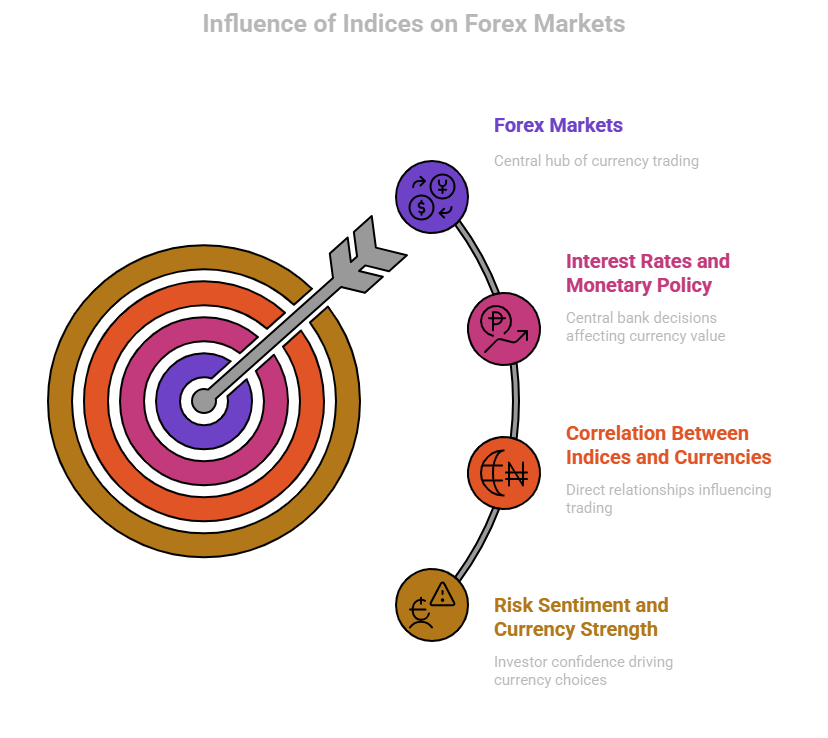
Currency markets are highly sensitive to global economic signals. Stock indices influence forex in several ways:
- Risk Sentiment and Currency Strength
Investors often adjust their positions based on perceived risk. A rising equity market signals confidence, encouraging investment in riskier assets such as the Australian Dollar (AUD) or New Zealand Dollar (NZD). Conversely, a declining index might drive investors toward safe-haven currencies like the US Dollar (USD), Japanese Yen (JPY), or Swiss Franc (CHF). - Correlation Between Indices and Currencies
Certain currencies are closely correlated with major indices. For example:- The USD often moves inversely to the S&P 500 during periods of market stress.
- Commodity-linked currencies (AUD, CAD, NZD) may follow indices related to commodities or emerging markets.
Understanding these correlations can help traders anticipate currency movements based on index performance.
- Interest Rates and Monetary Policy Expectations
Central banks monitor indices as part of their assessment of economic health. Strong stock market performance may influence monetary policy decisions, affecting interest rates and subsequently the forex market. For example, a bullish market might encourage tighter monetary policy, potentially strengthening the national currency.
Key Indices to Watch for Forex Traders
Forex traders often monitor specific indices to guide their trading strategies:
- S&P 500: Represents the 500 largest US companies. Its performance reflects overall US economic health and influences USD pairs like EUR/USD and USD/JPY.
- Dow Jones Industrial Average: Tracks 30 significant US companies. DJIA movements can signal shifts in investor sentiment affecting USD-based currencies.
- NASDAQ Composite: Tech-heavy index. NASDAQ performance often indicates risk appetite, impacting high-beta currencies like AUD and NZD.
- FTSE 100: UK-focused index. Movement in FTSE 100 can impact GBP pairs, especially GBP/USD.
- DAX 30: German index representing major European companies. Changes in DAX 30 may influence EUR-based pairs.
Trading Strategies Based on Indices
Traders can use indices as a foundation for several forex trading strategies:
- Correlation Trading
Identify correlations between an index and a currency pair. For instance, if the S&P 500 is rising, traders might go long on AUD/USD, anticipating a positive effect on risk-sensitive currencies. - Sentiment Analysis
Use indices as a proxy for market sentiment. A strong rally in stock indices may indicate bullish sentiment in global markets, potentially favoring higher-yielding currencies. - Hedging and Diversification
Traders can hedge forex positions against index movements to manage risk. For example, a trader long on USD/JPY may take a short position in a correlated index to offset potential volatility. - News and Event-Based Trading
Indices often react quickly to economic news such as GDP reports, unemployment data, or central bank announcements. Monitoring index responses can help traders anticipate currency reactions.
Practical Examples
- Example 1: USD and S&P 500
Suppose the S&P 500 experiences a sharp decline due to geopolitical tension. Traders often flock to safe-haven currencies, causing USD, JPY, and CHF to strengthen against riskier currencies like AUD or NZD. - Example 2: NASDAQ and AUD
A surge in NASDAQ driven by technology stocks may reflect increased risk appetite. Traders may buy AUD/USD, anticipating that investors are moving into risk-on assets. - Example 3: European Indices and EUR/USD
If the DAX 30 rises strongly, it may indicate confidence in the Eurozone economy. Traders might expect EUR to appreciate against the USD, particularly if US indices are flat or declining.
Benefits of Using Indices in Forex Trading
- Predictive Insights: Indices provide early signals of potential currency movements.
- Diversification: They allow traders to assess multiple markets simultaneously.
- Strategic Planning: By analyzing indices, traders can align forex positions with broader economic trends.
Understanding the relationship between stock market indices and forex markets is crucial for informed trading. Indices offer insights into risk sentiment, economic health, and market momentum, all of which directly affect currency values. By monitoring key indices like the S&P 500, Dow Jones, NASDAQ, FTSE 100, and DAX 30, traders can enhance their strategies, manage risk effectively, and potentially improve profitability.
Advanced Strategies for Trading Indices in Forex
Once traders understand the basic relationship between stock indices and forex markets, they can employ advanced strategies to maximize profits and manage risk. Trading indices in forex requires combining technical analysis, fundamental insights, and real-world economic understanding. This section explores advanced methods, correlation tactics, and practical examples of successful trading approaches.
Technical Analysis Using Indices
Technical analysis is a cornerstone of forex trading, and indices offer valuable signals:
- Trend Following
Traders often follow trends in major indices to guide currency trades. For example, if the S&P 500 is in a strong uptrend, the likelihood of risk-on behavior increases, encouraging long positions in currencies like AUD/USD or NZD/USD. Tools like moving averages, trendlines, and RSI (Relative Strength Index) can confirm momentum. - Support and Resistance Levels
Indices often show clear support and resistance zones that reflect market sentiment. These levels can be mirrored in forex markets, allowing traders to anticipate potential reversals or breakouts. - Divergence Analysis
Comparing an index with a correlated currency pair can reveal divergence. For instance, if the S&P 500 rises but AUD/USD declines, it may indicate an upcoming correction or market imbalance, signaling an opportunity for strategic entry.

Using Correlation Strategies
Correlation strategies leverage the relationship between indices and currency pairs:
- Positive Correlation: Some currencies move in tandem with specific indices. For instance, commodity-linked currencies like AUD and CAD often rise with bullish equity markets.
- Negative Correlation: Safe-haven currencies like USD, JPY, and CHF tend to move inversely to major indices during market stress.
Traders can track correlation coefficients over time to determine the strength of relationships, adjusting positions accordingly. Using tools such as correlation matrices or forex analytics platforms can help automate this process.
Hedging Forex Trades with Indices
Advanced traders often hedge their currency positions using indices to reduce exposure:
- Example: A trader holding a long position in EUR/USD may short the DAX 30 if a sudden European market downturn is expected, mitigating potential losses.
- Portfolio Diversification: By combining forex and index positions, traders can achieve a more balanced portfolio that reacts to multiple market stimuli.
Event-Driven Trading
Indices react rapidly to economic and geopolitical events, offering actionable signals for forex trading:
- Central Bank Announcements
Interest rate decisions by the Federal Reserve, European Central Bank, or Bank of England can trigger index and currency volatility. Traders can monitor indices pre- and post-announcement to anticipate currency movements. - Economic Data Releases
GDP growth, unemployment rates, and inflation data affect investor sentiment. Rising indices may indicate strong economic performance, impacting currency strength. - Geopolitical Events
Tensions, elections, or policy changes can lead to risk-off behavior. Indices often drop sharply, and safe-haven currencies gain value. Understanding these correlations enables traders to position themselves strategically.
Real-World Examples
- Case Study 1: USD/JPY and S&P 500 Crash
During the 2020 market downturn caused by the pandemic, the S&P 500 dropped significantly. Simultaneously, traders sought safe havens, pushing USD/JPY upward. Those monitoring index movements could anticipate this shift and capitalize on the trend. - Case Study 2: NASDAQ Tech Rally and AUD/USD
In periods of tech sector growth, NASDAQ surges, reflecting strong risk appetite. Traders who paired NASDAQ movements with AUD/USD long positions often benefited from simultaneous currency appreciation. - Case Study 3: European Indices and EUR/GBP
A strong rally in FTSE 100 and DAX 30 may indicate confidence in the UK and European markets, influencing EUR/GBP. Advanced traders use these signals for short-term swing trades and hedging strategies.
Combining Technical and Fundamental Analysis
The most successful traders integrate both technical and fundamental analysis:
- Technical Tools: Fibonacci retracements, Bollinger Bands, and MACD can identify entry and exit points.
- Fundamental Insights: Economic indicators, central bank policies, and political events offer context for index movements and currency reactions.
- Combined Approach: For instance, a bullish DAX 30 trend combined with positive Eurozone GDP data may justify a long EUR/USD position with a well-defined stop-loss and profit target.
Risk Management Strategies
Advanced index-based forex trading requires meticulous risk management:
- Position Sizing: Adjust trade size according to volatility in indices and currencies.
- Stop-Loss Orders: Place stops near technical support or resistance levels of correlated indices.
- Diversification: Trade multiple currency pairs or hedge with index positions to reduce exposure to market shocks.
Algorithmic and Automated Trading
Technology allows traders to automate strategies based on indices:
- Automated Correlation Trading: Algorithms monitor index-currency correlations and execute trades automatically when predefined conditions are met.
- Event-Driven Bots: Bots can react instantly to economic news, adjusting forex positions in real-time according to index reactions.
- Backtesting Strategies: Traders can test historical index movements against currency pairs to refine automated strategies and improve accuracy.
Psychological Considerations
Trading indices in forex also requires psychological discipline:
- Avoid overreacting to short-term index fluctuations.
- Maintain patience, relying on both data and technical signals.
- Understand market sentiment shifts and adjust strategies calmly without emotional bias.
Advantages of Advanced Index-Based Forex Trading
- Predictive Edge: Using indices improves the anticipation of currency moves.
- Diversified Signals: Indices offer multiple perspectives beyond standard forex charts.
- Improved Risk Management: Combining indices with currency trades allows for sophisticated hedging.
- Scalable Strategies: Automated systems can scale index-based strategies across multiple currency pairs simultaneously.
Integrating indices into forex trading is a powerful method for traders seeking a competitive advantage. By combining technical analysis, correlation strategies, event-driven trading, and automated systems, traders can better anticipate currency movements, hedge risks, and exploit market opportunities. Real-world examples demonstrate that successful traders leverage indices not only as indicators but also as instruments to refine strategy and maximize returns.
Next Question: Are you ready for the final 2000-word section, which will focus on practical implementation, trading platforms, tools, and actionable tips for traders using indices in forex?
Practical Implementation of Index-Based Forex Trading
Understanding the relationship between stock market indices and forex markets, along with advanced strategies, provides a strong theoretical foundation. However, success in trading requires practical implementation, including the selection of trading platforms, analytical tools, and a disciplined approach. This final section explores actionable insights, best practices, and real-world applications for traders leveraging indices in forex.
Choosing the Right Trading Platform
A robust trading platform is essential for index-based forex trading:
- Real-Time Data Access
Traders need live feeds for both forex pairs and global indices. Platforms like MetaTrader 4/5, cTrader, and TradingView offer integrated access to indices and forex charts, enabling informed decision-making. - Advanced Charting Tools
Comprehensive charting tools allow traders to analyze correlations between indices and currency pairs. Features like multi-timeframe analysis, overlaying indices on forex charts, and custom indicators are critical. - Execution Speed and Reliability
Index-based strategies often require quick reactions to market shifts. Choosing a platform with minimal latency ensures timely trade execution. - Risk Management Features
Look for platforms offering stop-loss, take-profit, trailing stops, and hedging capabilities to manage exposure effectively.
Essential Tools for Index-Based Forex Trading
Successful implementation depends on leveraging the right tools:
- Correlation Matrices: Track the relationships between indices and currencies over time.
- Economic Calendars: Monitor events that may impact indices, such as central bank meetings, GDP releases, or employment reports.
- Automated Alerts: Set notifications for index movements that trigger potential trading opportunities.
- Technical Indicators: Apply RSI, MACD, Bollinger Bands, or moving averages to both indices and currency charts to confirm trade setups.
Developing a Practical Trading Plan
A systematic trading plan is vital:
- Define Entry and Exit Criteria
Specify the conditions under which a trade will be initiated, based on index performance and forex correlation. Include stop-loss and take-profit levels for disciplined execution. - Determine Risk Exposure
Establish the percentage of capital allocated per trade, considering volatility in both the forex pair and correlated index. - Monitor Correlation Strength
Continuously evaluate how strongly the chosen indices influence currency pairs. Correlations can shift over time due to economic or geopolitical factors. - Backtest Strategies
Simulate historical index and forex data to validate strategies before committing real capital. Platforms like TradingView or MetaTrader allow extensive backtesting capabilities.
Integrating Indices with Forex Trading Techniques
Practical implementation involves combining indices with familiar forex trading techniques:
- Trend Following with Indices: Use index trends to confirm forex positions. For example, a rising S&P 500 trend may support long positions in AUD/USD.
- Range Trading: Identify periods where indices move sideways and adjust forex trades accordingly, capitalizing on consolidation phases.
- Breakout Strategies: Index breakouts often precede currency volatility. Traders can enter positions on confirmed index breakouts with appropriate risk controls.
- Swing Trading: Multi-day index movements provide opportunities for swing trades in correlated currency pairs.
Risk Management in Practice
Managing risk is even more critical in index-based forex trading:
- Hedging Positions
Offset potential forex losses with index positions or related currency pairs. For example, shorting a correlated index while holding a long currency position. - Stop-Loss Placement
Place stops near significant technical levels of the index, not just the currency pair, to account for broader market shifts. - Diversification
Trade multiple currency pairs and indices to avoid overexposure to one market movement. - Position Sizing Adjustments
Adjust position size according to volatility in the indices and currency pairs. Highly volatile periods require smaller trade sizes to maintain risk tolerance.
Case Studies: Applying Practical Strategies
- Case Study 1: S&P 500 Trend and EUR/USD
A trader observes a consistent upward trend in the S&P 500. By correlating this trend with EUR/USD, the trader initiates a long position with tight stop-loss orders, capitalizing on bullish risk sentiment. - Case Study 2: NASDAQ Volatility and AUD/USD
Rapid tech sector movements trigger NASDAQ fluctuations. Traders monitoring correlation patterns can time AUD/USD entries to benefit from these market swings. - Case Study 3: DAX 30 Consolidation and EUR/GBP
A consolidation phase in DAX 30 suggests limited movement in EUR/GBP. Traders may adopt range-bound strategies, entering at support levels and exiting at resistance zones.
Leveraging Automation and Algorithms
Automation enhances practical implementation by allowing traders to react instantly to market changes:
- Algorithmic Trading: Pre-programmed strategies can execute trades based on index signals, correlation thresholds, or economic events.
- Event-Driven Bots: Bots monitor indices and forex markets in real-time, executing trades when predefined triggers occur.
- Backtesting Automation: Historical testing of index-based strategies helps refine algorithms and improve accuracy.
Tips for Consistent Success
- Stay Updated: Continuously monitor global markets, indices, and economic indicators.
- Maintain Discipline: Stick to your trading plan and avoid impulsive decisions during short-term volatility.
- Analyze Performance: Review trades regularly to identify strengths, weaknesses, and areas for improvement.
- Continuous Learning: Market correlations evolve over time; adapt strategies and learn from historical patterns.
Practical implementation of index-based forex trading combines knowledge, strategy, technology, and discipline. By choosing the right trading platform, utilizing advanced tools, developing structured trading plans, and managing risk carefully, traders can leverage indices to gain a competitive edge in the forex market. Case studies and real-world examples highlight the tangible benefits of this approach, demonstrating how informed traders can capitalize on market sentiment and economic trends.