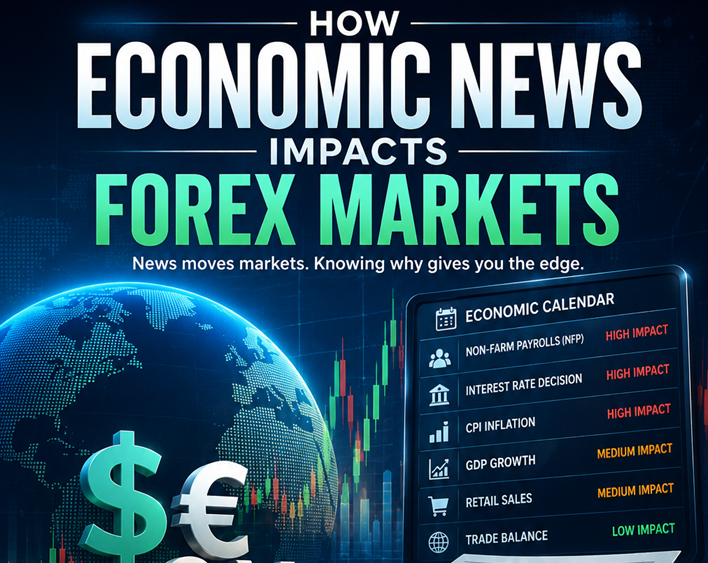
Forex News Trading: How Economic News Moves
Forex News Trading: How Economic News Moves Currency Markets
If you’ve ever watched a currency pair swing 100 pips in under a minute, you’ve witnessed the raw power of economic news. Forex news trading isn’t just a strategy — it’s a window into how the entire global financial system processes information in real time. The moment a central bank governor speaks, or a government releases a jobs report, billions of dollars shift across the market before most traders even finish reading the headline.
Understanding how economic news impacts forex markets is, quite simply, one of the most valuable skills a currency trader can develop. Whether you’re a complete beginner trying to make sense of why your trade suddenly went sideways at 8:30 AM Eastern, or an intermediate trader looking to build a more systematic approach, this guide is written for you.
In the sections ahead, we’ll break down the mechanics of how news moves markets, which economic releases carry the most weight, and how to build a real framework around forex news trading — one grounded in data, not guesswork.
What Is Forex News Trading?
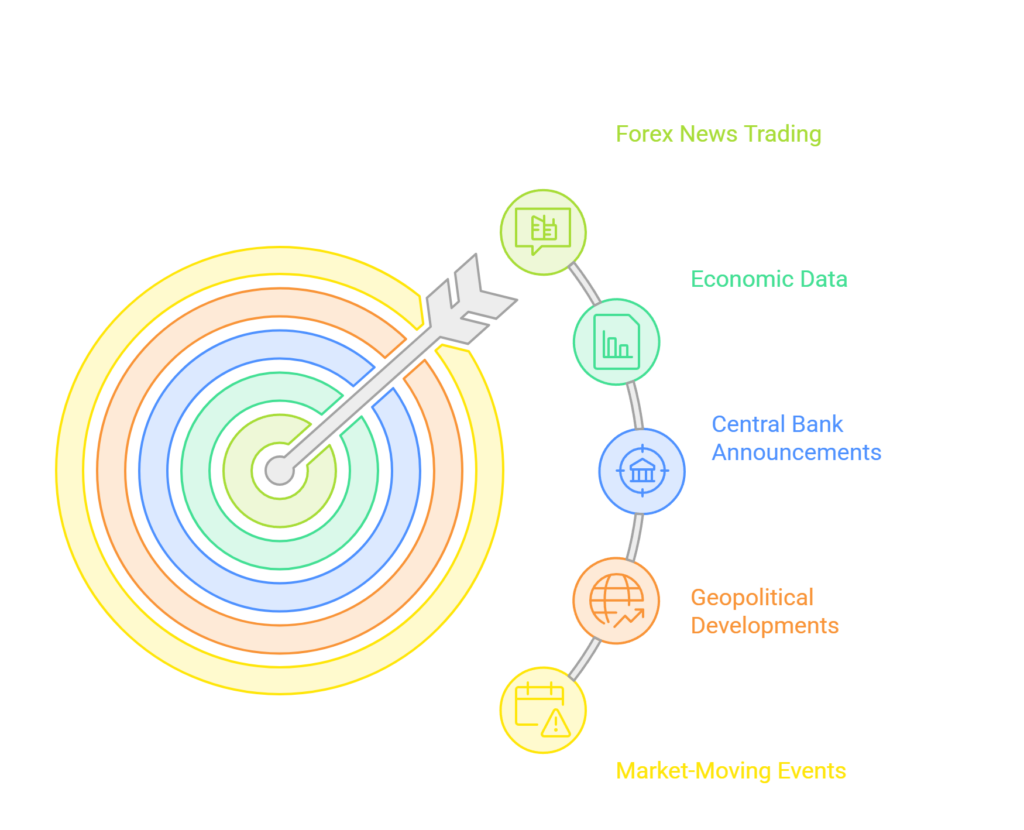
At its core, forex news trading is the practice of making trading decisions based on the release of economic data, central bank announcements, geopolitical developments, and other market-moving events. Unlike technical trading — which relies entirely on price charts and historical patterns — news trading is fundamentally about understanding cause and effect in the global economy.
The foreign exchange market is the largest and most liquid financial market in the world, with daily trading volume exceeding $7.5 trillion as of the Bank for International Settlements’ 2022 triennial survey. This scale means the market is extraordinarily sensitive to new information. When that information arrives in the form of a major economic release, the reaction can be immediate, violent, and highly directional.
The Core Logic Behind News-Driven Price Movement
Here’s the foundational principle: currency values reflect expectations. Markets don’t just react to what happens — they react to what happens relative to what was expected. This is a subtle but critical distinction.
Consider a scenario where analysts forecast that the U.S. economy added 200,000 jobs in a given month. If the actual number comes in at 180,000, the dollar may weaken — not because 180,000 jobs is catastrophically bad, but because the market had already priced in 200,000. The shortfall is the surprise. And in forex, surprise is everything.
This is why experienced news traders don’t just watch the data — they watch the deviation from consensus. The bigger the deviation, the bigger the potential market move.
The Economic Calendar: Your Most Important Trading Tool
No serious forex news trader operates without an economic calendar. This is a schedule of upcoming economic data releases, central bank meetings, speeches, and other events that are likely to move currency markets. Think of it as your roadmap for the trading week.
What the Economic Calendar Shows You
A well-structured economic calendar typically includes:
- Event name — e.g., Non-Farm Payrolls, Consumer Price Index, GDP Growth Rate
- Country/currency affected — which currency pair is most likely to react
- Release date and time — precise to the minute, often in multiple time zones
- Previous reading — what the last release showed
- Forecast/consensus — what economists and analysts are expecting
- Actual result — populated the moment data is released
- Impact rating — usually labeled as Low, Medium, or High
The impact rating is your first filter. High-impact events are the ones that reliably move markets by significant amounts. Medium-impact events can surprise, but the moves are typically more contained. Low-impact events are generally noise — they rarely produce tradable moves unless they come in at extreme deviations.
How to Use the Economic Calendar Strategically
Using an economic calendar effectively isn’t just about knowing when events happen. It’s about building a mental model of the week ahead. Here’s a practical approach:
- Review the week’s calendar every Sunday evening. Identify all high-impact events for each major currency: USD, EUR, GBP, JPY, AUD, CAD, CHF, NZD.
- Mark the major events on your chart. Most trading platforms allow you to overlay economic events directly on your price charts. This helps you visually identify how price has reacted to similar events in the past.
- Note the consensus expectations. Write down the forecast for each major release. This is your benchmark. When the actual number comes out, you’ll immediately know whether it beat, met, or missed expectations — and by how much.
- Identify correlated pairs. Some currencies move together or against each other in predictable ways. If USD strengthens on a surprise NFP beat, EUR/USD typically drops while USD/JPY typically rises. Understanding these correlations multiplies your analytical edge.
- Plan your risk accordingly. During high-impact events, spreads widen dramatically and slippage becomes common. If you’re already in a trade heading into a major release, you need to decide in advance whether to close, reduce your position, or add a wider stop.
The Best Free Economic Calendars
Several platforms offer high-quality economic calendars at no cost:
- Forex Factory — widely regarded as the gold standard among retail traders
- Investing.com — comprehensive with filtering by currency and impact level
- DailyFX — includes analyst commentary alongside the raw data
- TradingEconomics — excellent for historical data comparison
- MetaTrader 4/5 built-in calendar — convenient for traders already on the platform
Interest Rates: The Single Most Powerful Driver of Currency Values
If you want to understand what moves currencies over the medium to long term, start with interest rates. Central bank interest rate decisions are the gravitational center around which all other forex fundamentals orbit.
Why Interest Rates Move Currencies
The logic is elegant in its simplicity. When a country’s central bank raises interest rates, it offers investors a higher return on assets denominated in that currency — bonds, savings accounts, money market instruments. Capital flows toward higher yields. To invest in those assets, foreign investors must first buy the local currency, which drives up its value.
The reverse is equally true. When a central bank cuts rates, yield-seeking capital flows out, the currency weakens, and neighboring economies with relatively higher rates become more attractive destinations for investment.
This is the essence of carry trading — one of the most widely used strategies in professional forex trading — which involves borrowing in a low-interest-rate currency and investing in a high-interest-rate currency to capture the yield differential.
Central Banks and Their Role in Forex
Understanding which central banks matter most is essential for any forex news trader:
Central Bank | Currency | Acronym |
Federal Reserve | US Dollar (USD) | Fed |
European Central Bank | Euro (EUR) | ECB |
Bank of England | British Pound (GBP) | BoE |
Bank of Japan | Japanese Yen (JPY) | BoJ |
Reserve Bank of Australia | Australian Dollar (AUD) | RBA |
Bank of Canada | Canadian Dollar (CAD) | BoC |
Swiss National Bank | Swiss Franc (CHF) | SNB |
The Federal Reserve commands the most attention, simply because the US dollar is involved in approximately 88% of all forex transactions (BIS, 2022). When the Fed speaks, the entire market listens.
What to Watch Beyond the Rate Decision Itself
Here’s something many beginner traders miss: the actual rate decision is often less important than the language surrounding it. Markets are forward-looking. By the time a rate hike is officially announced, it’s frequently already priced in — meaning the currency may not move much at all.
What does move the market is unexpected language in the accompanying statement or press conference. Central bankers use very deliberate vocabulary. Key terms to watch for:
- “Hawkish” — language suggesting rates may rise or stay high for longer. Generally bullish for the currency.
- “Dovish” — language suggesting rates may be cut or that the central bank is worried about the economy. Generally bearish for the currency.
- “Data dependent” — the central bank is waiting for more information before deciding. Usually neutral, but can be interpreted either way depending on context.
- “Restrictive territory” — suggests current rates are already doing their job and cuts may be coming.
A classic example: in 2022, the Federal Reserve began one of the most aggressive rate-hiking cycles in modern history. The US dollar soared against virtually every major currency — the DXY (Dollar Index) rose from around 96 in January 2022 to above 114 by September 2022. Traders who understood the Fed’s hawkish pivot early had some of the clearest directional trades of the decade.
NFP: The Report That Moves Everything
No single economic release gets more attention from forex traders than the Non-Farm Payrolls report, universally known in trading circles simply as “NFP.” Released on the first Friday of every month by the U.S. Bureau of Labor Statistics, this report measures the number of jobs added or lost in the American economy during the previous month, excluding farm workers, government employees, and a few other categories.
Why NFP Matters So Much
Employment is one of the Federal Reserve’s two official mandates (the other being price stability). The strength of the labor market directly influences whether the Fed raises, holds, or cuts interest rates. A strong NFP reading signals economic health, supports the case for higher rates, and typically strengthens the dollar. A weak reading does the opposite.
Beyond the headline jobs number, the NFP report includes several other crucial data points:
- Unemployment Rate — the percentage of the labor force actively seeking work
- Average Hourly Earnings — arguably the most important inflation signal within the report
- Labor Force Participation Rate — measures how many working-age Americans are actually in the workforce
- Previous month revision — the Bureau often revises the prior month’s figure, which can itself move markets
How to Trade NFP: A Practical Framework
Trading NFP is notoriously tricky. The initial spike in either direction can reverse violently within seconds — a phenomenon traders call a “stop hunt” or “fakeout.” Here’s a structured approach that helps manage the chaos:
Before the Release:
- Know the consensus forecast. Check Forex Factory, Bloomberg, or Reuters for the median economist estimate.
- Identify your key technical levels — support, resistance, recent highs and lows.
- Note the previous reading and whether it was revised up or down in subsequent reports.
- Decide in advance whether you’ll trade the initial spike or wait for the dust to settle.
At the Release:
- Don’t enter trades in the seconds immediately before or after. Spreads can widen to 10–20 pips on major pairs. Slippage is extreme.
- Watch where price goes and where it fails. If the USD strengthens sharply on a positive number but then immediately pulls back, that’s information.
After the Initial Move:
- Many experienced news traders wait 3–5 minutes after the release for the initial volatility to subside.
- Look for the market to establish a clear direction before entering.
- A retest of a key technical level after the initial spike often provides a higher-probability entry.
Real-World Example: In November 2023, NFP came in at 199,000 — above the consensus of 180,000. The dollar initially strengthened, EUR/USD dropped about 80 pips in the first few minutes. However, once the dust settled, the move extended further as traders digested the average hourly earnings data, which also came in hotter than expected — reinforcing expectations that the Fed would maintain rates at restrictive levels.
CPI Data: Inflation’s Role in Currency Markets
The Consumer Price Index (CPI) has arguably become the most market-moving economic release of the post-pandemic era. As central banks around the world waged war on inflation from 2021 through 2024, every CPI release became a potential inflection point for monetary policy — and therefore for currency markets.
What CPI Measures
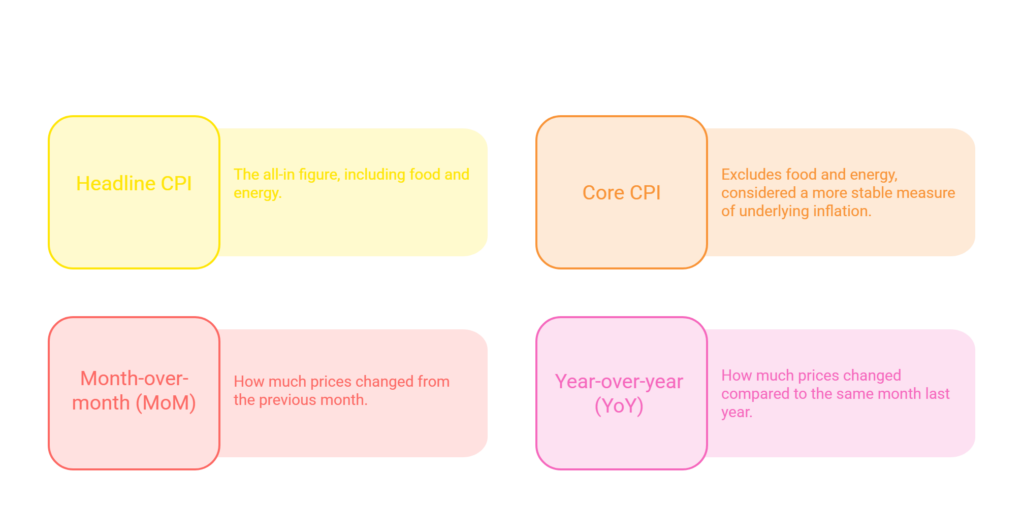
CPI measures the average change in prices paid by urban consumers for a basket of goods and services over time. It’s the most widely used measure of inflation in developed economies. The report is typically broken down into:
- Headline CPI — the all-in figure, including food and energy
- Core CPI — excludes food and energy, considered a more stable measure of underlying inflation
- Month-over-month (MoM) — how much prices changed from the previous month
- Year-over-year (YoY) — how much prices changed compared to the same month last year
Why CPI Is a Currency Catalyst
Central banks target inflation — typically around 2% in most developed economies. When CPI comes in above target, the central bank is under pressure to raise rates or keep them elevated. When CPI falls toward or below target, rate cuts become more likely.
This direct link to monetary policy is what makes CPI such a powerful currency mover. A hotter-than-expected CPI reading is generally bullish for the currency; a cooler-than-expected reading is bearish.
Notable Example: In June 2022, U.S. CPI came in at 9.1% year-over-year — a 40-year high and well above consensus estimates of around 8.8%. The dollar surged, EUR/USD briefly dipped below parity for the first time in decades, and gold fell sharply. The single data point reshaped expectations for Fed rate hikes across the entire year. Traders who understood the CPI-rate linkage were well-positioned for that move.
Trading CPI: Key Considerations
- Watch core CPI more than headline. Food and energy prices are volatile and noisy. The Fed explicitly focuses on core measures when making policy decisions. A headline miss but core beat can still be dollar-bullish.
- Context matters. A 0.3% MoM core CPI print reads very differently when the target is 2% YoY versus when you’re coming down from 6%.
- Revisions are rare but impactful. Unlike NFP, CPI revisions are infrequent. When they do occur, they’re significant.
- Watch the reaction, not just the number. If CPI beats expectations but the dollar sells off, that tells you the market was positioned even more aggressively bullish. The “buy the rumor, sell the news” dynamic is real.
How Markets Price in Expectations Before a Release
One of the most sophisticated — and often overlooked — dimensions of forex news trading is the concept of pricing in. Markets are not passive. In the days and weeks leading up to a major economic release, traders, institutions, and algorithms position themselves based on their expectations of what the data will show.
This pre-positioning has several important implications:
The “Buy the Rumor, Sell the News” Effect
This classic market axiom plays out regularly in forex. If the market broadly expects a strong NFP number, traders buy the dollar in advance. When the number is released and confirms expectations, there’s no one left to buy — the position is already on. Profit-taking kicks in, and the dollar may actually sell off on what appears to be good news.
Understanding this dynamic is crucial for news traders. Always ask: what has the market already priced in?
Positioning Data as a Clue
The Commitment of Traders (COT) report, released weekly by the CFTC, shows the positioning of large speculative traders (hedge funds, commodity trading advisors) in the futures market. While not a precise timing tool, extreme positioning in one direction is often a warning sign that a reversal could follow a news catalyst.
Implied Volatility and Options Markets
Professional traders also look at implied volatility in the options market to gauge how much movement the market is pricing in around a major event. When implied volatility spikes before a CPI or NFP release, it signals that big players are hedging — and that a large move is expected regardless of direction.
The foundation is now in place: you understand what forex news trading is, why the economic calendar is non-negotiable, and how the three most powerful fundamental forces — interest rates, NFP, and CPI — drive currency markets with predictable logic.
How to Read Central Bank Communications Like a Professional Trader
Most retail traders focus almost entirely on the numbers — the headline figure, the beat or miss, the deviation from consensus. And while that matters enormously, professional traders know that some of the biggest and most sustained currency moves don’t come from data releases at all. They come from central bank communication.
Central banks don’t just set rates and go silent. They communicate constantly — through formal policy statements, press conferences, meeting minutes, speeches, and even carefully worded interviews. Every word is deliberate. Every phrase is chosen to signal something to the market. Learning to decode that language is one of the highest-leverage skills in forex news trading.
The Federal Reserve’s Communication Toolkit
The Fed, being the most influential central bank in the world, has the most elaborate communication apparatus. Here’s what you need to track:
- FOMC Statement Released eight times per year after each Federal Open Market Committee meeting, this statement outlines the current rate decision and the reasoning behind it. Even when rates don’t change, the statement’s language shifts — and those shifts move markets.
- Press Conference Following each FOMC meeting, the Fed Chair holds a press conference. This is where markets get their richest signal. Jerome Powell — or whoever chairs the Fed — will often reveal nuance that isn’t in the written statement. Watch for:
- Tone shifts from the previous press conference
- How the Chair responds to journalist questions about the future path of rates
- Whether the Chair pushes back against market pricing or validates it
- FOMC Minutes Released three weeks after each meeting, the minutes provide a detailed account of the internal debate among committee members. If the vote was split, the minutes will show that. If several members were pushing for more aggressive action, that’s a hawkish signal the market may not have fully priced in.
- Dot Plot (Summary of Economic Projections) Released quarterly, the dot plot shows where each FOMC member expects rates to be at the end of each upcoming year. When the dot plot shifts — showing members expect higher or lower rates than previously indicated — it can move the dollar significantly.
- Fed Speeches Individual Fed governors and regional bank presidents speak publicly throughout the year. These speeches can either reinforce or subtly contradict the official stance, giving the market hints about where the internal debate is heading.
Decoding ECB and Bank of England Communications
The European Central Bank and the Bank of England follow similar patterns, but with their own vocabulary and meeting structures.
The ECB President’s press conference, following each Governing Council meeting, is the single most important event for EUR traders. Key phrases to track:
- “Sufficiently restrictive” — suggests the ECB believes rates are high enough; potential signal of a pause or cut ahead
- “Determined to return inflation to 2% in a timely manner” — hawkish commitment to fighting inflation
- “Unanimous decision” — signals strong consensus; tends to produce cleaner, more sustained moves
- “Some members preferred…” — signals internal dissent; can create uncertainty and choppy price action
The Bank of England publishes a particularly useful document called the Monetary Policy Report (formerly the Inflation Report), which includes growth and inflation forecasts. Significant revisions to these forecasts are strong indicators of the direction of future rate moves.
The Art of Reading Between the Lines
Here’s a practical example of how subtle language shifts move markets:
In early 2024, Fed Chair Powell repeatedly used the phrase “higher for longer” when describing the Fed’s rate outlook — a clear signal that cuts were not imminent. EUR/USD remained under pressure through much of Q1. Then, in late 2024, the language began shifting. Powell started acknowledging that inflation had made “significant progress” toward the 2% target. That single linguistic pivot — not a rate cut, not even a formal signal — was enough to trigger a meaningful dollar selloff and a rally in risk assets.
Traders who were tracking the language, not just the numbers, saw it coming.
GDP: The Broadest Measure of Economic Health
While NFP and CPI dominate the short-term news cycle, Gross Domestic Product (GDP) is the broadest and arguably most complete picture of an economy’s health. Understanding how GDP releases affect forex markets is essential for traders who want to think beyond the next candle.
What GDP Tells Currency Markets
GDP measures the total monetary value of all goods and services produced within a country over a given period. In the United States, GDP is reported quarterly in three stages:
- Advance estimate — released about four weeks after the quarter ends; the most market-moving because it’s the first look
- Second estimate — released one month later with more complete data; can revise the advance figure significantly
- Third (final) estimate — the definitive number, released another month later; often produces minimal market reaction unless the revision is dramatic
A strong GDP reading signals economic resilience — which supports the case for higher interest rates, attracts foreign investment, and typically strengthens the currency. A contraction (negative GDP growth) raises fears of recession, increases the likelihood of rate cuts, and typically weakens the currency.
The Recession Signal: Two Consecutive Quarters of Negative GDP
Technically, a recession is defined as two consecutive quarters of negative GDP growth. When an economy tips into recession, the central bank almost always pivots toward easing — cutting rates and, in extreme cases, implementing quantitative easing. Both actions are bearish for the currency.
This is why GDP trend data matters as much as any single reading. A currency trader tracking GDP should ask:
- Is growth accelerating or decelerating?
- How does this compare to other major economies?
- Is the central bank likely to revise its rate outlook based on this data?
GDP and Currency Divergence Trades
One of the most powerful long-term forex strategies involves economic divergence — finding two countries where GDP growth (and therefore monetary policy) is moving in opposite directions, then trading the currency pair accordingly.
Example: If the U.S. economy is growing at 3% annually while the Eurozone is contracting at -0.5%, the divergence in economic performance suggests the Fed will maintain rates while the ECB will cut. This creates a fundamental case for a stronger dollar and weaker euro — a bearish EUR/USD outlook. The trade may take months to fully play out, but it offers a high-conviction directional bias that news traders can use to filter their shorter-term setups.
PMI Data: The Forex Trader’s Early Warning System
If GDP is the rearview mirror of economic performance, Purchasing Managers’ Index (PMI) data is the windshield. It’s a forward-looking indicator that gives traders a real-time read on the health of the manufacturing and services sectors — often weeks before more comprehensive data becomes available.
How PMI Works
PMI surveys are conducted monthly among purchasing managers at companies across the manufacturing and services sectors. Respondents are asked whether key business conditions — new orders, output, employment, supplier delivery times, and inventory levels — improved, stayed the same, or worsened compared to the previous month.
The results are compiled into a single index:
- Above 50 = expansion (conditions improving)
- Below 50 = contraction (conditions worsening)
- Exactly 50 = no change
The further the reading deviates from 50 in either direction, the stronger the signal.
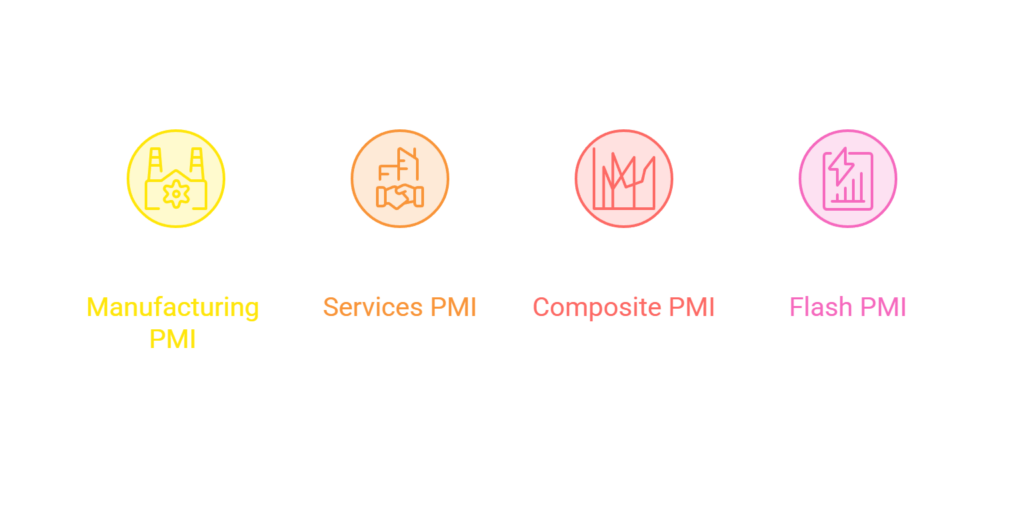
Types of PMI Reports
Manufacturing PMI — measures conditions in the goods-producing sector. More sensitive to global trade, commodity prices, and supply chain disruptions.
Services PMI — measures conditions in the service sector, which makes up the majority of most developed economies. Often more closely correlated with employment and consumer spending trends.
Composite PMI — a weighted average of both manufacturing and services. Provides the broadest picture.
Flash PMI — a preliminary estimate released about a week before the final reading. Since it’s the first look at the data, it tends to produce stronger market reactions than the final figure.
PMI in Practice: How Traders Use It
PMI data rarely produces the explosive, immediate moves of NFP or CPI. But it plays an important role in building or confirming a directional bias. Here’s how to use it practically:
- Confirming trends: If EUR/USD has been in a downtrend and Eurozone manufacturing PMI drops further below 50 while U.S. services PMI climbs above 55, that divergence confirms the bearish EUR/USD narrative.
- Early cycle signals: PMI often turns before GDP. A series of PMI readings below 50 is frequently a leading indicator of an official GDP contraction — giving currency traders advance warning.
- Sector-specific clues: A weak manufacturing PMI in a commodity-linked currency like the Australian dollar (AUD) or Canadian dollar (CAD) can signal trouble ahead, since these economies are closely tied to global goods demand.
Geopolitical Events and Their Impact on Forex Markets
Economic data is predictable in its schedule. Geopolitical events are not. Yet some of the most dramatic and sustained currency moves in history have been driven not by economic releases, but by political shocks — elections, wars, trade disputes, and diplomatic crises.
Safe Haven Flows: The Geopolitical Forex Mechanism
When geopolitical risk spikes, investors move capital away from risk and toward perceived safety. In forex, this manifests as demand for safe haven currencies:
- Japanese Yen (JPY) — the classic safe haven. Strengthens during global uncertainty because Japan is a net creditor nation with enormous overseas assets.
- Swiss Franc (CHF) — Switzerland’s political neutrality and financial system stability make the franc a go-to safe haven.
- US Dollar (USD) — despite being the U.S.’s domestic currency, the dollar serves as the world’s reserve currency and benefits from flight-to-safety flows.
Conversely, risk currencies — the Australian dollar (AUD), New Zealand dollar (NZD), and to some extent the British pound (GBP) — tend to weaken when geopolitical tensions rise.
Major Geopolitical Events and Their Forex Impact
Brexit (2016–2020) Few events demonstrate geopolitical impact on forex as clearly as Brexit. When the UK voted to leave the European Union in June 2016, GBP/USD collapsed from around 1.50 to below 1.32 overnight — one of the largest single-day moves in the pound’s history. Over the subsequent years of negotiation uncertainty, the pound remained structurally weak. Traders who understood the geopolitical risk premium embedded in sterling made some of the clearest long-term trades of that era.
Russia-Ukraine War (2022) The Russian invasion of Ukraine in February 2022 sent shockwaves through commodity markets and currencies simultaneously. The Russian ruble collapsed, but more importantly for forex traders, the euro came under severe pressure — the Eurozone’s dependence on Russian energy created an economic vulnerability that weighed on EUR throughout 2022. Meanwhile, commodity currencies like the Canadian dollar and Norwegian krone strengthened alongside surging energy prices.
U.S.-China Trade War (2018–2019) Trade tensions between the world’s two largest economies rippled through forex markets in complex ways. The Chinese yuan came under pressure. The Australian dollar — heavily tied to China’s demand for commodities — weakened significantly. The Japanese yen and U.S. dollar both saw safe haven demand at various points during the escalation.
Elections as Market Catalysts
National elections create currency volatility not because of who wins, but because of the uncertainty around potential policy changes. Markets hate uncertainty. The wider the gap between the economic policies of the candidates, the greater the pre-election volatility.
Key elections to watch for their forex impact:
- U.S. Presidential Election — the most globally impactful, given the dollar’s reserve currency status
- French Presidential Election — critical for EUR stability, given France’s role in the Eurozone
- UK General Election — significant for GBP, particularly around fiscal and trade policy shifts
- Japanese General Election — relevant for BoJ policy continuity and therefore the yen
Advanced Forex News Trading Strategies
With a solid understanding of the key economic releases and their market impact, it’s time to explore how professional traders structure their approach to news trading. These aren’t theoretical frameworks — they’re practical methodologies used by experienced traders every day.
Strategy 1: The Straddle Approach
The straddle is a pre-news positioning strategy. Before a high-impact release, the trader places two pending orders:
- A buy stop a set number of pips above the current price
- A sell stop a set number of pips below the current price
When the news is released, price moves sharply in one direction, triggering one of the orders. The other is immediately cancelled.
Practical considerations:
- Ideally, you want the pending orders placed far enough from the current price to avoid being triggered by the spread widening alone, but close enough to catch the initial move
- Works best when you expect a large move but genuinely don’t know the direction
- Must account for the possibility of a spike and reversal — a triggered buy stop that then reverses strongly is a losing trade
Strategy 2: The Wait-and-See (Post-News Confirmation)
Rather than trading the initial spike, many experienced traders wait for the market to establish a direction and then look for a retracement entry. Here’s the logic:
- Major news is released — for example, a significantly positive U.S. NFP number
- USD strengthens sharply — EUR/USD drops from 1.0850 to 1.0780 in two minutes
- Price then retraces back toward 1.0810–1.0820 as early buyers take partial profits
- The trader enters short on the retracement, with a stop above the pre-news level and a target at 1.0760 or lower
- The original fundamental driver — strong jobs data — provides the directional bias; the retracement provides the better entry price
This approach sacrifices some of the initial move but significantly reduces the risk of being caught in a fakeout.
Strategy 3: News as Confirmation for Technical Setups
This is perhaps the most sophisticated approach, and the one most aligned with how institutional traders operate. Rather than trading news in isolation, this strategy uses fundamental news to confirm pre-existing technical setups.
Here’s how it works:
- Identify a key technical pattern or level on a currency pair — perhaps EUR/USD has been consolidating below a major resistance at 1.0900 for two weeks
- The ECB meeting is approaching, and the market expects dovish language
- If the ECB delivers dovish language as expected (or more dovish than expected), and price simultaneously breaks below a key support level, the confluence of fundamental catalyst and technical breakdown creates a high-probability short entry
- The news provides the “why” — the technicals provide the “where” and “when”
This approach requires patience and preparation but produces some of the highest-conviction trades available in forex news trading.
Strategy 4: Trading the Revision
This is an underused strategy that exploits the market’s tendency to focus on the headline figure while overlooking upward or downward revisions to prior data.
In the NFP report, for example, the Bureau of Labor Statistics regularly revises the previous two months’ figures. If the current month’s NFP misses expectations by 20,000 jobs, that might seem bearish for the dollar. But if the prior two months are simultaneously revised upward by a combined 60,000 jobs, the net picture is actually positive. Traders who are watching only the headline miss will sell the dollar — creating a potential opportunity for those who read the full report.
Building Your News Trading Routine: A Week-in-the-Life Framework
Professional news traders don’t wake up each morning and improvise. They follow a structured routine that ensures they’re always prepared — never caught off guard by a major release. Here’s a practical weekly framework:
Sunday Evening (30–45 minutes):
- Review the economic calendar for the entire week
- Identify all high-impact events — note date, time, currency, consensus forecast, and previous reading
- Mark key technical levels on the pairs most likely to be affected
- Create a simple watchlist with your trading plan for each major event
Each Morning (15–20 minutes):
- Check for any overnight developments — central bank speeches, geopolitical news, unexpected data releases from Asian markets
- Review any Asian session moves that may be signaling direction ahead of European or U.S. sessions
- Update your technical levels based on overnight price action
Before Each Major Release (10–15 minutes):
- Confirm the release time and current consensus estimate
- Note the current spread on your broker for the affected pair
- Decide in advance: will you trade the initial spike, wait for confirmation, or stay out entirely?
- Set your pending orders or alerts
After Each Major Release:
- Record the actual number, the deviation from consensus, and the market reaction
- Note whether the reaction was as expected or counterintuitive
- If you traded, review what went right or wrong — not in terms of profit/loss, but in terms of process
Managing Risk in Forex News Trading
No discussion of news trading strategies is complete without an honest conversation about risk. Forex news trading carries specific risks that don’t exist to the same degree in regular technical trading.
The Spread Widening Problem
During major news releases, brokers widen their spreads — sometimes dramatically. A pair that normally trades at a 1-pip spread may widen to 5, 10, or even 20 pips during an NFP release. This means your trade starts significantly further in the red than usual, and your stop loss may be triggered not by genuine price movement but by the temporary spread expansion.
How to manage it:
- Know your broker’s typical spread behavior during major events
- Place stop losses wider than the maximum expected spread expansion
- Consider switching to an ECN-style broker with tighter event spreads if news trading is a core part of your strategy
Slippage: When Your Order Doesn’t Fill Where You Expected
During extreme volatility, the price moves so fast that your order is filled at a different price than you intended — sometimes significantly worse. This is called slippage, and it can turn a calculated risk into an unexpectedly large loss.
How to manage it:
- Use limit orders where possible instead of market orders
- Accept that some slippage is unavoidable during major releases
- Factor a slippage buffer into your risk calculations before the event
Position Sizing for News Events
Given the elevated risk environment around news events, many professional traders reduce their normal position size by 25–50% for news trades. The logic is straightforward: volatility is higher, spreads are wider, and the risk of a fakeout is elevated. Smaller size allows you to participate without catastrophic downside if the trade goes wrong.
We’ve now covered central bank communication, GDP, PMI, geopolitical risk, advanced trading strategies, and risk management for news events — giving you a professional-grade framework for navigating the most complex dimension of forex trading.