
Proprietary Trading in Forex : Understanding Prop Trading
Part1- Understanding Prop Trading
Introduction
Proprietary trading, commonly referred to as “prop trading,” has revolutionized the way traders engage in the Forex market. Instead of using personal capital, traders can access a firm’s funds, trade with higher leverage, and potentially earn substantial profits. This first part of our guide explores what proprietary trading is, how it works, its advantages and challenges, and key considerations for traders looking to enter this field.
What is Proprietary Trading?
Proprietary trading is a system in which firms provide traders with capital to trade financial markets, including Forex, stocks, commodities, and indices. In return, traders share a percentage of their profits with the firm. This model allows skilled traders to leverage larger funds without risking their own money. Prop trading firms profit by taking a share of successful trades, meaning their success is directly tied to the trader’s performance.
Unlike retail trading, where traders risk their personal funds, prop trading offers a structured approach to market participation. This model not only provides access to higher capital but also enhances risk management practices, ensuring that traders operate within predefined limits to minimize losses.
How Prop Trading Firms Operate
Prop trading firms typically follow a structured approach:
Evaluation Process:
Before granting access to funds, firms require traders to pass a test demonstrating their skills. This phase ensures that only competent traders receive funding.
Funded Accounts:
Once approved, traders receive access to a funded trading account with specific rules and risk parameters.
Profit Sharing:
Traders earn a percentage of their profits while the firm retains a share as compensation. The profit split varies from firm to firm, typically ranging between 50% and 90% in favor of the trader.
Risk Management:
Firms enforce strict risk limits to protect their capital and ensure disciplined trading. Common risk controls include maximum daily loss limits, stop-loss requirements, and leverage restrictions.
Scaling Programs:
Many prop firms offer scaling opportunities, where traders can access larger capital as they demonstrate consistent profitability.
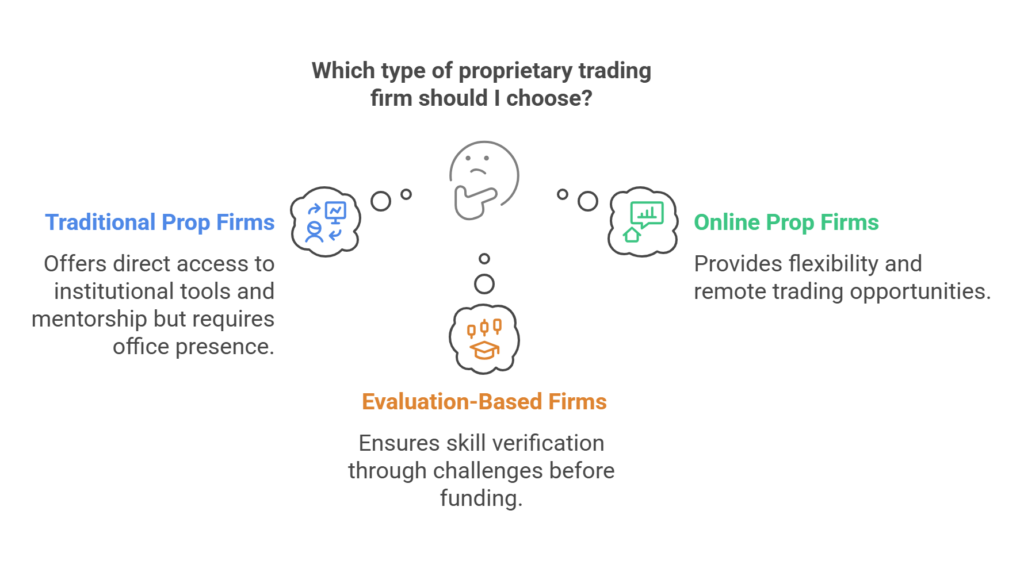
Types of Proprietary Trading Firms
There are different types of prop trading firms, each offering unique models and benefits:
Traditional Prop Firms:
Operate with physical offices, providing direct access to institutional trading tools, mentorship, and liquidity providers. These firms are often highly selective and require traders to work in an office environment.
Online Prop Firms:
Fully digital firms allowing traders to participate remotely from anywhere in the world. These firms have become increasingly popular due to their accessibility and flexible working conditions.
Evaluation-Based Firms:
Require traders to prove their consistency before receiving funding. Traders must complete a challenge or verification process to demonstrate their trading skills before accessing a funded account.
Advantages of Proprietary Trading
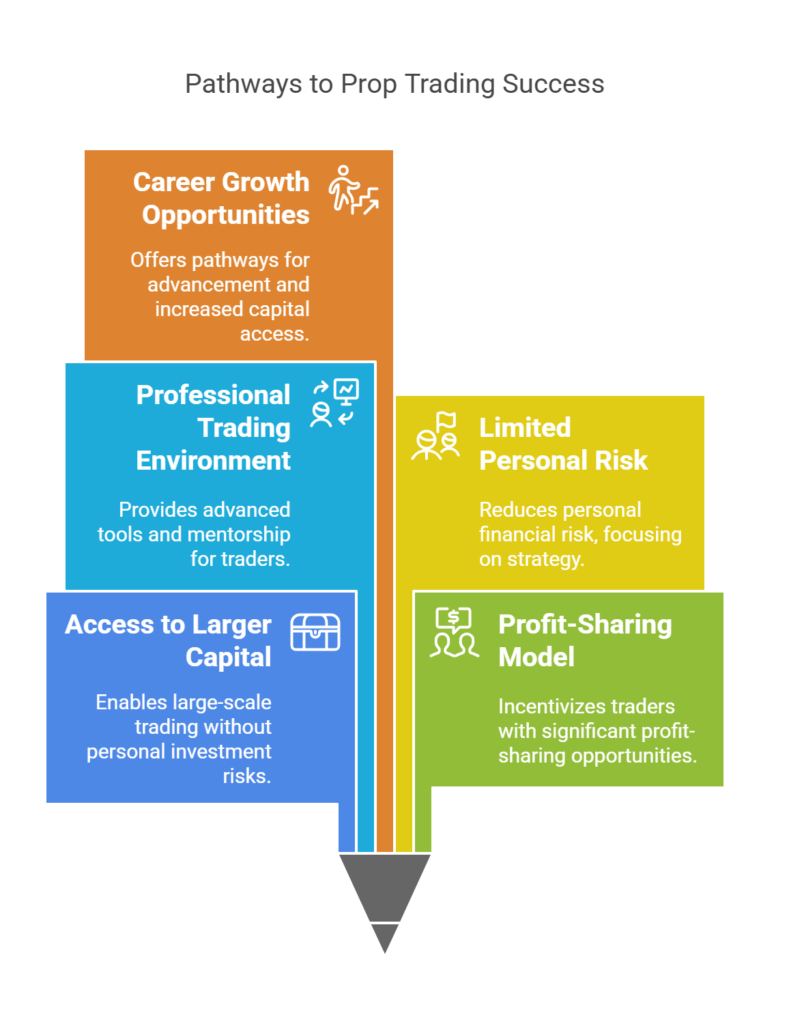
Access to Larger Capital
One of the biggest benefits of prop trading is that traders can manage large sums without needing personal investment. This allows traders to take advantage of market opportunities that may be unavailable with smaller personal accounts.
Profit-Sharing Model
Prop traders typically keep between 50% to 90% of their profits. This system incentivizes traders to maximize their performance while ensuring the firm benefits from successful trades.
Professional Trading Environment
Many firms provide access to institutional-level trading platforms, risk management tools, and mentorship programs. This enhances traders’ chances of success by offering them the resources needed to refine their strategies.
Limited Personal Risk
Unlike independent trading, where traders risk personal funds, in prop trading, losses are covered by the firm. This reduces financial pressure and allows traders to focus on executing their strategies effectively.
Career Growth Opportunities
Successful traders can advance within a firm, gaining access to more capital and higher profit shares over time. Many firms also offer leadership or mentorship roles for experienced traders.
Challenges of Prop Trading
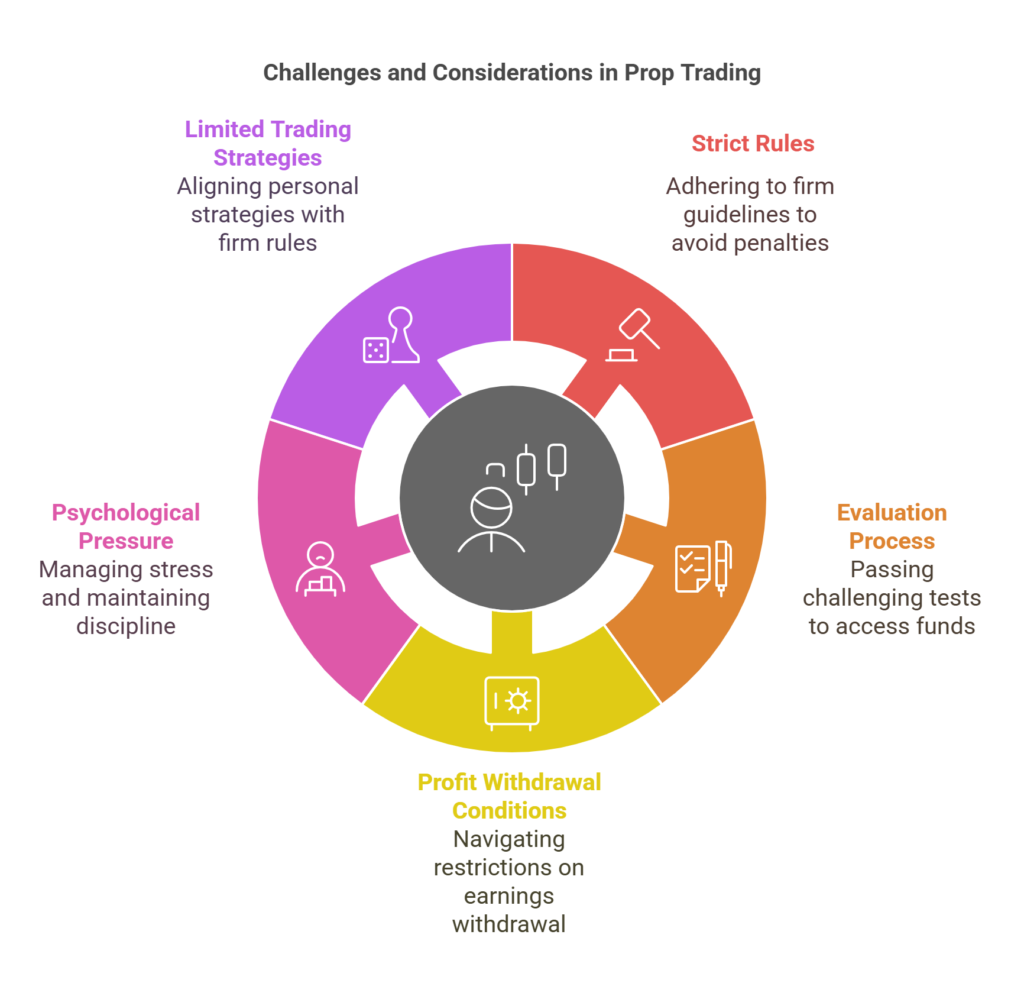
- Strict Rules and Risk Management
Most firms have strict guidelines on daily losses, drawdowns, and position sizing. Traders must adhere to these rules to maintain their funded accounts. Failure to comply may result in account suspension or termination.
- Evaluation Process
Many firms require traders to pass a challenging evaluation phase before accessing funds. This can be a barrier for beginners or those without a well-defined strategy.
- Profit Withdrawal Conditions
Some firms have restrictions on when and how traders can withdraw their earnings. Traders must be aware of these conditions before joining a firm.
- Psychological Pressure
Trading with a prop firm’s funds comes with added responsibility. Traders must remain disciplined and emotionally stable to manage stress and avoid impulsive decisions.
- Limited Trading Strategies
Some firms restrict certain trading styles, such as scalping or news trading. Traders should ensure their strategy aligns with the firm’s rules before committing.
Key Considerations Before Joining a Prop Trading Firm
Before signing up with a prop firm, traders should evaluate the following factors:
Firm Reputation and Reviews
- Research online reviews and trader testimonials to assess the firm’s credibility.
- Avoid firms with hidden fees or unfavorable payout structures.
Trading Conditions
- Check spreads, commissions, leverage, and trading platforms.
- Ensure the firm supports your preferred trading style.
Risk and Evaluation Rules
- Understand the firm’s risk management policies and evaluation criteria.
- Choose a firm with rules that align with your trading strategy.
Payout Policies
- Review withdrawal options, profit split ratios, and payout schedules.
- Confirm whether the firm offers instant or scheduled payouts.
Support and Training
- Some firms provide educational resources and mentorship programs.
- Look for firms that offer strong customer support in case of technical issues.
Conclusion
Proprietary trading provides traders with a unique opportunity to access large capital and trade professionally. However, it comes with challenges such as strict risk management and evaluation requirements. Traders should carefully choose a prop firm that aligns with their goals and risk tolerance. In the next part, we will explore how to get started with prop trading, select the right firm, and build a successful trading strategy.
Proprietary Trading in Forex – Part 2: Getting Started with Prop Trading
Introduction
After understanding the fundamentals of proprietary trading (prop trading) in Forex, the next step is to explore how traders can successfully get started with a prop firm. This section will provide a step-by-step guide on joining a prop trading firm, passing the evaluation process, managing risk effectively, and developing a profitable trading strategy.
Step 1: Selecting the Right Proprietary Trading Firm
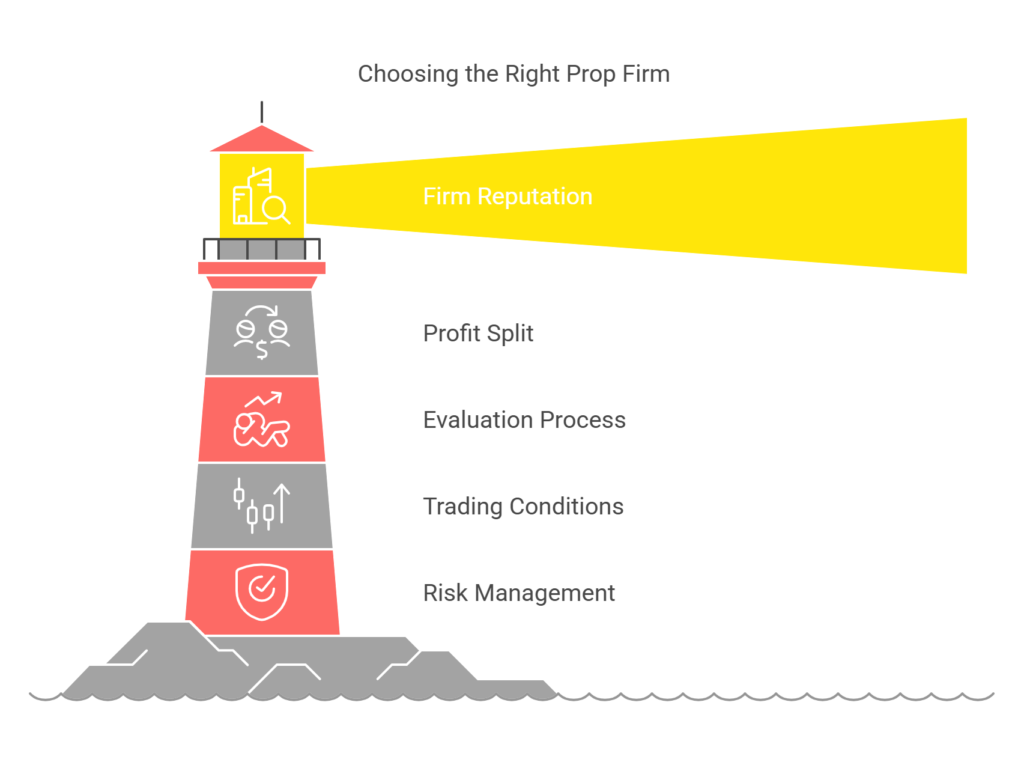
Choosing the right prop firm is a crucial decision for traders looking to maximize their success. Consider the following factors:
Firm Reputation and Credibility
- Research online reviews and trader testimonials.
- Check if the firm has transparent policies and a history of fair dealings.
- Avoid firms with hidden fees or unfavorable contract terms.
Profit Split and Payout Conditions
- Look for firms offering high profit splits (typically 70%-90%).
- Ensure the firm has a reliable and timely payout structure.
- Understand withdrawal limits and conditions.
Evaluation and Funding Process
- Some firms require traders to pass a trading challenge before funding.
- Evaluate the difficulty of the challenge and its cost.
- Consider firms offering direct funding without a challenge.
Trading Conditions and Platform Support
- Ensure the firm provides competitive spreads and low commissions.
- Verify the available trading platforms (MT4, MT5, cTrader, etc.).
- Confirm whether leverage and position sizing match your strategy.
Risk Management Rules
- Be aware of the firm’s drawdown limits and stop-out conditions.
- Understand the firm’s maximum loss tolerance per day or per trade.
- Check if scaling opportunities are available for consistent traders.
Step 2: Passing the Prop Firm’s Evaluation
Many prop firms require traders to complete an evaluation process before receiving a funded account. The evaluation typically consists of:
Profit Targets
- Most firms require traders to achieve a set profit percentage (e.g., 5-10%).
- Traders must reach this target within a specific timeframe, such as 30 or 60 days.
Drawdown Limits
- Maximum daily loss limits ensure traders do not take excessive risks.
- Some firms allow a 5% daily drawdown, while others have stricter limits.
Consistency Rules
- Traders may need to demonstrate a stable performance instead of relying on one or two large trades.
- Firms may set a maximum lot size per trade or restrict over-leveraging.
Trading Style Restrictions
- Some firms prohibit scalping, high-frequency trading, or news trading.
- Ensure the firm’s rules align with your preferred trading method.
Psychological Discipline
- Avoid overtrading or revenge trading after losses.
- Stick to a trading plan and manage emotions effectively.
Step 3: Developing a Profitable Trading Strategy
Once funded, traders must maintain consistency and follow an effective strategy. A solid trading plan should include:
Market Analysis Approach
- Choose between technical analysis, fundamental analysis, or a combination of both.
- Use indicators, chart patterns, and news events to make informed decisions.
Risk Management Techniques
- Use stop-loss orders to limit potential losses.
- Maintain a risk-reward ratio of at least 1:2 or higher.
- Avoid risking more than 1-2% of the account per trade.
Trading Journal and Performance Review
- Keep track of trades, including entry and exit points.
- Analyze mistakes and adjust the strategy accordingly.
- Set realistic performance goals and refine trading plans over time.
Psychological Preparation
- Avoid emotional trading by sticking to predefined rules.
- Take breaks to prevent burnout and maintain focus.
- Develop patience and discipline for long-term success.
Step 4: Scaling Up and Maximizing Profits
Once a trader proves consistency, many prop firms offer opportunities for account growth. Scaling programs allow traders to manage larger capital over time.
Profit Scaling Plans
- Some firms increase account size as traders hit specific profit milestones.
- Regular withdrawals help secure earnings while reinvesting profits into trading.
Risk-Adjusted Position Sizing
- Adjust trade sizes as account balance grows.
- Avoid excessive risk-taking that could jeopardize funding.
Adapting to Market Conditions
- Market volatility changes over time; traders must adapt accordingly.
- Review and modify trading strategies when necessary.
Common Mistakes to Avoid in Prop Trading
Even skilled traders can make costly mistakes. Here are some pitfalls to watch out for:
Overleveraging
- High leverage can lead to quick gains but also rapid losses.
- Stick to responsible risk management to ensure longevity.
Ignoring Risk Limits
- Exceeding daily loss limits can result in account termination.
- Follow firm guidelines to avoid unnecessary risks.
Emotional Decision-Making
- Fear and greed are common psychological traps.
- Develop emotional discipline and maintain a rational mindset.
Lack of Adaptability
- Market conditions shift; traders must adjust strategies accordingly.
- Avoid stubbornly sticking to ineffective methods.
Neglecting the Evaluation Rules
- Many traders fail prop firm challenges due to ignoring evaluation criteria.
- Read and follow all firm guidelines before starting the process.
Conclusion
Becoming a successful proprietary trader requires careful selection of a prop firm, passing the evaluation process, and maintaining a disciplined trading approach. By focusing on strong risk management, psychological resilience, and continuous improvement, traders can maximize their potential in the world of prop trading. With the right approach, prop trading offers a unique opportunity to trade professionally without risking personal capital.