Commodities Trading in the Forex Market
Commodities Trading in the Forex Market
Section 1: Introduction to Commodities Trading in Forex
Commodities trading in the forex market is one of the most dynamic and widely practiced forms of financial trading. While forex is primarily known for currency exchange, commodities such as gold, silver, oil, and agricultural products play a significant role in global financial markets and are often traded alongside currencies.
Commodities are raw materials or primary agricultural products that can be bought and sold. In the context of forex trading, commodities are typically traded through contracts such as CFDs (Contracts for Difference), futures, or spot markets. Traders do not necessarily take physical delivery of these goods; instead, they speculate on price movements to generate profit.
Types of Commodities in Forex Trading
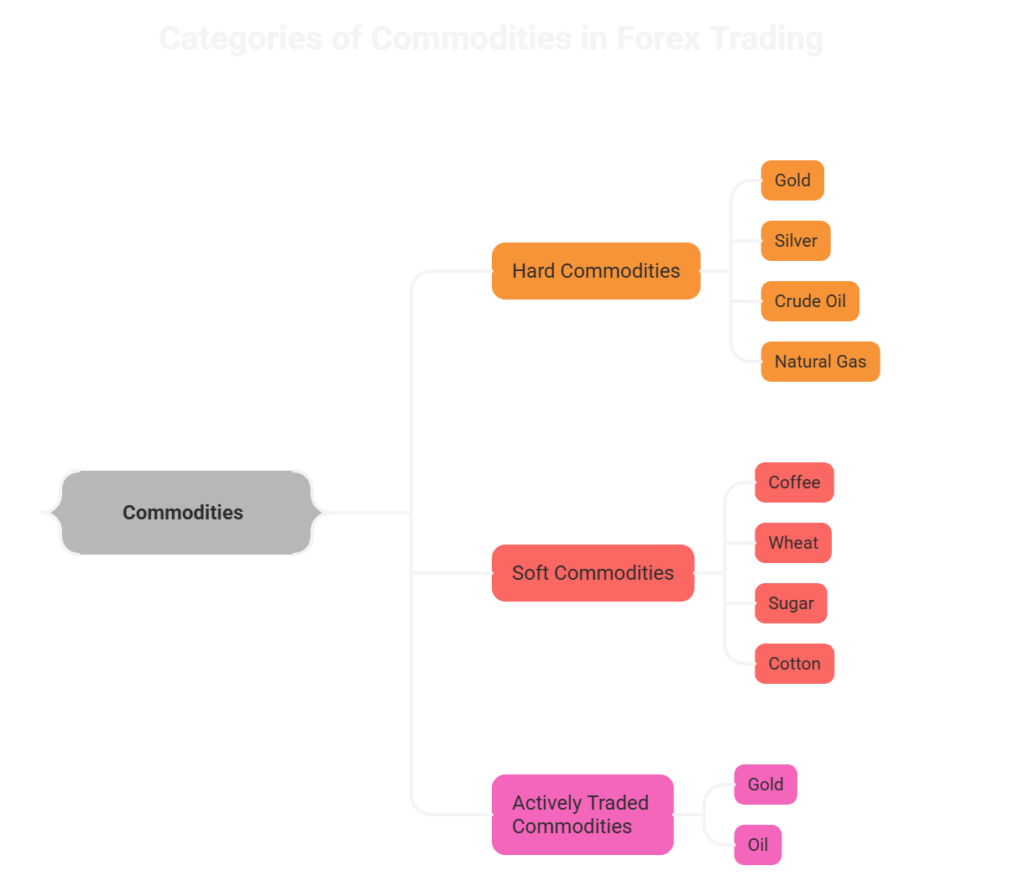
Commodities are generally divided into two major categories:
- Hard Commodities
These include natural resources that are mined or extracted, such as:- Gold
- Silver
- Crude oil
- Natural gas
- Soft Commodities
These are agricultural products or livestock, such as:- Coffee
- Wheat
- Sugar
- Cotton
Among these, gold and oil are the most actively traded commodities in the forex market due to their high liquidity and global demand.
Why Trade Commodities in Forex?
There are several reasons why traders participate in commodities trading within the forex market:
- Diversification: Commodities provide an opportunity to diversify a trading portfolio beyond currencies.
- Hedge Against Inflation: Precious metals like gold are often used as a hedge during inflation or economic instability.
- High Volatility: Commodities tend to have strong price movements, creating trading opportunities.
- Global Demand Influence: Prices are influenced by geopolitical events, supply-demand dynamics, and economic indicators.
Relationship Between Commodities and Currencies
One of the most interesting aspects of commodities trading in forex is its relationship with certain currencies. Some currencies are strongly correlated with commodity prices:
- The Canadian Dollar (CAD) is heavily influenced by oil prices.
- The Australian Dollar (AUD) is linked to gold and mineral exports.
- The New Zealand Dollar (NZD) is affected by agricultural commodities.
Understanding these correlations allows traders to make more informed decisions and identify trading opportunities.
Key Factors Affecting Commodity Prices
Commodity prices are influenced by several critical factors:
- Supply and Demand: Shortages or surpluses directly impact prices.
- Geopolitical Events: Wars, sanctions, and political instability can disrupt supply chains.
- Economic Data: Inflation rates, interest rates, and GDP growth affect demand.
- Weather Conditions: Especially important for agricultural commodities.
- Currency Strength: Since commodities are priced in USD, a strong dollar typically lowers commodity prices.
Trading Methods for Commodities in Forex
Traders can access commodities through various methods:
- Spot Trading: Buying or selling at current market prices.
- CFDs: Speculating on price movements without owning the asset.
- Futures Contracts: Agreements to buy or sell at a predetermined price in the future.
- ETFs: Exchange-traded funds tracking commodity prices.
Each method has its own risk level, leverage options, and capital requirements.
Section 2: Strategies and Risk Management in Commodities Trading in the Forex Market
Trading commodities in the forex market without a strategy is basically a slow-motion way of donating your money to people who actually know what they’re doing. This section focuses on the most effective trading strategies and the essential principles of risk management that every trader must understand.
Popular Trading Strategies for Commodities
Successful traders rely on structured approaches rather than guesswork. Below are some of the most widely used strategies:
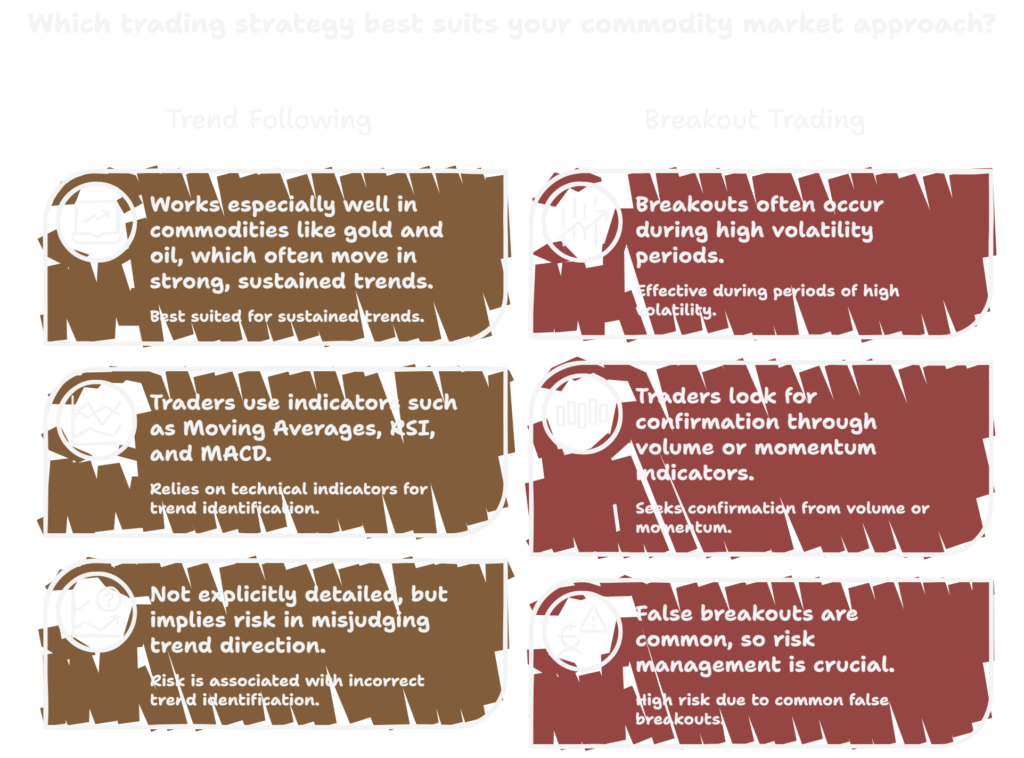
- Trend Following Strategy
This strategy is based on identifying and following the direction of the market trend.
- Traders use indicators such as Moving Averages, RSI, and MACD.
- If the price is making higher highs and higher lows, it indicates an uptrend.
- If the price is making lower highs and lower lows, it indicates a downtrend.
Trend following works especially well in commodities like gold and oil, which often move in strong, sustained trends.
- Breakout Trading
Breakout trading involves entering the market when the price breaks a key level of support or resistance.
- Breakouts often occur during high volatility periods.
- Traders look for confirmation through volume or momentum indicators.
- False breakouts are common, so risk management is crucial.
- Range Trading
In sideways markets, commodities often trade within a defined range.
- Traders buy near support and sell near resistance.
- Indicators like Bollinger Bands help identify overbought and oversold conditions.
- This strategy is less effective during strong trends.
- News-Based Trading
Commodities are highly sensitive to global events.
- Oil prices react to geopolitical tensions and OPEC decisions.
- Gold reacts to economic uncertainty and inflation data.
- Traders monitor economic calendars and breaking news.
This strategy requires fast execution and a strong understanding of market sentiment.
Technical Analysis in Commodities Trading
Technical analysis plays a major role in forecasting price movements.
Key tools include:
- Support and Resistance Levels
- Trendlines and Channels
- Candlestick Patterns
- Indicators (RSI, MACD, Fibonacci Retracement)
For example, gold often respects major psychological levels such as $1900 or $2000, making them important decision points.
Fundamental Analysis in Commodities
Fundamental analysis focuses on macroeconomic and geopolitical factors.
Important elements include:
- Supply Reports (e.g., oil inventories)
- Central Bank Policies
- Inflation Data
- Global Economic Growth
- Weather Patterns (for agriculture)
For instance, a decrease in oil supply combined with rising demand typically leads to higher prices.
Risk Management: The Part Everyone Ignores (Until It Hurts)
Risk management is what separates traders who survive from those who disappear after a few bad trades.
- Position Sizing
Never risk too much on a single trade.
- A common rule is risking only 1–2% of total capital per trade.
- This prevents large losses from wiping out your account.
- Stop-Loss and Take-Profit
Always define exit points before entering a trade.
- Stop-loss limits potential losses.
- Take-profit secures gains.
Skipping this step is basically gambling with extra steps.
- Risk-to-Reward Ratio
A good trade typically has a risk-to-reward ratio of at least 1:2.
- Risk $100 to potentially make $200.
- This ensures profitability even with a lower win rate.
- Leverage Control
Leverage can amplify profits, but it can also destroy accounts.
- High leverage increases risk exposure.
- Beginners often misuse leverage and face large losses.
- Emotional Discipline
Fear and greed are the two main enemies.
- Avoid revenge trading after losses.
- Stick to your trading plan.
Yes, easier said than done. That’s why most people fail.
Common Mistakes in Commodities Trading
Even experienced traders fall into these traps:
- Overtrading
- Ignoring risk management
- Trading without a plan
- Chasing the market
- Relying on a single strategy
Recognizing these mistakes early can save both money and sanity.
Combining Strategies for Better Results
Professional traders rarely rely on a single method. Instead, they combine:
- Technical analysis for entry and exit
- Fundamental analysis for market direction
- Risk management for capital protection
This integrated approach improves consistency and long-term performance.
Section 3: Advanced Concepts and the Future of Commodities Trading in the Forex Market
By the time traders reach this stage, they usually realize one uncomfortable truth: basic strategies are not enough to stay consistently profitable. Advanced commodities trading in the forex market requires deeper market understanding, smarter tools, and the ability to adapt to constantly changing conditions.
Intermarket Analysis
One of the most powerful advanced concepts is intermarket analysis. This approach studies the relationship between different asset classes:
- Commodities
- Currencies
- Bonds
- Stock markets
For example:
- Rising oil prices often strengthen the Canadian Dollar (CAD).
- Increasing gold prices may indicate economic uncertainty, often weakening risk-sensitive currencies.
- Strong US Treasury yields can impact commodity prices due to capital flows.
Understanding these relationships allows traders to anticipate market movements instead of reacting to them.
Correlation Trading
Correlation is the statistical relationship between two assets.
- Positive Correlation: Two assets move in the same direction.
- Negative Correlation: Two assets move in opposite directions.
Examples:
- Gold and USD often have a negative correlation.
- Oil and CAD tend to have a positive correlation.
Advanced traders use correlation matrices and tools to diversify trades and reduce overall risk exposure.
Algorithmic and Automated Trading
Automation is no longer optional for serious traders.
- Expert Advisors (EAs) execute trades based on predefined rules.
- Algorithms can analyze large datasets faster than humans.
- High-frequency trading dominates institutional markets.
However, automation comes with risks:
- Poorly designed algorithms can cause rapid losses.
- Market conditions can change, making strategies obsolete.
So yes, bots can help you. They can also destroy you faster than you can click “close trade.”
Sentiment Analysis
Market sentiment reflects the overall attitude of traders.
- Bullish sentiment = expectation of rising prices
- Bearish sentiment = expectation of falling prices
Tools for sentiment analysis include:
- Commitment of Traders (COT) reports
- News sentiment indicators
- Social trading data
Understanding crowd behavior helps traders avoid being on the wrong side of the market.
Liquidity and Market Sessions
Liquidity plays a crucial role in commodities trading.
- High liquidity = tighter spreads and smoother execution
- Low liquidity = higher volatility and slippage
Key trading sessions:
- London Session
- New York Session
Gold and oil typically experience the highest volatility during these overlaps, creating prime trading opportunities.
Macroeconomic Cycles and Commodities
Advanced traders pay close attention to economic cycles:
- Expansion Phase
- Rising demand for commodities
- Prices generally increase
- Peak Phase
- Inflation rises
- Commodities may hit highs
- Recession Phase
- Demand drops
- Prices decline
- Recovery Phase
- Gradual increase in demand
- Prices stabilize and rise again
Recognizing these cycles allows traders to align their strategies with broader economic trends.
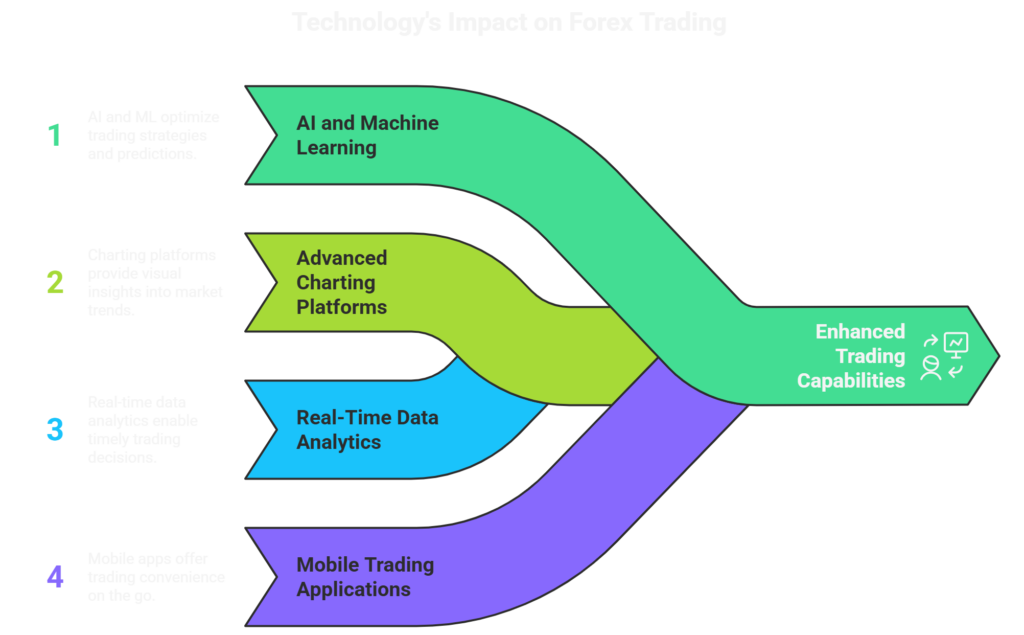
The Role of Technology in Modern Trading
Technology has reshaped commodities trading in forex:
- Artificial Intelligence and machine learning
- Advanced charting platforms
- Real-time data analytics
- Mobile trading applications
Retail traders now have access to tools that were once exclusive to institutions. Ironically, most still lose money. Access to tools isn’t the same as knowing how to use them.
Future Trends in Commodities Trading
The future of commodities trading is evolving rapidly:
- Digital Commodities and Tokenization
Blockchain technology is enabling tokenized commodities, allowing fractional ownership and easier access.
- ESG and Sustainable Investing
Environmental, Social, and Governance (ESG) factors are influencing commodity demand, especially in energy markets.
- Energy Transition
The shift toward renewable energy is changing demand for:
- Oil and gas
- Lithium
- Copper
- Rare earth metals
This transition will reshape trading opportunities for decades.
- Increased Regulation
Governments and financial institutions are tightening regulations, especially in leveraged markets.
Final Thoughts
Commodities trading in the forex market is not just about predicting price movements. It is about understanding a complex system influenced by economics, politics, technology, and human psychology.
Most traders fail because they underestimate this complexity. They rely on simple strategies in a market that demands adaptability and discipline.
Those who succeed treat trading as a long-term skill, not a shortcut to quick money.



1 Comment
How Investors Use Arbitrage - QMMFX LIMITED
September 25, 2026[…] framework is especially important when analyzing Forex trading strategies, because currency markets involve interconnected exchange rates, multiple liquidity sources, and […]