
Understanding Fundamental Analysis: A Comprehensive Guide
Fundamental analysis is a cornerstone of investing that allows individuals to evaluate the intrinsic value of a financial asset, such as a stock, bond, or currency. By delving into the economic, financial, and other qualitative and quantitative factors that influence an asset’s value, fundamental analysis provides a deep understanding of what drives market prices. This article explores the principles, methods, and applications of fundamental analysis in detail.
What is Fundamental Analysis?
Fundamental analysis involves assessing the financial health, industry position, and macroeconomic conditions impacting a particular asset. Its primary goal is to determine whether the asset is overvalued or undervalued relative to its market price.
This approach contrasts with technical analysis, which focuses solely on price movements and patterns. Fundamental analysis evaluates factors such as revenue, earnings, growth potential, competitive advantage, and economic conditions to derive an asset’s true worth.

Core Principles of Fundamental Analysis
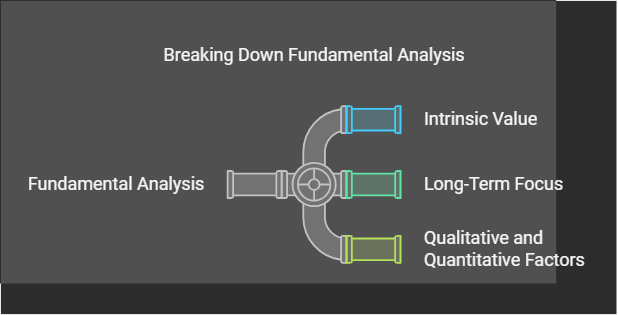
- Intrinsic Value The intrinsic value of an asset represents its true worth based on all available information. Investors compare this value with the current market price to make informed decisions. If the intrinsic value exceeds the market price, the asset is considered undervalued and vice versa.
- Long-Term Focus Fundamental analysis often takes a long-term view, as the market may not immediately reflect an asset’s intrinsic value. This approach is popular among value investors such as Warren Buffett, who seek to buy undervalued assets and hold them until the market corrects its mispricing.
- Qualitative and Quantitative Factors Fundamental analysis examines both qualitative aspects, such as brand value and management quality, and quantitative factors, including financial statements and key performance indicators (KPIs).
Key Components of Fundamental Analysis
Economic Analysis
Economic analysis examines macroeconomic indicators to understand the broader environment influencing an asset’s performance. Key factors include:
- Gross Domestic Product (GDP): Measures the economic activity and growth of a country.
- Inflation Rates: High inflation can erode purchasing power and impact profitability.
- Interest Rates: Changes in interest rates affect borrowing costs, consumer spending, and investment decisions.
- Employment Data: Reflects economic health and consumer spending power.
Industry Analysis
This step involves evaluating the competitive landscape and growth prospects within a specific industry. Tools and concepts used include:
- Porter’s Five Forces: Analyzes industry competition, buyer power, supplier power, the threat of substitutes, and the threat of new entrants.
- Market Trends: Identifies growth drivers, emerging technologies, and consumer behavior.
- Regulatory Environment: Examines laws and policies affecting the industry.
Company Analysis
Company analysis delves into the financial and operational performance of a specific organization. This includes:
- Financial Statements: The balance sheet, income statement, and cash flow statement provide insights into profitability, liquidity, and solvency.
- Key Ratios: Metrics such as Price-to-Earnings (P/E), Debt-to-Equity, and Return on Equity (ROE) help assess financial health and efficiency.
- Management Quality: Evaluates the leadership team’s experience, strategy, and decision-making capabilities.
Tools and Techniques in Fundamental Analysis
Financial Ratios
Financial ratios simplify complex financial data and allow for comparisons across time periods and industries. Common categories include:
- Profitability Ratios: Assess an entity’s ability to generate earnings (e.g., Gross Margin, Operating Margin).
- Liquidity Ratios: Evaluate the ability to meet short-term obligations (e.g., Current Ratio, Quick Ratio).
- Efficiency Ratios: Measure operational performance (e.g., Inventory Turnover, Asset Turnover).
- Valuation Ratios: Help determine if an asset is fairly priced (e.g., Price-to-Book, Dividend Yield).
Discounted Cash Flow (DCF) Analysis
The DCF method estimates the intrinsic value of an asset by projecting its future cash flows and discounting them to the present value using a discount rate. Key steps include:
- Forecasting cash flows.
- Selecting an appropriate discount rate (often the Weighted Average Cost of Capital, WACC).
- Calculating the present value of cash flows and the terminal value.
Comparative Analysis
This involves comparing a company’s metrics with its peers or industry benchmarks to identify strengths and weaknesses. Peer analysis often includes examining market share, growth rates, and financial performance.
Strengths of Fundamental Analysis
- In-Depth Understanding: Provides a comprehensive view of an asset’s drivers and potential.
- Long-Term Perspective: Helps investors identify sustainable growth opportunities.
- Decision-Making Framework: Offers a structured approach to evaluate investments.
Limitations of Fundamental Analysis
- Time-Consuming: Requires extensive research and data analysis.
- Subjectivity: Some qualitative factors, such as management quality, are difficult to quantify.
- Market Timing Challenges: The market can remain irrational for extended periods, delaying the realization of intrinsic value.
Practical Applications
Equity Investing
Investors use fundamental analysis to select stocks with strong financial performance, growth potential, and attractive valuations.
Forex Trading
Economic indicators such as interest rates, GDP, and trade balances guide currency valuation analysis.
Bond Investing
Analyzing interest rates, credit ratings, and economic conditions helps determine bond risk and return potential.
Business Strategy
Companies use fundamental analysis to assess competitors, evaluate potential acquisitions, and make strategic decisions.
some additional topics related to fundamental analysis
Behavioral Biases in Fundamental Analysis
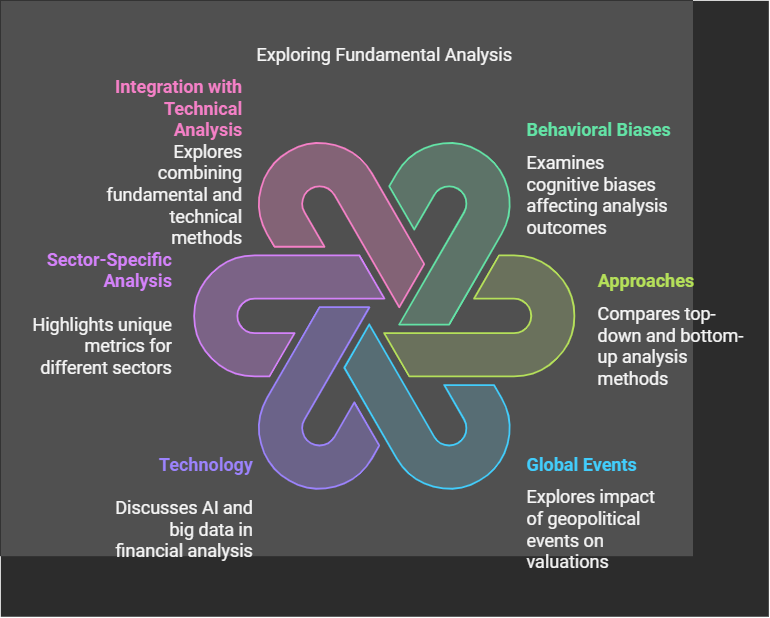
- Discuss how cognitive biases, such as overconfidence, anchoring, and confirmation bias, can influence the outcomes of fundamental analysis.
- Explain methods to mitigate these biases.
Top-Down vs. Bottom-Up Approaches
- Compare and contrast the top-down approach (starting with macroeconomic analysis) with the bottom-up approach (starting with company-specific analysis).
- Discuss when each approach might be more appropriate.
Impact of Global Events on Fundamental Analysis
- Explore how geopolitical events, natural disasters, or pandemics can disrupt fundamental valuation models.
- Highlight case studies where global events significantly impacted industries or companies.
The Role of Technology in Fundamental Analysis
- Discuss the use of artificial intelligence and machine learning in automating financial analysis.
- Explain how big data and predictive analytics are transforming the way fundamental analysis is performed.
- Sector-Specific Fundamental Analysis
- Delve into the nuances of fundamental analysis for specific sectors like technology, healthcare, energy, or financials.
- Highlight unique metrics or considerations for each sector.
- Linking Fundamental and Technical Analysis
- Explore the integration of fundamental analysis with technical analysis for a holistic investment strategy.
- Provide examples of how investors use both methods in tandem.
- Challenges in Emerging Markets
- Analyze the difficulties of conducting fundamental analysis in emerging markets where data transparency may be limited.
- Discuss strategies to overcome these challenges.
- Case Studies of Successful Fundamental Analysis
- Provide real-world examples where fundamental analysis led to significant investment success.
- Include companies like Amazon, Tesla, or Apple and how their fundamentals justified their valuation.
- The Evolution of Fundamental Analysis
- Trace the history of fundamental analysis and its transformation over decades.
- Discuss how modern financial theories and tools have shaped the discipline.
- Common Pitfalls in Fundamental Analysis
- Highlight common mistakes, such as relying on outdated data, ignoring macroeconomic conditions, or overestimating growth potential.
- Offer tips on avoiding these pitfalls.
Conclusion
Fundamental analysis is an indispensable tool for investors and analysts aiming to understand the intrinsic value of financial assets. By considering economic, industry, and company-specific factors, it equips individuals with the insights needed to make informed decisions. While it has limitations, its emphasis on long-term value creation makes it a powerful approach in navigating the complexities of financial markets.